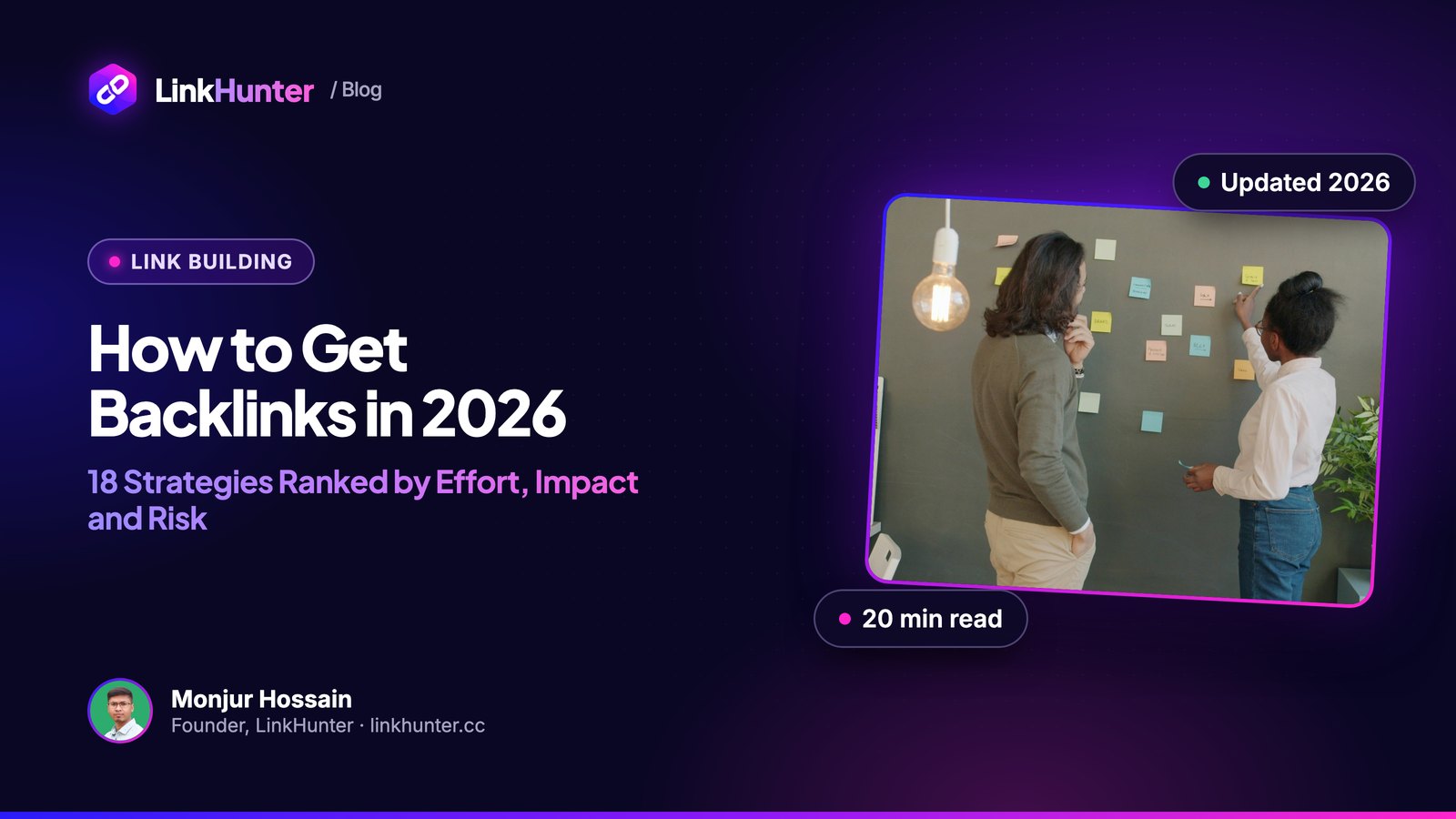
How to Get Backlinks in 2026: 18 Strategies Ranked by Effort, Impact and Risk
Eighteen white-hat ways to get backlinks, grouped into foundation, growth and authority tiers, with a decision matrix, a 90-day plan by site stage and an honest view of where directory listings fit.
Contents14 sections
- 1What is the fastest way to get backlinks in 2026?
- 2Do backlinks still matter in 2026?
- 3The backlink decision matrix: 18 strategies scored
- 4Tier 1: foundation links you can get this week
- 5Where do directory listings fit in a backlink strategy?
- 6Tier 2: growth links you earn with targeted outreach
- 7Tier 3: authority links that compound
- 8Which backlink tactics should you avoid?
- 9A 90-day backlink plan by site stage
- 10How do you tell if a backlink is worth getting?
- 11How should you measure backlink progress?
- 12How to start getting backlinks this week
- 13Frequently asked questions
- 14Sources
To get backlinks in 2026, start with foundation links you control (relevant directories, partners, profiles, unlinked mentions), then earn growth links through competitor gap analysis, listicle inclusion, broken link replacement and expert quotes, and build authority with original data and free tools. Match each tactic to your site stage and avoid paid links without rel="sponsored".
Every guide on how to get backlinks hands you a list. Guest posts, broken links, skyscraper, digital PR, podcasts. The list is rarely the problem. The problem is order: which tactic you should start with this week, given your site, your assets and the five hours you actually have.
That question shows up again and again in SEO communities. One beginner on r/SEO put it plainly: they had done the technical work and the internal linking, and wanted to know what the best ways to get backlinks actually are. A SaaS agency owner on r/seogrowth had a sharper version: competitors will never link to us, so who will?
This guide answers both. You get 18 white-hat strategies grouped into three tiers (foundation, growth and authority), a decision matrix that scores each one on effort, impact, risk and time to first link, a 90-day plan by site stage, and a clear view of where directory listings belong. Short version: at the bottom of the stack, holding everything else up.
What is the fastest way to get backlinks in 2026?
The fastest legitimate backlinks come from people who already know you: partners, suppliers, customers, integrations and sites that mention your brand without linking. After that, relevant directories and launch platforms are quick wins. Editorial links from strangers take longer because a real person has to read your pitch, decide and edit a live page.
Speed and value pull in opposite directions. The links you can get in an afternoon are the ones that move rankings least, and the links that change a category (a citation in a major publication, a mention in the top three roundups for your keyword) take months of groundwork. A good backlink plan uses fast links to build a clean base and buys time for slow links to compound.
Here is the mental model we use, adapted from the Ahrefs add, ask, earn and buy framework and turned into a sequence you can act on:
- Foundation links you can create or request with almost no persuasion. They make you findable and legitimate.
- Growth links you earn through targeted outreach, where you show a specific editor why your page improves theirs.
- Authority links that come to you because you published something people need to cite: data, tools, original ideas.
Buying links that pass ranking credit is not a tier. It is a risk, and we cover it in the section on what to avoid.
Do backlinks still matter in 2026?
Yes. Pages without links from other sites rarely earn search traffic, and links now also shape which brands AI answer engines see and cite. The evidence is correlation, not proof of cause, but it is consistent.
The Ahrefs search traffic study of about 14 billion pages found that 96.55% of pages get zero traffic from Google. Of roughly 20 million pages in that index with no referring domains, only 2,997 got more than 1,000 search visits a month. The same study shows a clear correlation between the number of websites linking to a page and its traffic, while noting that correlation alone does not prove links cause rankings.
Practitioners still put their budgets behind links. In the Editorial.Link 2026 survey of 518 SEO professionals, respondents named an average acceptable price of $508.95 for one high-quality backlink, which tells you how scarce good editorial links are. It also explains why 91.9% of them believe their competitors buy links, even though that is belief, not measured behaviour.
There is a newer reason too. AI assistants such as ChatGPT, Perplexity and Google AI Overviews lean on the same web of trusted pages when they choose what to cite. Being mentioned and linked on the pages those systems read is part of how a brand becomes an answer. We go deeper on that in link building for AI search.
The backlink decision matrix: 18 strategies scored
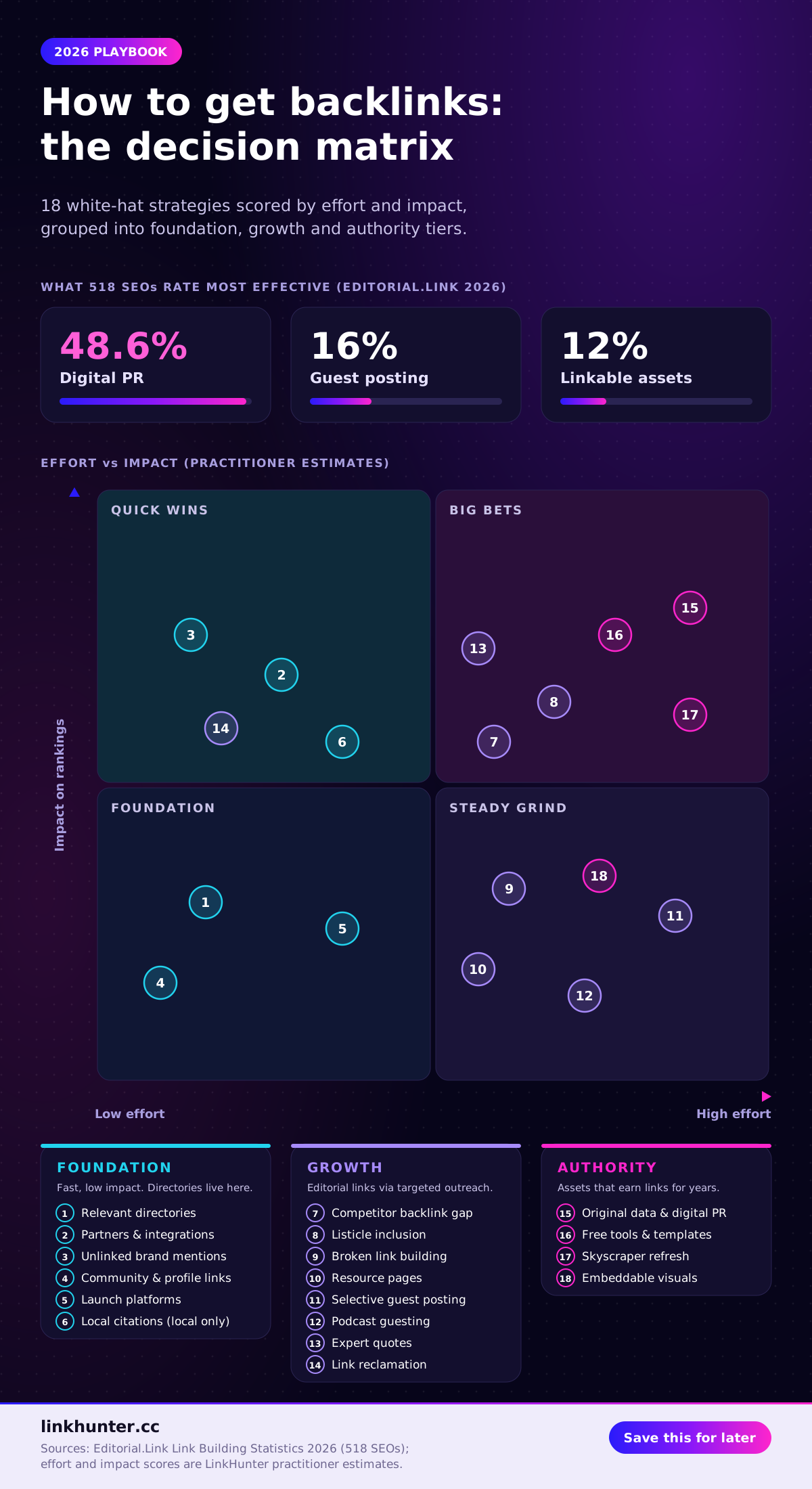
Score every tactic on effort, impact, policy risk and time to first link, then start where impact is decent and effort fits your week. The table below is our practitioner scoring after running these tactics for our own sites and customers. It is an estimate, not a measurement, and your niche will shift some cells.
| # | Strategy | Tier | Effort | Impact | Risk | Time to first link (estimate) |
|---|---|---|---|---|---|---|
| 1 | Relevant business and niche directories | Foundation | Low | Low | Low if selective | Days |
| 2 | Partners, suppliers, customers, integrations | Foundation | Low | Medium | Low | 1-2 weeks |
| 3 | Unlinked brand mentions | Foundation | Low | Medium | Low | 1-2 weeks |
| 4 | Community and profile links | Foundation | Low | Low | Medium if spammy | Days |
| 5 | Startup and product launch platforms | Foundation | Medium | Low to medium | Low | Days to weeks |
| 6 | Local citations (local businesses only) | Foundation | Low | Medium for local | Low | Days to weeks |
| 7 | Competitor backlink gap | Growth | Medium | High | Low | 2-4 weeks |
| 8 | Listicle and "best X" inclusion | Growth | Medium | High | Medium (pay-to-play) | 2-6 weeks |
| 9 | Broken link building | Growth | Medium | Medium | Low | 3-6 weeks |
| 10 | Resource page link building | Growth | Medium | Medium | Low | 3-6 weeks |
| 11 | Selective guest posting | Growth | High | Medium | Medium at scale | 4-8 weeks |
| 12 | Podcast guesting | Growth | Medium | Medium | Low | 4-10 weeks |
| 13 | Expert quotes for journalists | Growth | Medium | High | Low | 2-8 weeks |
| 14 | Link reclamation (lost and broken links to you) | Growth | Low | Medium | Low | Days |
| 15 | Original data and digital PR | Authority | High | Very high | Low | 1-3 months |
| 16 | Free tools, calculators and templates | Authority | High | Very high | Low | 1-3 months |
| 17 | Skyscraper and content refresh outreach | Authority | High | High | Low | 1-2 months |
| 18 | Embeddable visuals with attribution | Authority | Medium | Medium | Medium if anchors are stuffed | 1-2 months |
Two things stand out. First, the low-effort, medium-impact cells (partners, unlinked mentions, link reclamation) are wildly underused, because they feel too simple. Second, the very high impact tactics all require an asset. If you have nothing worth citing, outreach volume will not fix it.
Tier 1: foundation links you can get this week
Foundation links make your site findable, verifiable and consistent across the web. They will not push you past an established competitor on their own, but they give Google and people a clean picture of who you are, and they make every later pitch more credible.
1. Relevant business and niche directories
List your business in the directories your customers and your industry actually use: the main business listing sites, a few vertical directories, review platforms in your category, and professional associations. For a software agency that might be Clutch and GoodFirms; for a SaaS product, software review sites and curated tool lists. The r/SEO thread above lands on the same starting point, with commenters suggesting industry directories as easy links that also build brand visibility.
Quality matters more than count. A useful directory has editorial review, real traffic, category pages that rank for something, and listings that people read. A useless one accepts anything, has thousands of outbound links per page and no visitors. We explain the full vetting process in the directory submission guide.
2. Partners, suppliers, customers and integrations
Make a list of every company you work with: software you integrate with, agencies that resell or implement you, suppliers, wholesalers, customers who would happily say they use you, and associations you belong to. Many of them have a partner directory, an integrations page, a case study section or a "where to buy" page. Ask to be added, and make it easy by sending a logo, a one-line description and the exact URL.
These links are relevant by definition, and the conversation is warm. Keep them editorial: the link should describe a real relationship. Google spam policies call out partner pages created exclusively for the sake of cross-linking, so do not set up reciprocal "link partner" pages with strangers.
3. Unlinked brand mentions
Search for your brand name, product names and founder names in quotes, excluding your own domain. Any page that names you without a link is a prospect with an unusually easy ask: they already chose to write about you. Send a short, friendly note thanking them and suggesting the exact URL to link. Our link building email templates include one for this.
Set up an alert so new mentions reach you within days, while the author still remembers the piece. Older mentions convert less often because editors rarely revisit archived posts.
4. Community and profile links
Profiles on places you genuinely participate in (GitHub, Indie Hackers, a founder profile on a podcast network, speaker pages for events, author bios on publications you wrote for) add brand signals and referral paths. Most forum and community links carry rel="ugc" or nofollow, which Google uses for user-generated content, so value comes from visibility, not ranking credit.
The line to stay behind: Google lists forum comments with optimized links in the post or signature as link spam. Answer questions properly, link only when your page is the best answer, and use your brand name, not keyword anchors.
5. Startup and product launch platforms
If you build software or a product, launch platforms and curated tool directories give a burst of attention, feedback and a handful of listings that later get scraped and quoted by roundup writers. A Product Hunt launch was one of the first suggestions in the r/seogrowth thread. The listing link itself is minor; the follow-on mentions from people who discover you there are the real prize. We compare options in startup launch platforms, and our startup submission service handles the forms if you would rather not.
6. Local citations (local businesses only)
For anything with a physical location or service area, consistent name, address and phone listings across maps, local directories and chambers of commerce are a ranking input for local results and a trust signal for customers. If you serve customers nationally online, skip this tier beyond a couple of core listings. The local citations guide covers which ones matter and how to keep them consistent.
Where do directory listings fit in a backlink strategy?
Directory listings are foundation, not growth. They prove you exist, keep your business details consistent and send some qualified visitors, but they rarely change rankings for competitive keywords. Use them to start a profile cleanly, then move your time to editorial links.
We run a directory submission service, so it would be convenient to tell you directories are the answer. They are not, and the people who sell them as a ranking shortcut usually mean bulk submissions to generic link directories. Google's spam policies list low-quality directory or bookmark site links as link spam, right next to paid links.
So what does a good directory link do?
- Findability: buyers search review sites and category directories directly, especially for software, agencies and local services.
- Consistency: matching name, website and description across listings helps search engines and AI assistants connect the entity behind your brand.
- A clean base: a new domain with zero referring domains looks unproven. Twenty relevant listings give it a normal starting profile before you pitch editors.
- Prospect discovery: roundup writers often build "best X" lists from category directories, so being there can lead to growth-tier links later.
And what it does not do: replace the editorial links that competitors in a crowded niche already have. If the pages ranking for your target keyword each have 80 referring domains from industry publications, 200 directory listings will not close that gap.
| Signal | Worth submitting | Skip it |
|---|---|---|
| Review | Human or editorial approval, rejects some listings | Instant approval for anything |
| Relevance | Your industry, location or audience | "General web directory" for every topic |
| Traffic | Category pages rank and get visits | No organic traffic at all |
| Outbound links | Listings with descriptions, reviews and details | Hundreds of bare links per page, casino and loan sites |
| Ask | Free, or paid for genuine visibility (sponsored) | Paid "do-follow guaranteed" packages |
If you want a shortlist to start from, see best business directories, or have us do it through Directory Boost, which starts with a free audit and five free submissions to directories we have vetted by hand.
Tier 2: growth links you earn with targeted outreach
Growth links come from editors who decide your page makes theirs better. This is where most of your link building time should go once the foundation is in place, and where most of the measurable ranking movement comes from for small and mid-sized sites.
Set expectations honestly. Tim Soulo at Ahrefs reported 19 links from 111 outreach emails, a 17% success rate he called amazing, and estimated that without a strong asset or brand you might get about 5 links from 100 emails. Backlinko's analysis of 12 million outreach emails found only 8.5% got any reply, while a single follow-up lifted replies by 65.8%. Plan your volume around those numbers, not around what a vendor promises.

7. Competitor backlink gap
Put your domain and three to five competitors into a backlink tool and filter for sites that link to two or more competitors but not to you. Those sites already link to products or content like yours, so the pitch is a comparison, not a cold introduction. This is also the answer to the agency owner on r/seogrowth: do not pitch competitors, pitch the sites that link to them.
Sort the gap list by relevance first and authority second, then group it by why they link (a review, a roundup, a resource list, a quote). Each group becomes its own small campaign with its own angle. Our guide on how to find link building prospects walks through the filters.
8. Listicle and "best X" inclusion
Roundups such as "best CRM for startups" or "top bakeries in Leeds" rank for high-intent searches and are read by buyers. Search your category keywords, list every roundup on pages one and two, and check whether you belong on each one. If you genuinely do, send the author a short note with a one-sentence differentiator, a screenshot or a free account for testing.
Expect some to ask for payment. Decide in advance what you will do: if you pay, the link should carry rel="sponsored", which means it works as advertising, not as an editorial vote. The editorial ones are worth more because they are rarer.
9. Broken link building
Find pages in your niche that link to dead resources, create or point to a better replacement, and tell the editor. You are fixing their page, which is a much easier ask than "please link to me". Start from dead pages that used to attract lots of links (a closed competitor, a discontinued tool, an old study), because one dead page can give you dozens of prospects. The full workflow is in our broken link building guide.
10. Resource page link building
Many universities, associations, libraries, local councils and niche blogs keep curated "useful resources" pages. Search with operators such as "[topic]" inurl:resources or "[topic]" "useful links". Only pitch reference content (a guide, checklist, calculator or template), never a sales page, and match the audience exactly. A resource page for nursing students does not want your project management software.
11. Selective guest posting
Writing for another site still works when the site is relevant, has real readers and edits what it publishes. It works badly at scale: Google's spam policies flag links with optimized anchor text in articles, guest posts, or press releases distributed on other sites, and 23.0% of SEOs in the Editorial.Link survey cited the declining effectiveness of guest posting as a challenge.
Write one excellent post a month for sites your customers read, use a natural branded or author-bio link, and treat the exposure as the main benefit. The guest posting guide covers pitching, vetting and what to do when sites ask for fees.
12. Podcast guesting
Most podcasts publish show notes with links to guests and the resources they mention. Hosts need a steady supply of guests with a specific story, so a good pitch gets a decent response. Pitch one sharp topic you can talk about for 30 minutes, mention a resource listeners can use, and ask the host to include it in the show notes. You also get audio content you can quote and clip.

13. Expert quotes for journalists
Journalists and content writers constantly look for sources. HARO, the best-known request service, shut down on 9 December 2024, and several alternatives now carry those requests. The approach is the same on any of them: answer fast, answer the exact question, add one specific number or example only you can give, and include your credentials in one line.
Not every quote earns a link, and some outlets only mention your name. Those mentions still count; turn them into links with the unlinked mentions process from strategy 3.
14. Link reclamation
Check your own backlink profile for links that point to pages that now 404, redirect chains, or links you lost after a redesign. Redirecting a dead URL that still has links from 30 sites recovers those links in an afternoon. Then look at links that were removed recently and ask why: sometimes a page was updated and the editor would happily add you back.
Tier 3: authority links that compound
Authority links come from assets people cite without being asked: original data, free tools and the definitive resource on a topic. They cost the most to create and pay back the longest, because every new article on the topic becomes a chance to be cited.
The survey data backs this up. In the Editorial.Link 2026 survey, 48.6% of 518 SEOs named digital PR the most effective tactic, ahead of guest posting at 16% and creating linkable assets at 12%.
15. Original data and digital PR
Publish numbers nobody else has: a survey of your customers, anonymised product usage data, a price index, an analysis of public data nobody bothered to clean. Journalists and bloggers need statistics to support their claims, and they link to the source. Ahrefs describes an industry report that earned a homepage link and was linked by 570 other websites.
To make data linkable, lead with three to five headline findings, publish the method, give every chart a short URL, and pitch the most surprising finding to reporters who cover that beat. One strong study can feed a year of outreach.
16. Free tools, calculators and templates
A free calculator, generator, checker or template answers a job people search for repeatedly, and writers link to it whenever they explain that job. It does not need to be big: a margin calculator, a policy template or a schema generator can attract links for years. Build the smallest useful version, make it work without sign-up, and add a short guide explaining how to use the result.
17. Skyscraper and content refresh outreach
Find a page in your niche that has earned many links but has gone stale: old numbers, missing steps, dead examples. Publish a version that is clearly better on the dimension that matters (current data, more depth, a worked example), then show it to the people linking to the old one. Respona calls the reverse version, where you start from content you already have and find who links to similar pages, the reverse skyscraper technique.
"Bigger" is not "better". A 7,000-word post with the same information as the 3,000-word original will not win anyone over. Updated facts and original material will.
18. Embeddable visuals with attribution
Charts, diagrams and infographics get reused in articles and slide decks. Offer an embed code or simply ask people who use your visual to credit the source. Keep the credit link branded and natural; Google lists keyword-rich, hidden, or low-quality links embedded in widgets as link spam, and the same logic applies to infographic embed codes stuffed with keywords.
Which backlink tactics should you avoid?
Avoid anything that creates links without an editorial decision behind them: paid links that pass ranking credit, private blog networks, bulk directory blasts, excessive exchanges and automated link tools. Each is named in Google's spam policies, and the downside is losing the links (and the money) or a manual action.
| Tactic | What Google's spam policies say | Safer alternative |
|---|---|---|
| Buying followed links | Exchanging money, goods or services for links is link spam | Sponsored placements tagged rel="sponsored"; listicle inclusion on merit |
| Link exchanges at scale | Excessive "link to me and I will link to you" is link spam | Genuine partner and integration pages |
| Bulk directory and bookmark blasts | Low-quality directory or bookmark site links are link spam | Selective, relevant, reviewed directories |
| Automated link building software | Using automated programs or services to create links is link spam | Automate research and drafting; keep humans on decisions |
| Forum and comment signatures | Optimized links in posts or signatures are link spam | Helpful answers with branded, relevant links |
| Keyword-anchor guest posts at scale | Optimized anchors in guest posts and press releases are flagged | Fewer, better guest posts with natural links |
Source for every row: Google Search Central spam policies. Paying for visibility is not the problem; paying for ranking credit is. If you want to see what links legitimately cost, our breakdown of link building cost separates sponsored placements from outreach labour.
A 90-day backlink plan by site stage
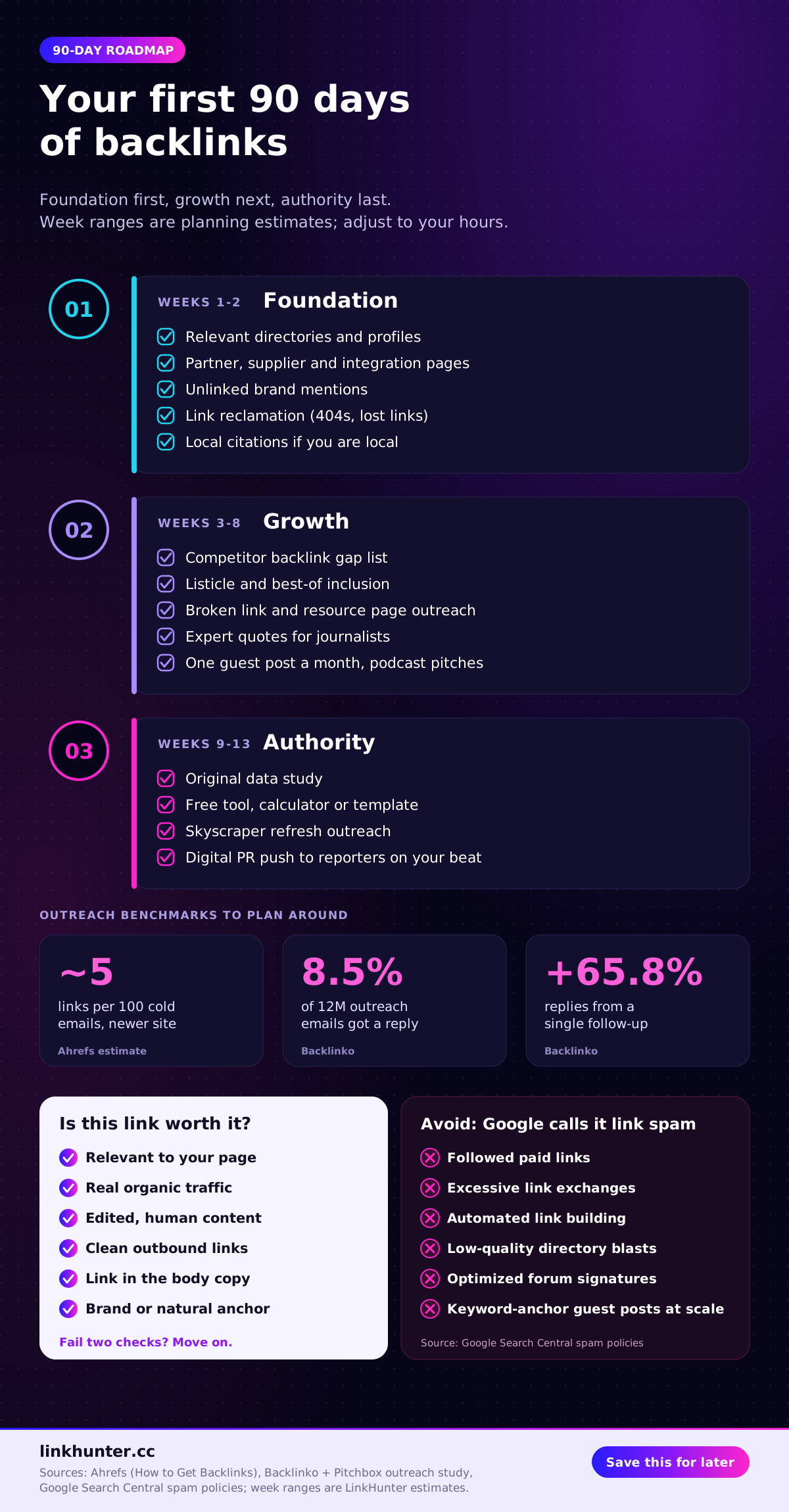
Your site stage decides your order: new sites lay the foundation and pick two growth tactics, established sites add an authority asset each quarter. Use the plan below as a starting point and adjust for the hours you actually have.
| Weeks | New site (0-10 referring domains) | Growing site (10-100) | Established site (100+) |
|---|---|---|---|
| 1-2 | 15-30 relevant directories and profiles, partner and customer links | Link reclamation, unlinked mentions sweep | Link reclamation, lost-link audit |
| 3-4 | Unlinked mentions, launch platforms, one reference resource | Competitor gap list, listicle inclusion campaign | Choose one data study or free tool |
| 5-8 | Competitor gap and listicle outreach, expert quotes | Broken link or resource page campaign, one guest post a month | Build and publish the asset; expert quotes ongoing |
| 9-13 | Broken link campaign, first podcast pitches | Podcast guesting, first small data piece | Digital PR push, skyscraper refresh outreach |
| Track | New referring domains, indexed pages, first rankings | Referring domains vs gap list, ranking movement | Links per asset, citations in news and AI answers |
These week ranges are our planning estimates, not benchmarks. For a sense of what is reasonable, 57.1% of SEOs in the Editorial.Link survey said one to three months is a reasonable time to expect results, and 33.0% said three to six months.
If outreach is the bottleneck, that is the part worth automating. LinkHunter finds prospects, drafts personalised pitches for a human to approve, sends from your authenticated mailbox and checks that links stay live. You can see how in the features overview or our guide to automating link building.
How do you tell if a backlink is worth getting?
A backlink is worth getting when the site is relevant to your page, has real readers, publishes edited content and links out selectively. Authority scores are a tiebreaker, not the main test.
The SEOs in the Editorial.Link survey agree on what to avoid: their most common red flags when vetting a site were spammy outbound links (89.0%), low-quality content (86.3%), poor domain authority (72.2%), low topical relevance (67.2%) and declining organic traffic (63.9%). Turn that into a quick pass or fail check before you pitch:
- Relevance: would a reader of this page plausibly want to visit yours?
- Traffic: does the site get organic visits, and is the trend flat or rising?
- Content: are posts written for people, with an editor, or are they thin, off-topic "sponsored" pieces?
- Outbound links: do recent posts link to reputable sources, or to casinos, loans and pills?
- Placement: will the link sit in the body copy near related text, or in a footer or sitewide widget?
- Anchor: can the link use your brand or a natural phrase, not an exact-match keyword?
Fail two of these and move on. One relevant link from a small, real site beats five links from a high-authority site that sells posts to anyone.
How should you measure backlink progress?
Track new referring domains, the share that are relevant, rankings for the pages you built links to, and referral traffic, monthly rather than daily. Total backlinks is the least useful number, because one sitewide link can add thousands.
- Referring domains by tier: how many foundation, growth and authority links you added this month.
- Target page rankings: links should move the pages you pointed them at; if they do not after a quarter, check relevance and on-page fit.
- Outreach funnel: emails delivered, replies, positive replies, live links. Compare against the Backlinko 8.5% reply benchmark and the roughly 5 links per 100 emails Ahrefs estimates for newer sites.
- Link health: re-check links at 30, 60 and 90 days. Links disappear in redesigns and edits more often than people think.
- Referral visits and leads: the best links send customers, not just crawlers.
For SaaS teams, our SaaS link building guide shows how to connect link work to signups rather than vanity metrics.
How to start getting backlinks this week
Pick your site stage, do the foundation work in the first two weeks, and choose two growth tactics that match an asset you already have. Consistency beats intensity: a few relevant links every week compound; a burst of 200 low-quality ones does not.
Here is a short checklist to begin:
- Count your referring domains and those of the top three pages for your main keyword. That is your gap.
- List every partner, supplier, integration and customer who could link to you, and ask this week.
- Run an unlinked mentions search and a broken-links-to-you check.
- Submit to 15-30 relevant, reviewed directories and fix inconsistent business details.
- Pull a competitor backlink gap list and split it into listicles, resource pages and review sites.
- Choose one asset to build this quarter: a data piece, a free tool or a definitive guide.
- Write one outreach template per tactic, send small batches and follow up once.
Every strategy in this guide is something a person decides to do, for a reason a reader would understand. Keep it that way and your link profile becomes an asset rather than a liability. When you are ready to scale the outreach part, you can compare plans or start a free 14-day trial.
Frequently asked questions
How do beginners get backlinks?
Start with links you can create or ask for easily: a handful of relevant business and niche directories, profiles on communities you actually use, links from partners, suppliers and customers, and unlinked mentions of your brand. Then publish one genuinely useful resource and pitch it to sites that already link to similar pages. That sequence gives a new site a clean, relevant base before harder outreach.
Can I get backlinks for free?
Yes. Unlinked brand mentions, partner pages, free directory listings, broken link replacement, expert quotes for journalists, podcast guesting and original data all cost time rather than money. What you cannot get for free is speed at scale. If your time is limited, tools or a service can do the research and drafting, but the links themselves should still be editorial.
How many backlinks do I need to rank?
There is no fixed number. Look at the pages ranking in the top five for your keyword, count their referring domains (not total links) and note how relevant those sites are. That gives you a realistic target. Low-competition topics can rank with a few relevant links; competitive commercial terms may need dozens or hundreds of referring domains over time.
How long do backlinks take to work?
Usually weeks to months. In an Editorial.Link survey of 518 SEOs, 57.1% said one to three months is a reasonable timeframe to expect link building results, and 33% said three to six months. Google first has to crawl the linking page, and one link rarely changes rankings alone, so judge progress over a quarter, not a week.
Are directory backlinks still good for SEO?
Relevant, moderated directories still help as a foundation: they make your business findable, keep your name, address and website consistent, and send some referral traffic. Google lists low-quality directory or bookmark site links as link spam, so skip bulk submissions to generic link directories. Treat directories as the first layer of a profile, not the growth engine.
Is it safe to buy backlinks?
Paying for links that pass ranking credit breaks Google spam policies. Paid placements are fine as advertising if the link carries rel="sponsored" or rel="nofollow", but then they do not pass ranking value. The risk is not only penalties: many sellers run link farms that get deindexed, and your money disappears with them.
What is the fastest way to get backlinks?
The fastest legitimate links come from places where you already have a relationship or a mention: partners, suppliers, customers, integrations, associations, and sites that already name your brand without linking. Relevant directories and launch platforms are also fast. Editorial links from new prospects take longer, typically weeks, because someone has to read, decide and edit a page.
Do nofollow backlinks help SEO?
Google treats nofollow, ugc and sponsored as hints, so they pass little or no ranking credit directly. They still matter: they bring referral visitors, make your brand visible to people who later link editorially, and keep a link profile natural. A profile made only of followed links from unrelated sites looks more manipulative than one with a normal mix.
How do I get backlinks if my competitors will not link to me?
Do not pitch competitors. Pitch the sites that write for your audience: industry publications, newsletters, podcasts, tools in your stack, agencies that serve your customers and roundup posts that compare options. A competitor backlink gap analysis shows exactly which of those sites already link to rivals and are likely to consider you.
Sources
- Ahrefs: Search traffic study (96.55% of pages get no Google traffic)ahrefs.com
- Ahrefs: How to Get Backlinks (Tim Soulo)ahrefs.com
- Editorial.Link: Link Building Statistics 2026 (518 SEOs surveyed)editorial.link
- Editorial.Link: How to Get Backlinkseditorial.link
- Backlinko: We Analyzed 12 Million Outreach Emailsbacklinko.com
- Respona: How to Get Backlinks in 2026respona.com
- Google Search Central: Spam policies for Google web searchdevelopers.google.com
- Google Search Central: Qualify your outbound linksdevelopers.google.com
- Reddit r/SEO: Beginner. What are the best ways to get backlinks?reddit.com
- Reddit r/seogrowth: How can I get backlinks for my new site?reddit.com

About the author
Monjur Hossain
Founder, LinkHunter
Monjur founded LinkHunter (linkhunter.cc) and MotionTrust Digital, where he has led marketplace strategy since 2022. He has eight years in e-commerce and marketplace marketing and writes these guides from the work of building an AI link-building platform: what earns links, what gets ignored, and where a person still needs to make the call.