How Much Does Link Building Cost in 2026? Per-Link, Agency and Software Prices
Sourced 2026 link prices, agency retainers and software plans, plus a cost-per-earned-link model that counts the hours, content and lost links most guides skip.
Contents14 sections
- 1How much does one backlink cost in 2026?
- 2Link building cost by method: guest posts, niche edits and digital PR
- 3How much do link building agencies charge per month?
- 4How much does link building software cost?
- 5DIY vs agency vs software: what is the cost per earned link?
- 6What hidden costs does nobody mention?
- 7Why are some low-DR links more expensive than high-DR links?
- 8Is buying backlinks worth it, and is it safe?
- 9How should paid links be marked: sponsored or nofollow?
- 10How do you set a link building budget?
- 11Red flags in cheap link building packages
- 12Where we land on what link building should cost you
- 13Frequently asked questions
- 14Sources
In 2026, link building typically costs $100 to $500 per link, with digital PR links at $700 to $1,700 or more. BuzzStream data puts the average paid link insertion at $179 and a direct guest post at $295. Agencies charge about $2,500 to $10,000 a month, while outreach software runs $49 to $1,200 a month plus your time.
Key takeaways
- BuzzStream data puts the average paid link insertion at $179 and a guest post at $295 direct or $461 through a vendor, roughly a 56% markup.
- SEOs surveyed by Editorial.Link said they would pay an average of $508.95 for one high-quality backlink.
- Most agency retainers fall between $2,500 and $10,000 a month, usually for 4 to 10 links at the entry level.
- The number that matters is cost per live, earned link: fees plus tools, content and hours, divided by links still live.
- Google allows paid links only when they carry rel="sponsored" or rel="nofollow", so a compliant paid link is advertising, not ranking credit.
- Prices do not rise neatly with DR; real organic traffic and topical relevance predict price and value better.
Link building cost in 2026 depends less on the price tag of one link and more on how many of the links you pay for are still live and still useful a year later. Most pricing guides on page one are written by agencies that sell links, so their ranges quietly point toward their own packages. This guide pulls sourced prices from large datasets, shows what agencies and software really charge, and then works out the cost per earned link for DIY outreach, an agency and a marketplace, hidden costs included.
All prices below were checked in October 2026. Where a number is our own assumption rather than a published figure, we say so.
How much does one backlink cost in 2026?
A single backlink costs between $100 and $500 in most cases, and the averages sit closer to the low end of that range than agency price lists suggest. The cleanest data comes from BuzzStream, which collected seller prices across more than 400,000 sites.
- Link insertion (niche edit): $179 on average, with a range from $20 to $1,500, based on 62,916 sites that offered insertions (BuzzStream link insertion study, updated August 2026).
- Guest post bought directly: $295 on average. The same post through a vendor averages $461 (BuzzStream link building pricing).
- Marketplace links: a median of $216.96 and an average of $280.67 across 93,812 links on six marketplaces (The Website Flip analysis).
- What SEOs say they would pay: $508.95 on average for one high-quality backlink, from 412 answers in a survey of 518 SEO professionals (Editorial.Link 2026 statistics).
That last number is a willingness-to-pay figure, not a market price. It tells you that experienced buyers expect a genuinely good link to cost around $500, which matches what agencies quote for editorial placements. The cheaper averages include a long tail of sites you would never want a link from.
You will also see DR-based tiers quoted everywhere. One common version puts DR 20-40 links at $50 to $150, DR 40-60 at $250 to $500 and DR 60+ at $500 to $5,000 or more (VisibilityStack). Treat the bottom tier with care. BuzzStream's measured averages for DR 20-39 are $188 to $246 for an insertion and $225 to $290 for a direct guest post, so a $50 to $150 link is below market.
Link building cost by method: guest posts, niche edits and digital PR
The method you choose changes the link building cost more than any other decision. A niche edit is the cheapest paid option, a guest post costs more because someone has to write it, and digital PR costs the most per link but earns links that were never for sale.
Quick definitions first. A niche edit (or link insertion) is a link added to an article that already exists. A guest post is a new article you supply for another site, with a link back. Digital PR is creating a story, study or data asset and pitching it to journalists, who link because it is newsworthy.
| Method | Typical cost per link | What drives the price | Source |
|---|---|---|---|
| Link insertion / niche edit | $179 average ($20 to $1,500) | Traffic of the page, niche, DR | BuzzStream |
| Guest post, direct | $295 average | Site authority, content length, who writes it | BuzzStream |
| Guest post, via vendor | $461 average | Vendor markup of about 56% | BuzzStream |
| Marketplace link | $217 median, $281 average | Marketplace margin of 30% to 50% | The Website Flip |
| High-authority editorial link | $600 to $1,500 | Relationships, content quality | Agency quote cited by BuzzStream |
| Digital PR | $5,000 to $10,000 per campaign for 6 to 7 linking domains, about $700 to $1,700 per link | Idea quality, data, journalist reach | BuzzStream |
| Earned outreach (resource pages, broken links, mentions) | No fee; cost is time, tools and content | Reply rate, your hourly rate | See the model below |
Guest post pricing climbs steeply at the top. BuzzStream's data shows direct guest posts averaging $470 on DR 50-59 sites, $832 on DR 60-69 and $1,735 on DR 80+. Vendors charge $759, $1,289 and $2,983 for the same bands. Industry matters too: sports and news sites were the most expensive niches for guest posts in that dataset, and business and finance sites among the cheapest.
Digital PR looks expensive per link, but the links are different in kind. A journalist linking to your study is an editorial decision, nothing changed hands, and those links rarely disappear. If your budget can carry one campaign a quarter, it often produces the links that matter most.
How much do link building agencies charge per month?
Link building agencies usually charge $2,500 to $10,000 a month, and entry packages deliver roughly 4 to 10 links. The retainer pays for prospecting, content, outreach, reporting and the agency's margin on any paid placements.
BuzzStream's roundup of published agency pricing gives a useful spread:
- Low-competition or local: $500 to $1,500 a month for 2 to 5 links.
- Entry or starter: $2,500 to $3,500 a month for about 4 to 10 links.
- Growth or mid-market: $5,000 to $7,500 a month.
- Competitive niches such as SaaS, finance, legal and health: $3,000 to $10,000 a month.
- Enterprise: $10,000 to $15,000 or more a month.
Divide a $3,000 entry retainer by 4 to 10 links and you get $300 to $750 per link before your own time. That is in line with the $508.95 survey average, which is reassuring, but it also means a good agency is rarely cheaper per link than a careful in-house effort. What you buy is capacity, contacts and someone else's hours.
The pricing model matters as much as the number. Retainers reward steady output. Per-link pricing makes costs predictable but pushes vendors toward the cheapest acceptable sites. Performance pricing, where you pay only for ranking gains, sounds safe but invites shortcuts. Whatever the model, insist on seeing the target site list before anything is published.
How much does link building software cost?
Link building software costs about $49 to $1,200 a month, depending on seats, mailboxes and how much of the work the tool does for you. Unlike an agency fee, software buys capacity, not links, so the real price depends on the hours you put in.
| Tool | Listed price (Oct 2026) | Pricing model | Notes |
|---|---|---|---|
| BuzzStream | $49, $174, $424 a month | Per plan; extra seats $58 to $70 | Outreach CRM, month to month |
| Pitchbox | $300, $600, $1,200 a month (monthly billing) | Per plan, one-year commitment | Full outreach suite, onboarding fee unless prepaid |
| Respona | $100 to $500 per placement | Managed, pay per placement | Now a service decision, not self-serve software |
| LinkHunter (linkhunter.cc) | $49, $149, $399 a month | Per capacity; search, SEO data and AI billed to your own API keys | Seven AI agents, human approval on every commitment |
Sources: BuzzStream pricing, Pitchbox pricing, Respona pricing and our own pricing page. Vendors change plans often, so check on the day you buy. Our Pitchbox alternatives comparison breaks these down by team size, and the best link building tools guide covers the rest of the stack.
Budget for the extras too: a backlink data tool for prospecting and checking, an email finder if the outreach tool lacks one, and mailboxes. LinkHunter is our product, so weigh this accordingly: it fits teams that want AI agents to do the prospecting, qualification, drafting and reply sorting while a person approves every pitch and every deal (see the features page). If you want to write every email by hand, a plain CRM like BuzzStream is simpler. If you want zero involvement, an agency fits better.
DIY vs agency vs software: what is the cost per earned link?
Cost per earned link is the total you spend in a period, including your own time, divided by the links that are live and indexable at the end of it. It is the only fair way to compare DIY outreach, an agency and a marketplace, because each one hides its costs in a different place.
The formula and worksheet
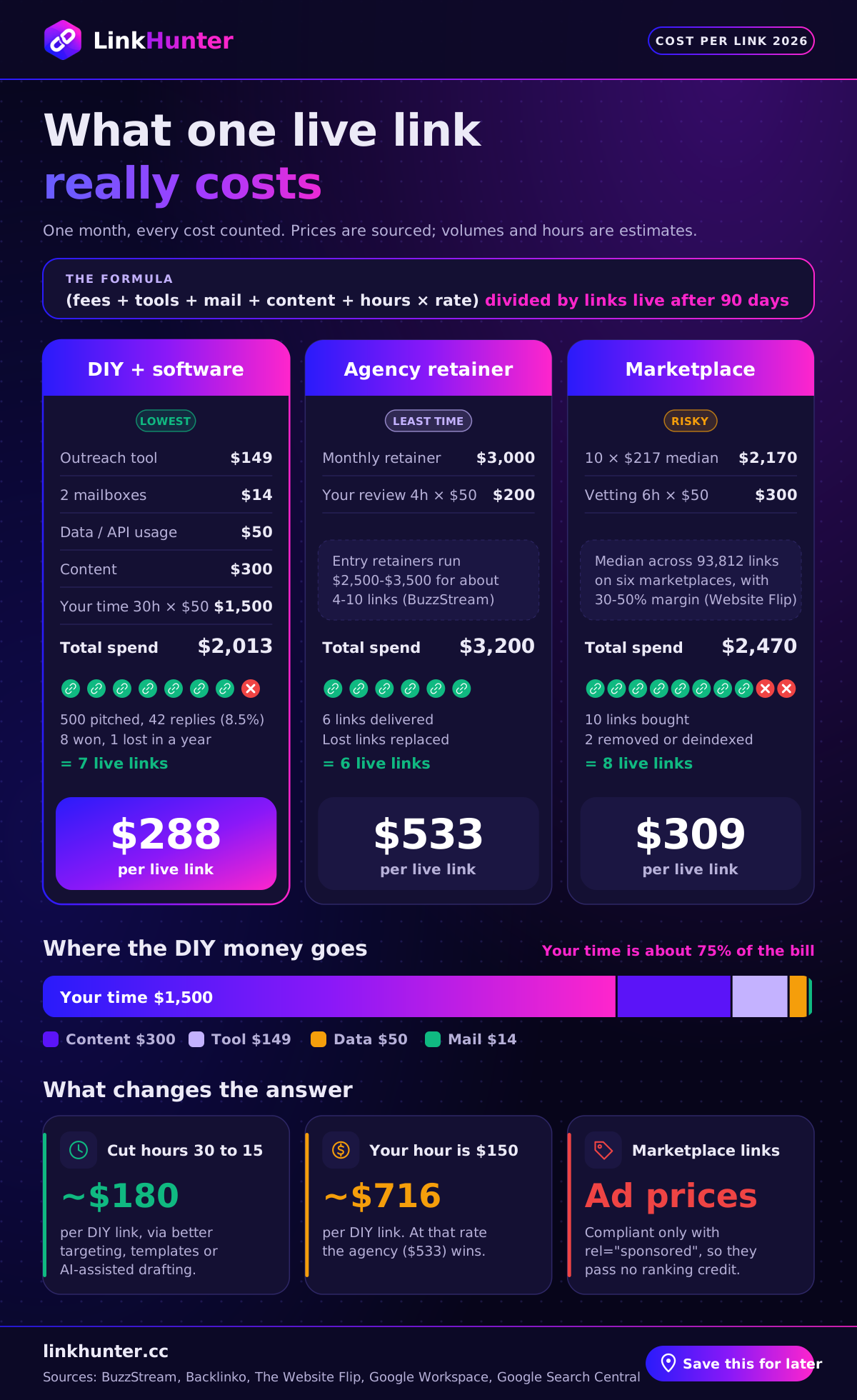
Cost per earned link = (placement fees + tools + email infrastructure + content + hours × hourly rate) ÷ links still live after 90 days.
- Fees: retainers, placement fees, marketplace orders.
- Tools: outreach software, backlink data, email finding and any API usage.
- Email infrastructure: mailboxes on a separate sending domain. Google Workspace Business Starter lists at $7 per user per month on an annual plan (Google Workspace pricing).
- Content: guest articles, data pieces, page updates.
- Hours: every hour of prospecting, writing, follow-up, negotiating and checking, at what that hour would cost you to hire out.
- Live links: count only links that are published, indexable and still in place. Ignore promises.
A worked example for one month
Here is the model with numbers. Prices come from the sources above; the volumes and hours are our assumptions, so replace them with yours.
- DIY with outreach software. You pitch 500 qualified prospects. At the 8.5% average reply rate Backlinko found across 12 million outreach emails (Backlinko study), that is about 42 replies. Assume one in five turns into a free link: 8 links, and one disappears within the year. Costs: $149 tool, $14 for two mailboxes, $50 data usage, $300 content, 30 hours at $50. Total $2,013 for 7 live links, about $288 per link.
- Agency retainer. $3,000 for 6 links, plus 4 hours of your review time at $50. Total $3,200, about $533 per link, assuming the agency replaces anything lost.
- Marketplace. 10 links at the $217 median, plus 6 hours of vetting. Total $2,470. Assume 2 links are removed or deindexed, leaving 8. About $309 per link, and these links only comply with Google's rules if they carry rel="sponsored".
What the model tells you
Three things stand out. First, in the DIY column your time is about 75% of the bill. Cut the hours from 30 to 15, whether through better targeting, templates or AI-assisted drafting, and the cost drops to about $180 per link. That is where outreach software earns its keep, and it is why our link building outreach playbook spends so much time on targeting.
Second, the agency looks expensive per link but carries almost none of your time. If your hour is worth $150 rather than $50, the DIY figure rises to about $716 per link and the agency wins.
Third, the marketplace number is misleading. A marketplace link that follows Google's rules is marked sponsored and is not meant to pass ranking credit, so you are paying ad prices for referral traffic. If the link is not marked, it is cheap because you are carrying the risk.
What hidden costs does nobody mention?
The hidden costs of link building are the ones that never appear on an invoice: hours, content, email setup, vendor markups and links that vanish. Together they can double the headline price per link.
- Your hours. Prospecting, qualifying, finding contacts, writing, following up and negotiating. Most teams undercount this by half because nobody logs the twenty-minute tasks.
- Content. Guest posts need writing, and editors increasingly reject thin AI drafts. A strong data piece or tool page that earns links on its own may cost more up front but lowers the cost of every link after it.
- Email infrastructure. A separate sending domain, authenticated mailboxes and warm-up time. Skip it and you burn your main domain's reputation.
- Vendor markup. BuzzStream measured an average markup of about 56%, roughly $166 per guest post, when buying through a vendor instead of directly.
- Lost links. Ahrefs found that at least 66.5% of links pointing to the 2,062,173 sites it sampled since 2013 had rotted (Ahrefs link rot study). Paid links on sites that sell to everyone disappear faster than editorial links, so ask for a replacement window in writing.
- Monitoring. Someone has to check that links stay live, keep the agreed anchor and keep the right rel attribute. Changes often happen silently.
- Cleanup. If a previous vendor built spammy links, auditing and disavowing them costs time you never budgeted for.

Why are some low-DR links more expensive than high-DR links?
Low-DR links are sometimes more expensive because DR is a third-party score, and sellers price on real traffic, niche demand and how few links they sell. A low-DR site with an engaged audience in your niche is often worth more than a high-DR site that links out to anyone who pays.
In one r/seogrowth thread, a link builder noticed sites with an authority score of 10 to 20 charging $200 to $400 or more, while some sites scoring 50+ sold links for under $50. The replies were consistent: DA and DR are not Google metrics, relevance and traffic matter more, cheap high-score sites are often private blog networks, and a site that links out heavily spreads its value thin.
The data backs this up. In BuzzStream's link insertion set, DR 40-49 sites averaged $197, cheaper than DR 30-39 sites at $246. Organic traffic followed price far more steadily, from $137 on sites with 0-100 monthly visits to $510 on sites with 100,000 or more.
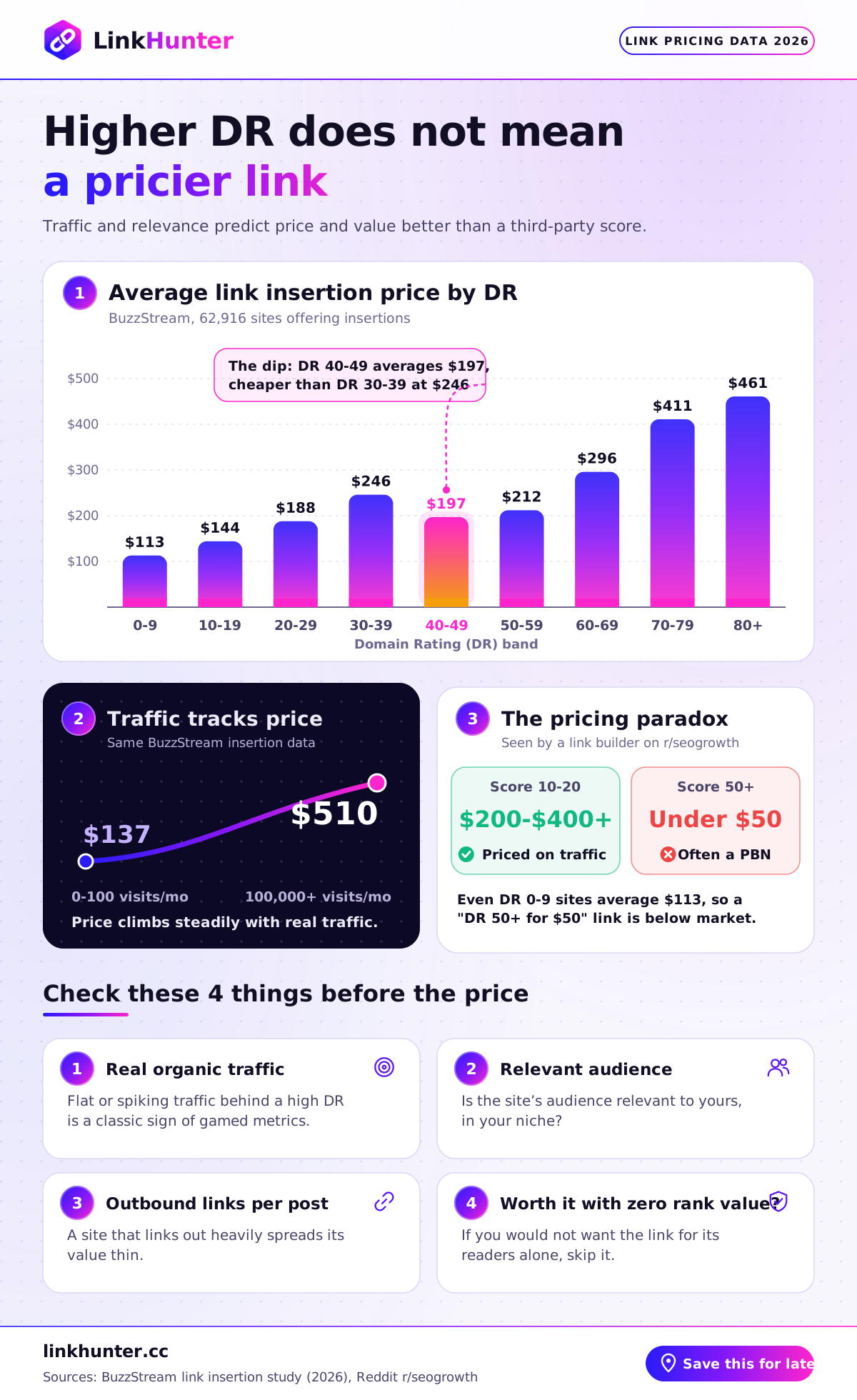
So judge a link by four checks before the price: does the site get real organic traffic, is its audience relevant to yours, how many outbound links does it carry per post, and would you want the link if it sent no ranking value at all? Our guide to finding link building prospects includes a qualification scorecard built around exactly these signals.
Is buying backlinks worth it, and is it safe?
Buying backlinks to pass ranking credit is against Google's rules, so it is not safe in that sense. Paying for a placement that is clearly marked as sponsored is allowed, but then you are buying exposure and referral traffic, not rankings.
Google's spam policies list "buying or selling links for ranking purposes" as link spam, and add that such links are not a violation as long as they are qualified with rel="nofollow" or rel="sponsored". The likely outcomes of ignoring that range from Google simply discounting the links, which means wasted money, to a manual action against your site.
The market knows this and buys anyway. Editorial.Link found that 91.89% of surveyed SEOs believe their competitors buy backlinks. That does not make it safe; it makes it common. Our view after years in this trade:
- Worth it: sponsored placements on relevant sites that send real readers, marked correctly. Price them like ads, by expected traffic and conversions.
- Worth it: paying for things around the link, such as content, data, design or outreach time, while the publisher links on editorial merit.
- Not worth it: unmarked links bought for rankings from sites that sell to everyone. The cheap ones fail quickly and the expensive ones carry the same risk at a higher price.
If you automate any part of this, keep a human approval step in front of every payment. Our guide on how to automate link building without getting penalized explains where we draw that line.
How should paid links be marked: sponsored or nofollow?
Paid links should be marked rel="sponsored", which Google prefers. rel="nofollow" is still acceptable for paid links, and you can combine values such as rel="sponsored nofollow".
Google's guidance on qualifying outbound links says sponsored is for links that are advertisements or paid placements, that nofollow was the earlier recommendation and remains acceptable, and that multiple rel values can be listed together. In practice:
- Agree on the attribute in writing before you pay. A publisher who refuses to mark a paid link is selling you risk.
- Check the live HTML after publication, not the CMS preview.
- Re-check on a schedule. Attributes get removed in redesigns, and some sellers quietly change them later.
- Record each paid link in your tracker with price, date, attribute and contact, so an audit takes minutes.
This is exactly why the attribute belongs in your cost model. A sponsored link should be valued on traffic and brand exposure. If that number does not justify the price, do not buy it.
How do you set a link building budget?
Set a link building budget as a share of your SEO budget, then convert it into a target number of live links using a realistic cost per earned link. Editorial.Link found agencies allocate about 32.1% of SEO budgets to link building and in-house teams about 36%.

- Start with the gap. Compare referring domains on the pages that outrank you for your money keywords. That tells you roughly how many links you need, and on which pages.
- Take your share. Put about a third of your SEO budget toward links. On $6,000 a month, that is around $2,000.
- Price your realistic route. Use the worksheet above with your own hourly rate. If DIY comes to $250 per live link, $2,000 buys about eight a month.
- Mix methods. Most budgets work best as steady outreach links plus one digital PR push a quarter, with sponsored placements only where the traffic justifies them.
- Commit for six months. Links take time to be crawled and to move rankings. Judging after six weeks wastes the first spend.
- Review on cost per live link. Every quarter, recalculate with real numbers and shift money toward whatever method came out cheapest for links you are proud of.
For a SaaS company the targets usually sit on comparison, integration and feature pages rather than the blog. Our SaaS link building playbook covers which pages deserve the budget.
Red flags in cheap link building packages
Cheap link building packages usually save money by using sites that sell to anyone, hiding the site list or refusing to mark paid links. Walk away if you see any of these.
- "DR 50+ links for $50." Below the market average for even the lowest DR band. Expect link farms or private blog networks.
- Bulk bundles. Hundreds of links for a flat fee. No real editor publishes at that volume.
- No site list before payment. If you cannot vet the domains, you cannot judge the price.
- Guaranteed dofollow on paid links. That is a promise to break Google's rules on your behalf.
- Metrics without traffic. High DR or DA with flat or spiking organic traffic is a classic sign of manipulated metrics.
- "Write for us" sites covering every topic. Casino, crypto, pets and plumbing on one blog means links are the product.
- No replacement policy. Good vendors replace links removed within a set window, often 6 to 12 months.
- Reports full of anchors, no live URLs. Ask for the exact page, the anchor and the rel attribute for every link.
Where we land on what link building should cost you
For most teams in 2026, a good link costs $250 to $550 all in, whether you pay an agency, run outreach yourself or mix the two. Paid placements under $100 rarely survive scrutiny, and digital PR at $700 to $1,700 per link is worth it when the idea is strong. The cheapest honest route is usually DIY outreach with good targeting. The safest expensive route is an agency that shows you its site list and replaces lost links. Whichever you pick, measure it the same way: total cost divided by links that are still live, and mark every paid link as sponsored. If you want to test the DIY route first, you can start a free 14-day trial without a card and run the worksheet on your own numbers.
Frequently asked questions
How much does a backlink cost in 2026?
A paid link insertion averages $179 and a guest post bought directly from the site averages $295, according to BuzzStream data covering hundreds of thousands of sites. Through a vendor the same guest post averages $461. Digital PR links work out to roughly $700 to $1,700 each. Links you earn through outreach have no fee, but you pay in hours, tools and content.
Is $50 per backlink a good price?
Usually it is a warning sign, not a bargain. BuzzStream found that even DR 0-9 sites average $113 for a link insertion. A $50 link on a site claiming DR 50 or more often comes from a link farm or private blog network that sells to anyone. Check the site's real organic traffic and outbound links before paying anything.
How much do link building agencies charge per month?
Most retainers run $2,500 to $10,000 a month. Entry plans of $2,500 to $3,500 typically deliver about 4 to 10 links, competitive niches such as SaaS, finance and legal cost $3,000 to $10,000, and enterprise programs reach $10,000 to $15,000 or more. Always ask for the price per live link and a replacement policy.
Is buying backlinks against Google's guidelines?
Yes, when the link is meant to pass ranking credit. Google's spam policies list buying or selling links for ranking purposes as link spam. Paid links are allowed only when they carry rel="sponsored" or rel="nofollow", which tells Google to treat them as advertising. Unmarked paid links risk being ignored or triggering a manual action.
Why are backlinks so expensive?
Good links are scarce. BuzzStream found that only 1.37% of guest post sites passed its quality bar, so real demand concentrates on a small pool of sites with traffic and relevance. Vendor markups of around 56% and the cost of writing content add more. In an Editorial.Link survey, 80.9% of SEOs expected link building to get harder and more expensive.
What is the average cost of a guest post?
BuzzStream's 2026 dataset of 257,267 sites puts the average guest post at $295 when bought directly from the publisher and $461 through a vendor. Price climbs with authority: about $225 direct for DR 20-29 and $1,735 direct for DR 80+. Add $50 to $300 if you pay someone to write the article.
Is link building software cheaper than an agency?
In cash terms, yes: outreach tools cost $49 to $1,200 a month against $2,500 or more for an agency. But software does not build links by itself. Once you count your hours at a fair rate, DIY usually lands somewhere between a marketplace and an agency per live link. It wins when you have the time, a clear linkable asset and someone who can write well.
How much should a small business spend on link building?
Start from your SEO budget. Editorial.Link found agencies put about 32% of SEO spend into links and in-house teams about 36%. On a $3,000 monthly SEO budget that is roughly $1,000 for links, enough for software plus your own outreach or two to four quality placements. Commit for at least six months before judging results.
Sources
- BuzzStream: Link Building Pricing (2026 data)buzzstream.com
- BuzzStream: The Cost of Link Insertions, Based on ~420k Sitesbuzzstream.com
- Editorial.Link: Link Building Statistics for 2026 (survey of 518 SEOs)editorial.link
- The Website Flip: Backlink marketplace price analysis (93,812 links)thewebsiteflip.com
- Google Search Central: Spam policies for Google web searchdevelopers.google.com
- Google Search Central: Qualify your outbound linksdevelopers.google.com
- Backlinko: We Analyzed 12 Million Outreach Emailsbacklinko.com
- Ahrefs: At Least 66.5% of Links to Sites in the Last 9 Years Are Deadahrefs.com
- Google Workspace pricingworkspace.google.com
- BuzzStream plans and pricingbuzzstream.com
- Pitchbox pricingpitchbox.com
- Respona pricingrespona.com
- VisibilityStack: Link building costs by DR tiervisibilitystack.ai
- Reddit r/seogrowth: Backlink pricing makes zero sense sometimesreddit.com

About the author
Monjur Hossain
Founder, LinkHunter
Monjur founded LinkHunter (linkhunter.cc) and MotionTrust Digital, where he has led marketplace strategy since 2022. He has eight years in e-commerce and marketplace marketing and writes these guides from the work of building an AI link-building platform: what earns links, what gets ignored, and where a person still needs to make the call.