Pitchbox Alternatives: 8 Outreach Tools Compared on Price, AI and Deliverability
Why teams leave Pitchbox, what it really costs in 2026, and which of 8 outreach tools fits a solo SEO, an in-house team or a 5-seat agency.
Contents16 sections
- 1Why do teams look for Pitchbox alternatives?
- 2What does Pitchbox cost in 2026?
- 3Pitchbox alternatives at a glance
- 4What do the alternatives cost for a solo SEO vs a 5-seat agency?
- 5BuzzStream: best budget outreach CRM
- 6Respona: what changed and who it still fits
- 7Postaga: best for solo SEOs and small agencies
- 8LinkHunter: best for AI agents with human approval
- 9Hunter plus a cold-email tool: the DIY stack
- 10NinjaOutreach and influencer-first tools: when do they fit?
- 11Respona vs Pitchbox vs BuzzStream: which is right for you?
- 12Which Pitchbox alternative is best for agencies?
- 13How do you migrate off Pitchbox without losing prospect history?
- 14Our verdict on Pitchbox alternatives in 2026
- 15Frequently asked questions
- 16Sources
The best Pitchbox alternatives in 2026 are BuzzStream (cheapest full outreach CRM, from $49/month, no contract), Postaga (low-cost AI outreach for solo SEOs), LinkHunter (AI agents with human approval) and Hunter plus a cold-email tool for DIY teams. Respona now sells mainly managed pay-per-placement links rather than self-serve software.
Key takeaways
- Pitchbox lists $300, $600 and $1,200 a month on monthly billing, and every plan carries a one-year commitment.
- BuzzStream is the cheapest full outreach CRM at $49 a month and runs month to month, but extra seats cost $58 to $70 each.
- Respona's pricing page now sells managed placements at $100 to $500 each, so it is a service decision, not a software swap.
- For a 5-seat agency, the gap between Pitchbox and the cheapest workable stack is several thousand dollars a year.
- Deliverability now matters as much as features: Gmail asks bulk senders to keep spam complaints under 0.3% and support one-click unsubscribe.
- Export prospects, do-not-contact lists and live links before your Pitchbox term ends, then run one pilot campaign in parallel.
Most people searching for Pitchbox alternatives are not unhappy with outreach software in general. They are unhappy with a specific bill, a specific contract or a specific workflow. We have run link building campaigns on Pitchbox, BuzzStream, Respona and home-made stacks over the last 15 years, and the right switch depends far more on team size and sending volume than on any feature checklist.
The pages ranking for this term today are mostly review aggregators. Some of them list display-ad and influencer platforms that have nothing to do with link building. The rest is vendor marketing. So this guide does the dull, useful work instead: current list prices checked on each vendor's site in October 2026, two worked cost scenarios, a fit matrix, and a checklist for leaving without losing years of prospect history.
Why do teams look for Pitchbox alternatives?
Teams leave Pitchbox for three reasons: the price, the one-year commitment, and a workflow built for high-volume automated outreach that smaller teams do not need. Features are rarely the problem. Pitchbox is a capable product.
Here is what we hear most often from SEO leads who are shopping around:
- The entry price climbed. Pitchbox Pro now lists at $300 a month on monthly billing and $210 a month billed annually, for two users and 2,000 outreach emails a month (Pitchbox pricing). A solo consultant who sends a few hundred pitches a month pays for capacity they never touch.
- The contract. The same page states that all plans require a one-year commitment regardless of billing frequency. Monthly billing is just a payment schedule, not an exit.
- Seat and mailbox limits on the entry plan. Pro gives you two users and two connected email accounts. Add a third team member and you are on Advanced at $600 a month.
- Onboarding cost. Expert-led implementation is listed at $2,000 to $4,000 unless you prepay annually.
- Workflow fit. Pitchbox leans into volume: email rotation, bulk AI personalization and multi-region sending sit on the higher tiers. Teams that win links through fewer, better pitches often find it heavier than they need.
None of these make Pitchbox a bad tool. They make it a tool with a specific buyer: an agency or in-house team running thousands of emails a month across many campaigns. If that is not you, keep reading.
What does Pitchbox cost in 2026?
Pitchbox pricing in 2026 runs from $210 to $825 a month billed annually, or $300 to $1,200 a month billed monthly, with a one-year term on every plan. Enterprise pricing is quote-only.
| Plan | Monthly billing | Annual billing | Users | Email accounts | Outreach emails / month |
|---|---|---|---|---|---|
| Pro | $300/mo | $210/mo | 2 | 2 | 2,000 |
| Advanced | $600/mo | $420/mo | Unlimited | 6 | 5,000 |
| Scale | $1,200/mo | $825/mo | Unlimited | 20 | 25,000 |
| Enterprise | Custom | Custom | Custom | Custom | Custom |
Source: pitchbox.com/pricing, checked October 2026. Every plan includes the email finder and verifier, AI personalization, an AI reply agent, a CRM, a unified inbox and link monitoring. Advanced adds email rotation, deliverability monitoring, Slack and the API. Scale adds an approval workflow and multi-region sending.
So what does a Pitchbox review look like on price alone? For a team that sends 4,000 to 5,000 emails a month across several clients, Advanced is reasonable. For anyone below that, you are paying for headroom.
Pitchbox alternatives at a glance
The quickest way to choose among Pitchbox alternatives is to match the pricing model to how you work: per seat, per placement, per credit, or per capacity. This table summarises the eight options we compare below.
| Tool | Best for | Starting price (Oct 2026) | Pricing model | AI help | Contract |
|---|---|---|---|---|---|
| BuzzStream | Relationship-led outreach teams | $49/mo | Per plan, extra seats $58 to $70 | Light | Monthly, cancel anytime |
| Respona | Buyers who want placements done for them | $100 per placement | Pay per placement | Handled by vendor | Per order |
| Postaga | Solo SEOs and small agencies | Free plan; Pro listed $84 to $99/mo | Per plan | AI campaign generator | Monthly |
| LinkHunter (linkhunter.cc) | AI agents with a human approving every deal | Free 14-day trial, see pricing | Per plan capacity, your own API keys | Seven agents | No card for trial |
| Hunter | Finding and verifying emails, simple campaigns | Free; Starter $49/mo | Credits | AI assistant | Monthly or yearly |
| Instantly or lemlist | The sending half of a DIY stack | Check vendor | Per plan | Varies | Varies |
| NinjaOutreach | Influencer and blogger discovery | Check vendor | Per plan | Light | Varies |
| Upfluence | Brand influencer programs, not SEO | Quote only | Annual contract | Varies | Annual |
Prices come from each vendor's pricing page except Postaga, whose site would not load for us in October 2026; that figure is from Toolradar's Postaga listing. Where we could not verify a current price, the table says "check vendor" rather than guessing.
What do the alternatives cost for a solo SEO vs a 5-seat agency?
For a solo SEO, the cheapest workable alternative costs roughly a sixth of Pitchbox Pro per year. For a 5-seat agency, a BuzzStream Growth setup saves about $1,500 to $3,700 a year against Pitchbox Advanced, depending on how you pay Pitchbox.
We built two realistic scenarios and multiplied list prices by twelve. No discounts, no tax, no add-ons.
Scenario 1: one person, one site, about 1,500 emails a month
- Pitchbox Pro: $2,520 a year billed annually, or $3,600 on monthly billing (still a 12-month term).
- BuzzStream Growth: $2,088 a year. You need Growth rather than Starter once you pass 500 contacts, and you get bulk sending and automated follow-ups.
- Postaga Pro: about $1,188 a year at the listed $99 a month.
- BuzzStream Starter: $588 a year, if you can live within 500 contacts.
- Hunter Starter: $408 a year billed annually, with 2,000 credits a month and three connected mailboxes (Hunter pricing).
Scenario 2: five seats, several clients, about 5,000 emails a month
- Pitchbox Advanced: $7,200 a year on monthly billing or $5,040 billed annually. Unlimited users, six mailboxes, 5,000 emails.
- BuzzStream Professional: $5,088 a year for six users and 100,000 contacts.
- Postaga Agency: about $3,588 a year at the listed $299 a month, unlimited users.
- BuzzStream Growth plus two extra seats: $174 + 2 x $58 = $290 a month, or $3,480 a year (BuzzStream pricing).
- Hunter Growth: $1,248 a year billed annually, ten mailboxes, before you add a separate sender or CRM.
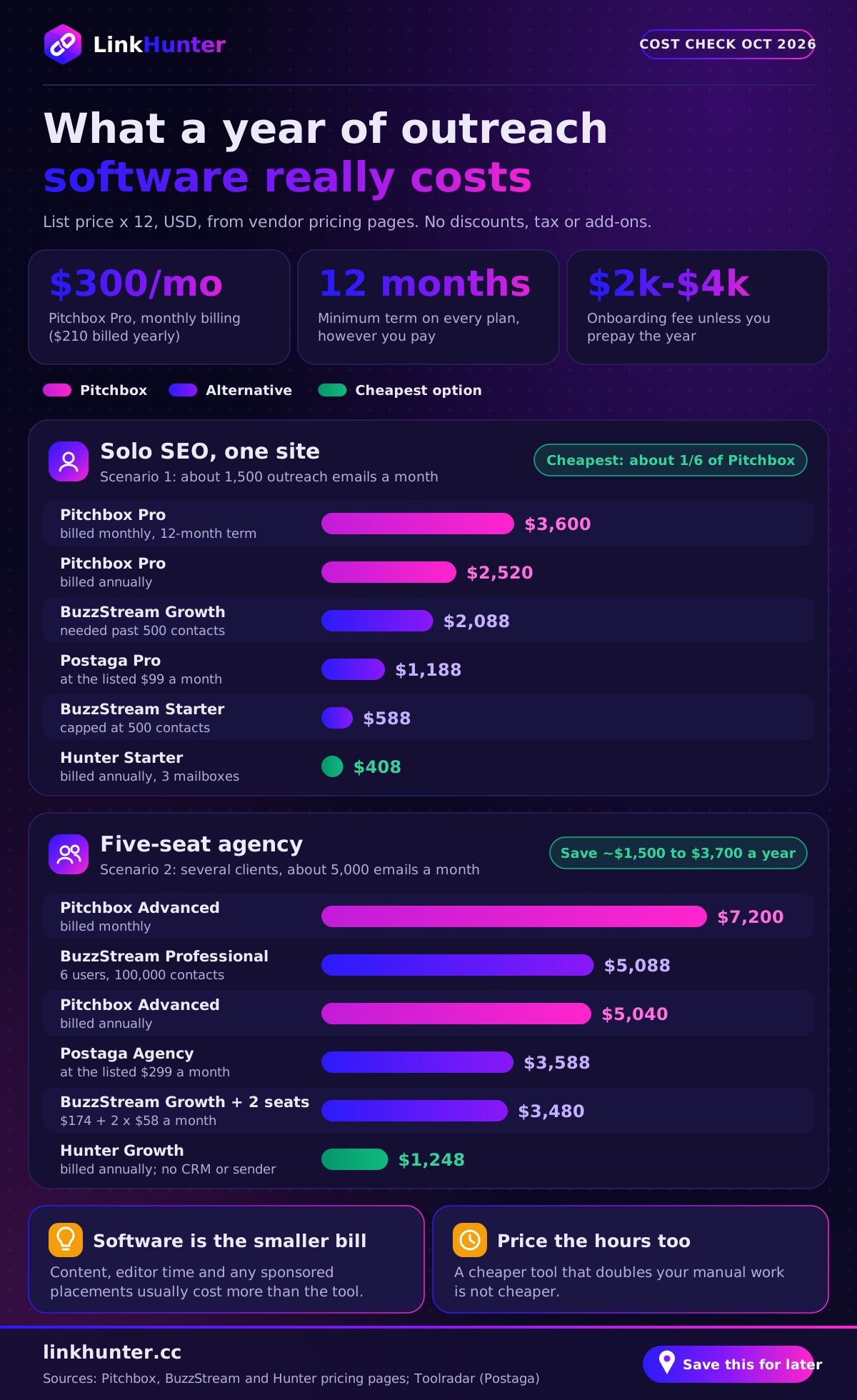
Two honest caveats. First, software is usually the smaller line item. Content, editor time and any sponsored placements cost more than the tool, which we break down in our guide to link building costs. Second, a cheaper tool that doubles your manual work is not cheaper. Price the hours too.
BuzzStream: best budget outreach CRM
BuzzStream is a link building and digital PR CRM that tracks every contact, email and placement in one shared history, and it is the closest like-for-like replacement for Pitchbox at a lower price. Plans start at $49 a month and run month to month.
BuzzStream's current plans (BuzzStream pricing):
- Starter, $49/mo: 1 user, 500 contacts, 30 prospecting searches, 1,000 monitored links.
- Growth, $174/mo: 3 users (+$58 each), 25,000 contacts, bulk send, automated follow-ups, Ahrefs integration.
- Professional, $424/mo: 6 users (+$70 each), 100,000 contacts, API, dedicated account manager.
- Custom, from $999/mo: 12+ users and 300,000+ contacts.
Where it beats Pitchbox: no minimum term, cheaper entry, and a contact history that the whole team sees, which stops two people pitching the same editor. BuzzStream's own BuzzStream vs Pitchbox analysis reports that across 31 million emails, reply rates fell from 1.15% for campaigns of 1 to 50 emails to 0.37% for campaigns of 1,001 to 5,000. That is vendor data, but it matches what we see: smaller, targeted lists win.
Where it falls short: the AI layer is thin next to Pitchbox, and per-seat pricing gets expensive past six people. It is also manual by design. You still qualify prospects and write pitches yourself.
Pick BuzzStream if you run relationship-led outreach, want to cancel monthly, and have a team of one to six.
Respona: what changed and who it still fits
Respona is now sold primarily as a managed, pay-per-placement link service, not as self-serve outreach software. That is the biggest change in this market, and most comparison pages have not caught up.
Respona's pricing page lists placement tiers rather than software seats:
| Respona tier | Price per placement | Publisher DR | Publisher monthly traffic |
|---|---|---|---|
| Starter | $100 | 20+ | 100 to 5K |
| Standard | $160 | 30+ | 100 to 10K |
| Authority | $240 | 40+ | 500 to 20K |
| Power | $400 | 50+ | 1K to 30K |
| Elite | $500 | 60+ | 1K to 100K |
The page says placements include content, outreach and publishing, with a standard 28-day turnaround (14 days with an express add-on), and volume discounts starting at 10% off at $3,000 a month. The site still shows login and "create an account" buttons, so some platform access appears to exist, but no software plan is priced.
What this means for you: Respona vs Pitchbox is no longer a software comparison. It is "do it yourself" versus "pay someone per link." That can be a perfectly good choice for a founder with budget and no time. Just go in with clear eyes:
- Google's spam policies list "buying or selling links for ranking purposes" as link spam, and Google asks that paid placements carry
rel="sponsored"ornofollow(Google spam policies; qualifying outbound links). Ask any placement vendor how links are labelled. - You give up the relationships. When the editor knows the vendor, not you, the next link costs money again.
Looking for Respona alternatives because you wanted the old self-serve tool? BuzzStream and LinkHunter are the closest matches; Postaga is the budget option.
Postaga: best for solo SEOs and small agencies
Postaga is a budget outreach platform that finds opportunities, generates campaigns with AI and sends sequences, and it has historically been the cheapest all-in-one option for one-person SEO shops.
A caution first. When we tried to load postaga.com in October 2026 the site returned an error, so we could not confirm current pricing or availability first-hand. Toolradar's listing, verified the same month, shows a free plan (three campaigns, 500 emails), Pro at $84 to $99 a month (2,000 contacts, 10,000 emails, five users) and Agency at $250 to $299 a month (unlimited users, 30 accounts). Verify with the vendor before you commit.
What we like: campaign types for guest posts, broken links, skyscraper and podcast pitching, plus AI drafting that gets a beginner from zero to sending quickly. What to watch: Postaga leans on Hunter for unlimited contact data, and the AI drafts need editing before they sound like a person.
Searching for Postaga alternatives? If the site issues persist, BuzzStream Starter or Hunter cover the same budget.

LinkHunter: best for AI agents with human approval
LinkHunter is an AI link building platform where seven specialised agents handle prospecting, qualification, contact finding, drafting, reply triage, negotiation and link monitoring, and a human approves every commitment before it goes out. It is our product, so weigh this section accordingly.
Here is how the work splits across the agents (full detail on the features page):
- Prospect Hunter finds sites through Brave Search and DataForSEO.
- Quality Analyzer scores each site and shows you why it scored that way, instead of a black-box number.
- Contact Finder locates the right person and verifies the address.
- Outreach Writer drafts a pitch from the prospect's real content. No invented compliments.
- Reply Manager sorts the inbox so you see interested replies first.
- Negotiator works within the budget limits you set and waits for your approval.
- Backlink Monitor checks that won links stay live and keep their attributes.
The deliverability stance is deliberate. Every email carries an unsubscribe link, and we do not rotate dozens of mailboxes to dodge spam filters. That matters more each year: Google's sender guidelines ask bulk senders to keep spam rates below 0.30%, ideally under 0.10%, and to support one-click unsubscribe. Any paid placement is recorded as sponsored or nofollow.
Where LinkHunter is not the right pick: if you want a pure CRM and plan to write every email by hand, BuzzStream is simpler. If you want someone else to do all the work, a managed service fits better. And because search, SEO data and AI usage run on your own API keys, you pay those providers directly on top of the plan. That is cheaper at small volumes and more transparent, but it is one more bill. If you are weighing how far to automate, our guide to automating link building without penalties draws the line we use.
Hunter plus a cold-email tool: the DIY stack
The DIY stack pairs an email finder such as Hunter with a sender such as Instantly or lemlist and a spreadsheet or lightweight CRM. It is the cheapest route and the most work.
Hunter alone already covers more than people expect. Its pricing page lists a free plan with 50 credits and one connected mailbox, Starter at $49 a month ($34 billed yearly) with 2,000 credits and three mailboxes, Growth at $149 ($104 yearly) with 10,000 credits and ten mailboxes, and Scale at $299 ($209 yearly). A found email costs one credit and a verification half a credit.
What you give up: link-specific workflow. There is no built-in idea of "placement pending," "link live" or "link lost," no domain metrics next to the contact, and no shared history unless you build it. In our experience, DIY stacks work well for one disciplined person and fall apart at three people, when two of them pitch the same editor in the same week.
If you go this way, follow the outreach basics that actually move reply rates. Backlinko's analysis of 12 million outreach emails (run with Pitchbox data) found an average response rate of 8.5%, and that one follow-up lifted replies by 65.8%. Our link building outreach playbook turns that into a sequence.
NinjaOutreach and influencer-first tools: when do they fit?
NinjaOutreach and similar influencer platforms fit when your goal is social reach or sponsored creator content, not editorial backlinks. They show up on G2 and Capterra lists of Pitchbox alternatives because the categories overlap, not because they do the same job.
NinjaOutreach searches a database of bloggers and social accounts by niche and audience size, then lets you email them in bulk. That is handy for product seeding and creator campaigns. Its pricing page was down when we checked in October 2026, so we have not listed a figure. Upfluence and Sprout Social's influencer product sit further from SEO still: they are built for running paid creator programs, with contracts to match.
Use them alongside a link building tool if creators are part of your plan. Do not use them instead of one.
Respona vs Pitchbox vs BuzzStream: which is right for you?
Choose Pitchbox for high-volume automated outreach, BuzzStream for relationship-led outreach on a smaller budget, and Respona only if you want to buy finished placements instead of running outreach yourself.
| Question | Pitchbox | BuzzStream | Respona |
|---|---|---|---|
| Who sends the emails? | You | You | Respona |
| Entry price | $210/mo annual, $300 monthly | $49/mo | $100 per placement |
| Minimum term | 12 months | None | Per order |
| Seats on entry plan | 2 | 1 | Not applicable |
| AI drafting and replies | Yes, all plans | Limited | Done for you |
| You own the relationships | Yes | Yes | No |
| Best for | Agencies sending 5,000+ emails a month | Teams of 1 to 6 who value contact history | Founders with budget and no time |
BuzzStream vs Pitchbox in one line
BuzzStream is the cheaper, contract-free CRM; Pitchbox is the more automated platform with unlimited seats from Advanced up. For three or fewer people, BuzzStream usually wins on cost. For eight or more people on one plan, Pitchbox Advanced's unlimited users can come out ahead.
Respona vs BuzzStream in one line
Respona sells you links; BuzzStream sells you the system to earn them. They are not substitutes any more.
Which Pitchbox alternative is best for agencies?
BuzzStream is the best Pitchbox alternative for agencies that want a shared outreach CRM at a lower, contract-free price, while LinkHunter suits agencies that want AI agents to do the repetitive work under human approval.
Agencies have three needs individual SEOs do not: separate client workspaces, clean reporting, and a guarantee that two account managers never pitch the same editor for different clients in the same week. Run any candidate through this five-point test during the trial:
- Client separation: can you keep prospects, templates and reports apart per client without a second account?
- Collision check: does the tool warn you when a contact is already in another active campaign?
- Seat maths at your real headcount: price it at today's team plus two hires.
- Approval control: can a senior person sign off on pitches, prices and paid placements before they go out?
- Client-ready reporting: can you export won links, status and attributes without rebuilding the report in a spreadsheet?
The agency horror story we hear most is not about price. It is a junior agreeing to a paid link on a client's behalf without anyone noticing. Whatever you choose, put a human approval step in front of money, which is why LinkHunter's Negotiator stops at budget limits and Pitchbox reserves its approval workflow for Scale. For a broader shortlist by workflow stage, see our best link building tools roundup.
How do you migrate off Pitchbox without losing prospect history?
Start 60 days before your renewal date, export every record to CSV, carry your do-not-contact list across first, and run one pilot campaign in the new tool before the old term ends. Your prospect history is the asset; the software is replaceable.
Here is the checklist we use when moving a client between outreach tools:
- Check your renewal date. Pitchbox plans carry a one-year term, and access stays active until the contract period ends. Put the date in a calendar with a 60-day reminder.
- Export everything. Prospects, contacts, campaign stages, link partners and live links. Do it twice, a month apart, so nothing added late is missed.
- Map your fields. At minimum: domain, contact name, email, status, last contacted date, link URL, anchor, link attribute, owner and notes. Decide what "won," "pending" and "declined" mean in the new tool before importing.
- Carry over do-not-contact first. Unsubscribes, hard bounces and clear "no" replies go into the new tool's suppression list before any campaign is built. Re-pitching someone who opted out is the fastest way to spam complaints.
- Re-check mailbox authentication. SPF, DKIM and DMARC on every sending domain you connect. Google's sender guidelines require all three for bulk senders.
- Load live links into monitoring. Otherwise a link that disappears in month two goes unnoticed.
- Run one pilot in parallel. One small campaign, 50 to 100 prospects, in the new tool while Pitchbox is still live. Compare reply rates and time spent before cancelling.
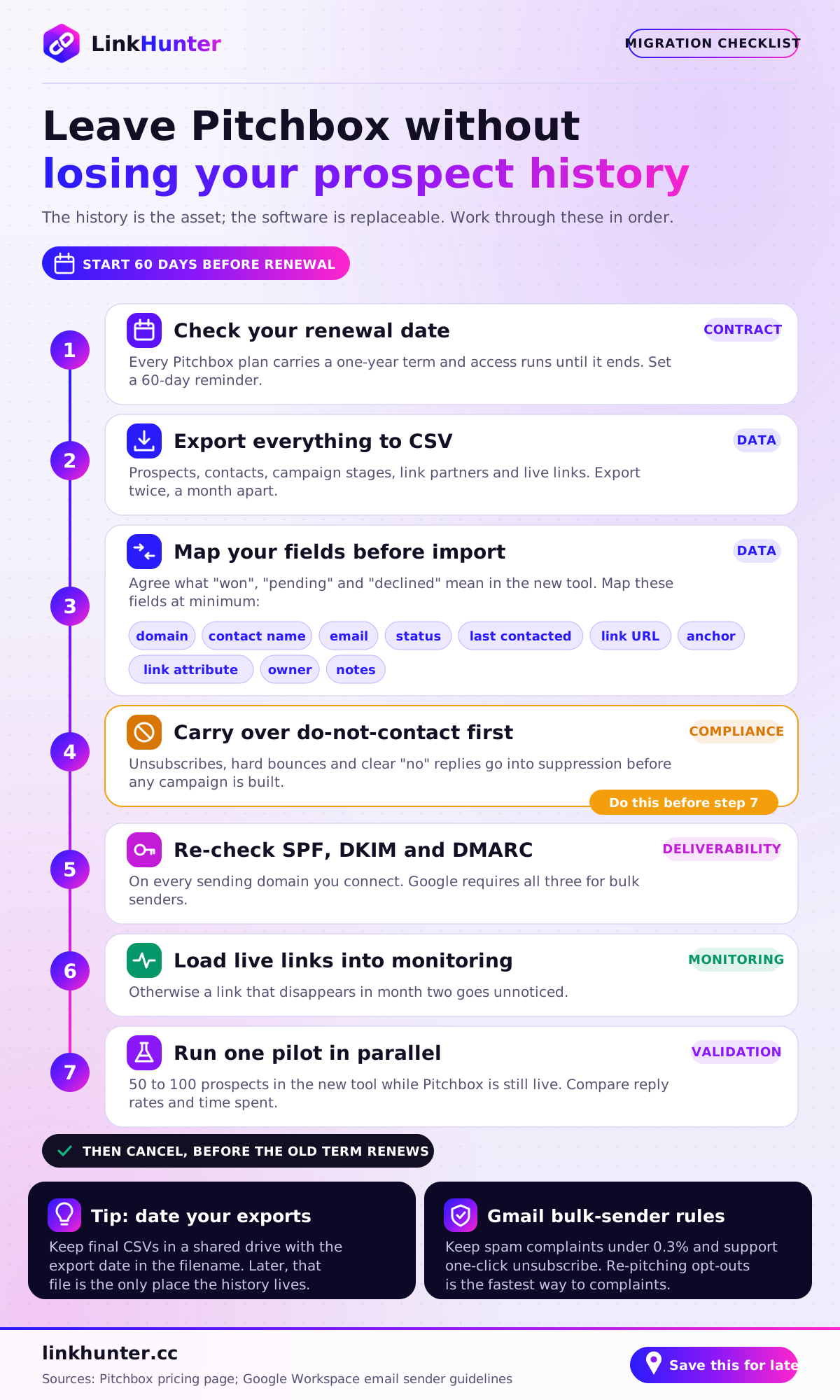
LinkHunter imports prospects by CSV and includes Backlink Monitor on every plan, so steps 2, 3 and 6 map directly. BuzzStream and Postaga both import CSV too. The tool matters less than doing step 4 before step 7.
Our verdict on Pitchbox alternatives in 2026
If you are a solo SEO, start with BuzzStream Starter or Hunter and upgrade only when you hit a limit. If you run a team of three to six, BuzzStream Growth or Professional replaces Pitchbox for less money and no contract. If you want AI to carry the prospecting, drafting and inbox work while a person approves every pitch and every dollar, trial LinkHunter. If you simply want links delivered, that is Respona's model now, and you should judge it as a service, not a tool.
And if you send 5,000+ emails a month across many clients and Pitchbox is working? Stay. The best tool is the one your team actually uses well, with honest pitches, clean lists and a human checking anything that costs money. You can read more about who builds LinkHunter and why on our about page.
Frequently asked questions
What is cheaper than Pitchbox?
BuzzStream Starter ($49/month), Postaga Pro (listed at $84 to $99/month) and Hunter Starter ($49/month, or $34/month billed yearly) all cost far less than Pitchbox Pro at $300/month. The catch is capacity: BuzzStream Starter caps you at 500 contacts, and Hunter is an email finder with campaigns rather than a full link-building CRM.
How much does Pitchbox cost per month?
In October 2026 Pitchbox lists Pro at $300, Advanced at $600 and Scale at $1,200 per month on monthly billing, or $210, $420 and $825 per month billed annually. Its pricing page says all plans require a one-year commitment, and expert-led onboarding costs $2,000 to $4,000 unless you prepay annually.
Is Respona better than Pitchbox?
They now solve different problems. Pitchbox is self-serve outreach software you run yourself. Respona's pricing page sells managed placements from $100 (DR 20+) to $500 (DR 60+) with content and outreach handled for you. If you want to keep outreach in-house, compare Pitchbox with BuzzStream or LinkHunter instead.
Is BuzzStream cheaper than Pitchbox?
Yes, for most team sizes. BuzzStream Growth costs $174/month for 3 users with no minimum term, against $300/month for 2 users on Pitchbox Pro. The gap narrows for larger teams because BuzzStream charges $58 to $70 per extra seat while Pitchbox Advanced includes unlimited users.
Does Pitchbox have a free trial?
Pitchbox says free trials are available, but its pricing page routes you to a demo with a product specialist first, so there is no instant self-serve signup. BuzzStream, Postaga, Hunter and LinkHunter let you start a trial without talking to sales.
What is the best Pitchbox alternative for agencies?
For agencies that want a shared outreach CRM, BuzzStream Growth or Professional is the safest switch. Agencies that want AI to do prospecting, drafting and reply triage while a human signs off on every deal should trial LinkHunter. Agencies sending very high volumes may find Pitchbox Scale still makes sense.
Does Respona still offer self-serve software?
Respona's site still has login and account-creation buttons and pages about its outreach software, but in October 2026 its pricing page only lists pay-per-placement plans and its FAQ says it handles everything end to end by default. Ask their team directly what self-serve access is included before you plan around it.
What are the main BuzzStream competitors?
The main BuzzStream competitors are Pitchbox (automation-heavy, higher price), Respona (now mostly managed placements), Postaga (budget AI outreach), Hunter (email finding plus campaigns), NinjaOutreach (influencer discovery) and AI-agent tools such as LinkHunter. Which one fits depends on whether you want a CRM, a sender or someone else doing the outreach.
Sources
- Pitchbox pricing pagepitchbox.com
- BuzzStream plans and pricingbuzzstream.com
- BuzzStream vs Pitchbox (BuzzStream blog)buzzstream.com
- Respona pricing (pay-per-placement plans)respona.com
- Hunter pricinghunter.io
- Postaga pricing listing, Toolradartoolradar.com
- Backlinko: We Analyzed 12 Million Outreach Emailsbacklinko.com
- Google Workspace: Email sender guidelinessupport.google.com
- Google Search Central: Spam policies (link spam)developers.google.com
- Google Search Central: Qualify your outbound linksdevelopers.google.com

About the author
Monjur Hossain
Founder, LinkHunter
Monjur founded LinkHunter (linkhunter.cc) and MotionTrust Digital, where he has led marketplace strategy since 2022. He has eight years in e-commerce and marketplace marketing and writes these guides from the work of building an AI link-building platform: what earns links, what gets ignored, and where a person still needs to make the call.