AI Link Building in 2026: How AI Agents Find, Pitch and Win Backlinks
How AI agents split link building into seven jobs, where they fail, ChatGPT prompts that work, and the guardrails that keep AI outreach safe.
Contents15 sections
- 1What is AI link building?
- 2How is AI link building different from automated link building?
- 3The 7 jobs AI agents can do in a link building workflow
- 4How are link builders actually using AI in 2026?
- 5Where does AI still fail, and why should humans approve every commitment?
- 6How to use ChatGPT for link building: prompts that work
- 7Is AI link building safe with Google?
- 8How do you personalize AI outreach emails without sounding robotic?
- 9Best AI link building tools compared
- 10How do you evaluate an AI link building tool?
- 11What results can you realistically expect from AI link building?
- 12Where LinkHunter fits
- 13The bottom line on AI link building
- 14Frequently asked questions
- 15Sources
AI link building uses language models and AI agents to find prospects, score site quality, find contacts, draft grounded pitches, sort replies and monitor links. It is safe with Google when links are earned editorially and paid links are marked sponsored. A human should approve every email, deal and payment, because AI invents details and overcommits.
Key takeaways
- AI link building splits into seven jobs: find, qualify, contact, write, reply, negotiate and monitor.
- AI is strongest at research, qualification and reply sorting, and riskiest when it negotiates or spends money.
- The four common failures are invented personalization, fake flattery, over-sending and overcommitting budget.
- Google does not penalize AI-written outreach; it penalizes link schemes, so label paid links rel="sponsored" or nofollow.
- In Hunter data, manually edited emails got 5.2% replies against 4.4% for fully automated ones.
- Expect AI to cut hours, not to lift the roughly 8.5% reply rate that link outreach typically sees.
AI link building has gone from a novelty to a default in about two years. Plenty of SEO teams now use AI to find prospects or draft pitches, and a new wave of tools sells "AI agents" that promise to run the whole thing while you sleep. Some of that is real. Some of it gets domains blacklisted.
We have built links for 15 years, and for the last two we have been building AI agents that do it. This guide is what we wish the current top results told you. Instead of another list of tools, it breaks down the seven jobs inside a link building workflow, shows which ones AI does well, names the four places it reliably fails, and gives you prompts, a buyer's checklist and honest numbers. Updated for 2026.
What is AI link building?
AI link building is the use of large language models and AI agents to research, qualify, pitch and track backlink opportunities, while a person decides what gets sent, agreed or paid. The AI does the reading and writing at scale. The human keeps the judgment calls: which sites are worth a link, what you promise, and what you spend.
In practice that covers three kinds of work:
- Research and qualification. A model reads a prospect's page, checks topical fit and flags problems such as thin content or a "write for us, $150" page.
- Pitching. The model drafts an email that refers to the real content on the prospect's page and explains why your resource helps their readers.
- Tracking. AI sorts replies, keeps follow-up schedules and checks whether links went live and stayed live.
An AI link building agent is a narrower thing: a piece of software that takes a goal ("find 50 relevant resource pages for our calculator"), decides which steps to run, calls tools such as a search API or an email verifier, and reports back. A good agent hands the result to you for approval. A bad one sends 2,000 emails before you finish your coffee.
How is AI link building different from automated link building?
Automated link building creates or requests links mechanically and at volume; AI link building uses models to make each step smarter, and should still involve human decisions. The difference matters because Google treats them very differently.
Google's spam policies list "using automated programs or services to create links to your site" as link spam (Google Search Central spam policies). That covers comment bots and profile-link tools. Using AI to research a page and write a better email is not that: an editor still decides whether to link.
| Automated link building | AI link building (done right) | |
|---|---|---|
| Who places the link | Software, on sites you or a network control | An independent editor who chose to link |
| Volume logic | More links, faster | Fewer, better-matched pitches |
| Personalization | Merge tags or none | Based on the actual page content, checked by a person |
| Payment | Often hidden | Disclosed, approved, marked rel="sponsored" |
| Google risk | Named as link spam | Low, if the links are editorial |
We cover the automation side, including what is safe to put on autopilot, in our guide on how to automate link building without getting penalized.
The 7 jobs AI agents can do in a link building workflow
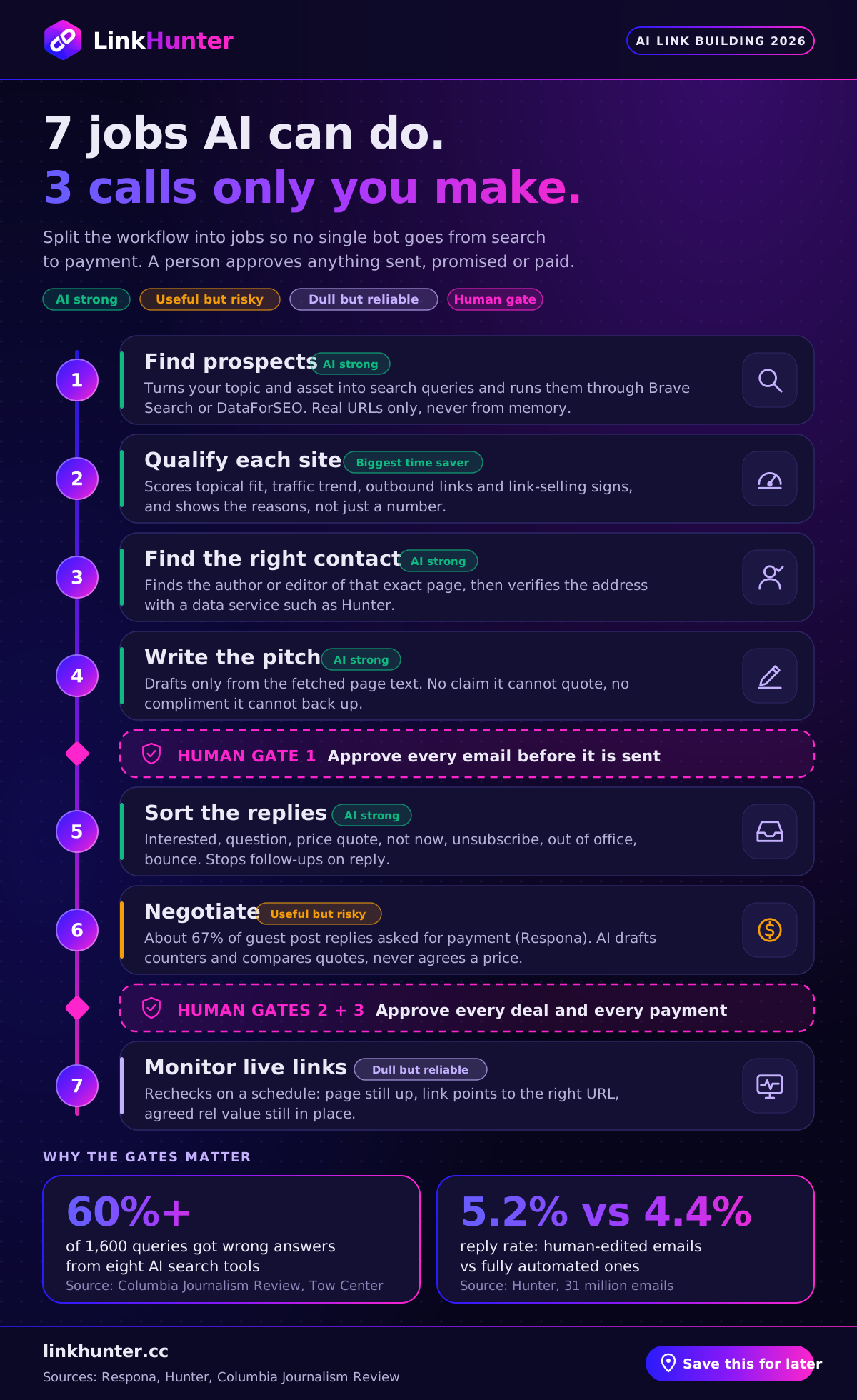
A link building campaign breaks into seven jobs: find, qualify, contact, write, reply, negotiate and monitor. AI is strong at the first five, useful but risky at the sixth, and dull but reliable at the seventh. Splitting the work this way is how a multi-agent system avoids the "one big bot" problem where a single model hallucinates its way from search to payment.
1. Find prospects
The agent turns a topic and an asset into search queries ("best budgeting tools" + "resources", "inurl:links" + your niche), runs them through a search API such as Brave Search or an SEO data provider such as DataForSEO, and returns real URLs. The word that matters is real: a model asked to "list 50 blogs that accept guest posts" from memory will invent some of them.
2. Qualify each site
This is where AI saves the most hours. Good qualification looks at topical fit, organic traffic trend, outbound link patterns, and signs of link selling. The key requirement: the score must show its reasons. "72/100" means nothing. "Relevant topic, traffic down 60% in a year, 14 outbound casino links on the homepage" means you can make a decision.
3. Find the right contact
The agent finds the author or editor responsible for that specific page, then verifies the email address before anyone sends to it. Verification is a data job for services such as Hunter, not a language model guess.
4. Write the pitch
Language models write competent emails. The trap is that they also write confident nonsense about the recipient's site. The fix is grounding: give the model the actual page text and forbid it from claiming anything it cannot quote. We show exactly how in the prompts section below.
5. Sort the replies
Classifying replies is close to a solved problem for current models: interested, asked a question, quoted a price, not now, unsubscribe, out of office, bounce. The agent should stop follow-ups the moment anyone replies and suppress anyone who opts out, permanently.
6. Negotiate
Plenty of replies are price lists. When Respona pitched 1,000 guest post sites, 137 of the 205 replies (about 67%) asked for payment (Respona guest post outreach study). AI can draft polite counters and compare quotes. It must never agree to a price on its own.
7. Monitor live links
After a link goes live, an agent rechecks it on a schedule: is the page up, does the link point to the right URL, does it carry the agreed rel value. Links quietly disappear, and you only notice if something checks.
How are link builders actually using AI in 2026?
Most use AI for writing and research, fewer trust it with tracking and monitoring, and the biggest worry is inaccurate output. That pattern comes through clearly in Omniscient Digital's survey of 105 link building professionals across 21 countries (Omniscient Digital: How AI Is Reshaping Link Building).
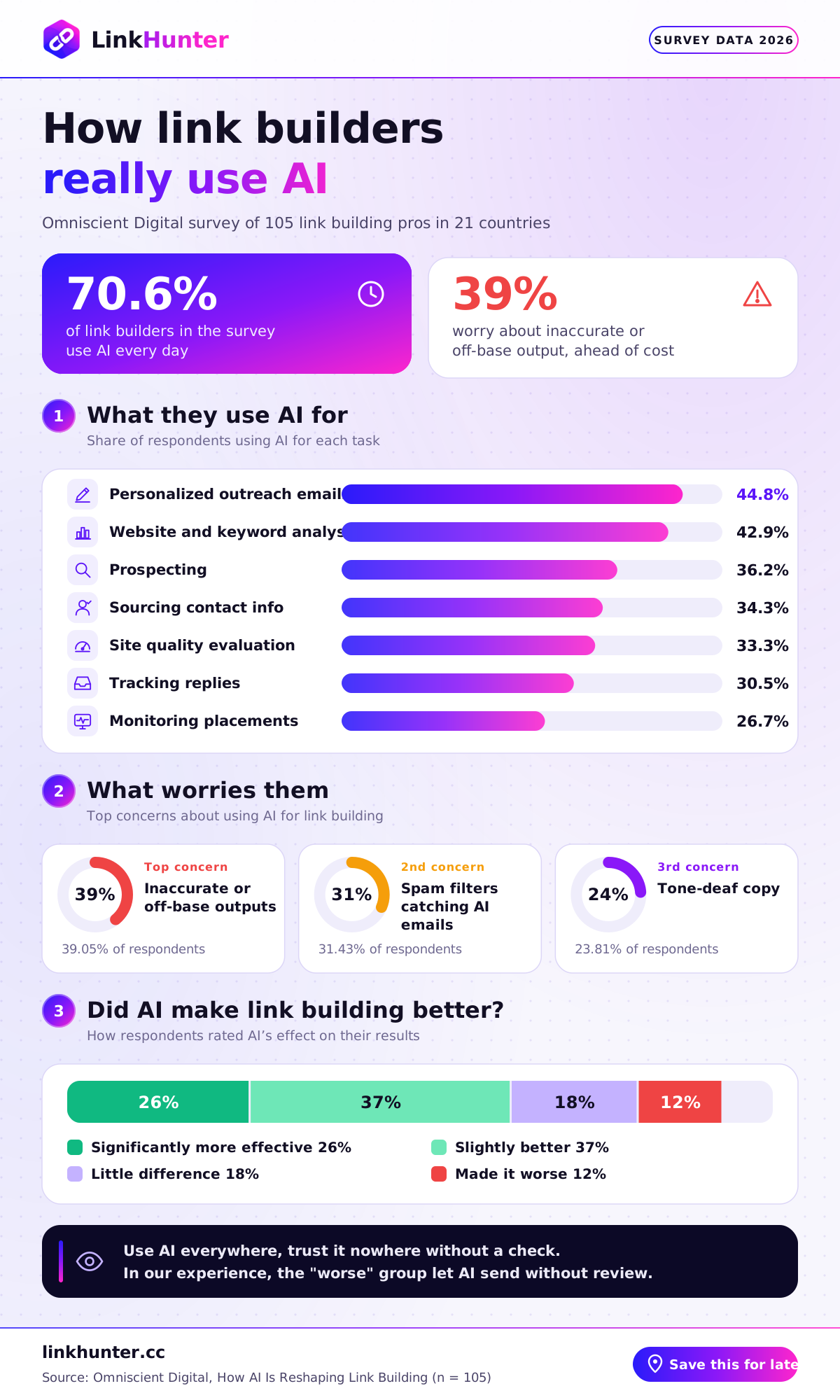
Two numbers stand out. Among link builders in that survey, 70.6% use AI daily. And 39% of all respondents named inaccurate or off-base outputs as a concern, ahead of cost. It is a small sample, but it matches what we see: people use AI everywhere and trust it nowhere without a check.
Where does AI still fail, and why should humans approve every commitment?
AI fails in four predictable places: invented personalization, fake flattery, over-sending and overcommitting money. Each one has a guardrail, and the common thread is that a human approves anything that leaves your company or costs money.
Failure 1: hallucinated personalization
Ask a model to "personalize this email for example.com" without giving it the page, and it will guess. You get lines like "Loved your recent piece on remote team culture" sent to a plumbing blog. This is not a rare glitch. When the Tow Center at Columbia Journalism Review tested eight AI search tools on 1,600 queries, they collectively gave incorrect answers to more than 60% of them, and more than half of the responses from Gemini and Grok 3 cited fabricated or broken URLs (Columbia Journalism Review, March 2025).
Guardrail: the writing step only sees text that was actually fetched from the prospect's page, and every specific claim in the email must map to that text.
Failure 2: fake flattery
Models default to warmth and open every email with "I've been a huge fan of your work for years." Editors have read that sentence ten thousand times. It is also a lie, and lying in the first line of a cold email is a bad trade. Hunter's 2026 report found that 69% of US decision makers say it bothers them when AI was used to write an email, unless it feels genuinely human (Hunter, The State of Cold Email).
Guardrail: ban compliments the sender cannot back up. Say what you noticed, not how you feel about it.
Failure 3: over-sending
The cheapest thing an AI tool can do is send more. Volume hides poor targeting and wrecks your domain. Gmail's sender guidelines ask senders to keep spam rates reported in Postmaster Tools below 0.1% and never reach 0.3%, and bulk senders over 5,000 messages a day must authenticate with SPF, DKIM and DMARC and support one-click unsubscribe (Google email sender guidelines). Rotating dozens of mailboxes to dodge limits spreads the damage rather than avoiding it.
Guardrail: daily caps per mailbox, an unsubscribe link in every email, no mailbox rotation to dodge limits, and a hard stop after two follow-ups.
Failure 4: overcommitting budget and promises
An agent negotiating on its own will happily say yes to a $400 post on a site that sells links to anyone, or promise a "do-follow link, no sponsored tag" because the publisher asked. Google's spam policies name "buying or selling links for ranking purposes" as link spam and ask that paid placements carry rel="sponsored" or nofollow (Google: qualify your outbound links).
Guardrail: a budget cap per link and per month, and a human approval step before any price, payment, link attribute or deadline is agreed.
How to use ChatGPT for link building: prompts that work
ChatGPT is useful for link building when you give it real data to work on, and unreliable when you ask it to recall websites from memory. Use it to analyze, sort and draft. Do not use it as a search engine for prospects unless its web search is on and you check every URL it returns.
These four prompts are the ones we use most. Paste your own data where the brackets are.
- Turn a topic into search queries.
"I have a free [mortgage calculator] aimed at [first-time buyers in the UK]. Write 15 Google search queries that would surface pages likely to link to it: resource pages, guides that mention similar tools, and roundups. Use operators such as intitle: and inurl: where they help. Do not list websites."
- Qualify a prospect from pasted text.
"Here is the text of a web page: [paste]. Answer in a table: main topic, intended reader, whether it already links to tools like ours, any sign the site sells links (for example 'sponsored post' pricing or many unrelated outbound links), and a fit score from 1 to 5 with one sentence of reasoning. Only use information in the text."
- Draft a grounded pitch.
"Write a cold email under 120 words to the author of this page: [paste]. Our resource: [URL + two-sentence description]. Rules: refer to one specific section of their page and quote no more than six words from it; no compliments; no claims about the author you cannot see in the text; one link; end with an easy way to say no."
- Classify a batch of replies.
"Classify each reply below as: interested, question, price quote, not now, unsubscribe, out of office, or bounce. For price quotes, extract the price and currency. Output CSV. Replies: [paste]."
Can ChatGPT find backlink opportunities by itself? With web search on, it can surface some, but it cannot see backlink data, traffic numbers or who already links to your competitors. For that you still need an SEO data source. For more email structures to feed into prompt 3, see our link building outreach email templates.
Is AI link building safe with Google?
Yes, as long as the links are earned editorially and paid placements are labelled. Google does not penalize you for using AI to write an outreach email. It penalizes link schemes, however they are produced.
Google's own guidance on AI content is direct: "Appropriate use of AI or automation is not against our guidelines," while using automation "with the primary purpose of manipulating ranking in search results is a violation of our spam policies" (Google Search Central blog). Google never sees your outreach email. It sees the link that results from it.
So the risk sits in three places:
- The links themselves. Paid links without
rel="sponsored"ornofollow, excessive link exchanges and automated link creation are all named in the spam policies. - The content you place. Mass-produced AI guest posts on low-quality sites fall under scaled content abuse on the publisher's side, and they make your link look like part of a pattern.
- Your email reputation. Not a Google Search risk, but the one that bites first: spam complaints damage your sending domain long before any algorithm notices your links.
How do you personalize AI outreach emails without sounding robotic?
Personalize with facts from the page, keep it short, and have a human edit before sending. The data backs this up. In Hunter's analysis of 31 million emails, bodies with no personalization averaged a 3.6% reply rate against 5.6% for those with two custom attributes, and manually edited emails reached 5.2% compared with 4.4% for fully automated ones (Hunter, The State of Cold Email). Backlinko's study of 12 million outreach emails found personalized bodies got 32.7% more replies (Backlinko outreach study).
What makes AI copy sound robotic is predictable, so you can strip it out:
- Openers about the sender. "I hope this email finds you well" and "My name is" waste the preview line. Start with their page.
- Adjective stacks. "Insightful, comprehensive and well-researched" is a model filling space. One plain observation beats three adjectives.
- Fake familiarity. "As a long-time reader" is the fastest way to be ignored when it is not true.
Here is the kind of pitch a grounded agent should produce, before human edits:
Subject: Your section on fixed vs variable rates
Hi Priya, your first-time buyer guide explains fixed vs variable rates but sends readers to a bank calculator that only covers 25-year terms. We built a free calculator that handles 10 to 40 years and shows the total interest side by side: [link]. If it is useful for that section, feel free to link it. If not, no worries, and I won't follow up more than once.
No compliments, one fact from the page, one link, an easy no. That is the bar. Our 7-step link building outreach playbook covers subject lines, follow-up timing and deliverability in detail.
Best AI link building tools compared
The right AI link building tool depends on which jobs you want covered and how much control you keep. Prices below were checked on vendor pages in October 2026. LinkHunter is our product, so weigh our description accordingly.
| Tool | Type | AI coverage | Human approval | Starting price |
|---|---|---|---|---|
| LinkHunter (linkhunter.cc) | Multi-agent platform | Seven agents: discovery, quality scoring, contacts, writing, replies, negotiation, monitoring | Required for every send, deal and payment | Free 14-day trial, no card; plans on pricing; you connect your own search, data and AI keys |
| Pitchbox | Outreach platform | AI personalization, AI reply agent, campaign and template assistants | Approval workflow on Scale plan | $210/mo billed annually or $300/mo monthly, one-year commitment (Pitchbox pricing) |
| BuzzStream | Outreach CRM | ListIQ for AI-driven list building | You send manually or in bulk | Starter $49/mo, monthly, no minimum term (BuzzStream pricing) |
| Respona | Managed placements | Handled by the vendor | You approve orders, not pitches | From $100 per placement, 28-day standard turnaround (Respona pricing) |
| Hunter | Email finder and sender | Contact data, verification, simple campaigns | Manual | Free plan; paid tiers on Hunter's site |
| ChatGPT or Claude + spreadsheet | DIY | Whatever you prompt; no backlink data | Entirely manual | Free tiers and paid plans |
Our honest read: for a few dozen pitches a month, a chat assistant plus a spreadsheet is enough. For campaigns across several clients where you want AI to handle the grind without losing control, a multi-agent tool with approval gates fits better. For a broader view by workflow stage, see our comparison of the best link building tools in 2026.
How do you evaluate an AI link building tool?
Judge the guardrails before the features. Every tool demos well. Ask these ten questions during the trial, and if a vendor cannot answer one clearly, count that as a no.

- Where do prospects come from? A live search or SEO data API, or the model's memory?
- Can you see why a site scored the way it did? Transparent scoring beats a single number.
- Is personalization grounded? Ask to see the page text the email was based on.
- Who approves sends? Per email, per batch, or nobody?
- Who approves money? Is there a hard budget cap the agent cannot exceed?
- How does it protect deliverability? Look for daily caps, unsubscribe links in every email and authentication checks. Mailbox rotation to get around limits is a warning sign.
- Does it stop on reply and honor opt-outs permanently?
- How are paid links handled? The answer should include
rel="sponsored"ornofollow. - Can you export everything? Prospects, emails, replies and link records.
- What does it really cost? Include seats, mailboxes, credits and any API usage you pay for separately.
What results can you realistically expect from AI link building?
Expect AI to cut hours, not to change the basic maths of outreach. Reply rates for link outreach are low and stay low. Backlinko and Pitchbox found that only 8.5% of 12 million outreach emails got any response (Backlinko). Hunter puts the average cold email reply rate at 4.5% across all uses and about 13% for digital PR (Hunter).
Here is a rough illustration using those published rates, not a promise:
| Stage | Count | Based on |
|---|---|---|
| Qualified prospects pitched | 200 | Your list |
| Replies | about 17 | 8.5% reply rate (Backlinko) |
| Replies asking for money (guest posts) | up to about 11 | about 67% in Respona's guest post test |
| Free editorial links | a handful | Depends heavily on asset and tactic |
What AI changes is the cost of each row: qualifying 200 prospects by hand takes days, and an agent does it in a fraction of that, leaving you the 17 conversations that matter. Smaller, better-targeted batches also help: Hunter saw 6.2% replies on sequences of 21 to 50 recipients against 2.4% for 500 or more.
Perception data from practitioners lines up. In the Omniscient survey, 26% said AI made link building significantly more effective, 37% slightly better, 18% saw little difference, and 12% said it made things worse. In our experience, the teams in that last group are usually the ones who let AI send without review.
Where LinkHunter fits
LinkHunter (linkhunter.cc) is an AI link building platform built around the seven jobs above, with a human approving every commitment. Prospect Hunter finds pages through Brave Search and DataForSEO. Quality Analyzer scores them and shows the breakdown. Contact Finder looks up and verifies the right person. Outreach Writer drafts from the actual page content. Reply Manager runs an AI inbox. Negotiator works inside budget limits you set and asks before agreeing anything. Backlink Monitor checks links after they go live.
The guardrails in this article are defaults, not settings you have to find: no fake flattery in drafts, an unsubscribe link in every email, no mailbox rotation, and paid links recorded as sponsored or nofollow. You connect your own search, data and AI provider keys, so you can see what each agent costs. The features page walks through each agent, and our about page explains why we chose approval over full autopilot.
Where it is not the best fit: very low volume (use a chat assistant), pure journalist PR (use a media database), or buyers who want to pay per placement and never touch outreach (use a managed service).
The bottom line on AI link building
AI link building works when you treat the model as a fast, tireless researcher and first-draft writer, and treat yourself as the editor and the budget holder. Ground every email in the real page. Cap volume. Label paid links. Approve every deal. Do that and AI saves you most of the grunt work without risking your domain. If you want to try the agent approach on a live campaign, you can start a free 14-day trial with no card required.
Frequently asked questions
What is an AI link building agent?
An AI link building agent is software that takes a goal, such as finding relevant resource pages for one of your assets, then decides which steps to run, calls tools like a search API or email verifier, and reports back. Good agents stop for human approval before sending emails or agreeing to deals.
Can AI build backlinks for you?
AI can do most of the work behind a backlink: finding and qualifying sites, locating the editor, drafting the pitch, sorting replies and checking the link later. It cannot make an editor link to you. Tools that create links without an editor deciding fall under Google's link spam policies.
Is AI link building safe?
Yes, if the links are editorial and any paid placement carries rel="sponsored" or nofollow. Google says appropriate use of AI is not against its guidelines. The real risks are automated link creation, unlabelled paid links, mass-produced guest posts and spam complaints that damage your sending domain.
Will Google penalize AI-written outreach emails?
No. Google never sees your outreach emails, only the links that result from them. What matters is whether those links are earned or bought without a label. Recipients are a different story: Hunter found 69% of US decision makers are bothered by AI-written emails that do not feel human.
Can ChatGPT find backlink opportunities?
Partly. With web search on, ChatGPT can surface pages and write search queries for you, but it has no backlink, traffic or competitor link data, and from memory it can invent URLs. Use it to analyze pages you paste in and draft emails, and use an SEO data source for prospecting.
What is the best AI tool for link building?
It depends on volume and control. A chat assistant plus a spreadsheet suits a few dozen pitches a month. Outreach platforms such as Pitchbox add AI to a classic workflow. Multi-agent tools such as LinkHunter cover all seven jobs with human approval gates. Check guardrails before features.
How much do AI link building tools cost?
Prices checked in October 2026 range from BuzzStream at $49 a month to Pitchbox at $210 a month billed annually with a one-year commitment. Respona sells managed placements from $100 each. Also budget for API usage, mailboxes and any sponsored placements. See our pricing for LinkHunter plans.
Sources
- Google Search Central: Spam policies for Google web searchdevelopers.google.com
- Google Search Central: Qualify your outbound linksdevelopers.google.com
- Google Search Central blog: Google Search's guidance about AI-generated contentdevelopers.google.com
- Google Workspace: Email sender guidelinessupport.google.com
- Hunter: The State of Cold Email 2026hunter.io
- Backlinko: We Analyzed 12 Million Outreach Emailsbacklinko.com
- Omniscient Digital: How AI Is Reshaping Link Building (survey)beomniscient.com
- Columbia Journalism Review, Tow Center: AI search engines are bad at citing newscjr.org
- Respona: Guest post outreach study (1,000 sites)respona.com
- Pitchbox pricingpitchbox.com
- BuzzStream plans and pricingbuzzstream.com
- Respona pricingrespona.com

About the author
Monjur Hossain
Founder, LinkHunter
Monjur founded LinkHunter (linkhunter.cc) and MotionTrust Digital, where he has led marketplace strategy since 2022. He has eight years in e-commerce and marketplace marketing and writes these guides from the work of building an AI link-building platform: what earns links, what gets ignored, and where a person still needs to make the call.