11 Link Building Outreach Email Templates (With Reply-Rate Benchmarks)
Eleven annotated link outreach templates with word counts, subject lines and sourced reply-rate benchmarks, plus follow-ups and a compliant reply to paid-link requests.
Contents19 sections
- 1What makes a link building email get a reply?
- 2What is a good reply rate for backlink outreach emails?
- 3Template 1: Broken link replacement
- 4Template 2: Resource page addition
- 5Template 3: Unlinked brand mention
- 6Template 4: Guest post pitch
- 7Template 5: Data or expert quote offer for journalists
- 8Template 6: Lost link reclamation
- 9Template 7: Integration and partner link request
- 10Follow-up templates: when and how to nudge
- 11How should you reply when a site asks for payment?
- 12Template 11: The thank-you after the link goes live
- 13Which subject lines work best for link outreach?
- 14Bad vs good: rewriting a spammy outreach email
- 15How do you personalize at scale without fake flattery?
- 16What compliance lines should every outreach email include?
- 17Your next step
- 18Frequently asked questions
- 19Sources
A good link building outreach email names one specific page, states one verifiable fact about it, offers something that page's readers will use, and makes one small ask in under 125 words. Use a 36 to 50 character subject line, follow up once or twice in the same thread, and include an opt-out line.
Most link building outreach email templates online were written to be copied, not answered. They open with a compliment the editor has read four hundred times, bury the ask in paragraph three and quote reply rates nobody can trace.
Below are 11 link building outreach email templates we actually use, annotated line by line: why each line exists, word count, matching subject lines and the published benchmark to measure it against. You also get a two-touch follow-up sequence, a compliant reply for when a site asks for money, and a bad-to-good rewrite. Updated for 2026 sending rules.
What makes a link building email get a reply?
A link building email gets a reply when it proves you looked at one specific page, offers something its readers will use, and makes one small ask. Length and subject line matter, but relevance decides most of it.
In the Backlinko and Pitchbox analysis of 12 million outreach emails, personalized email bodies earned 32.7% more replies than generic ones, and subject lines of 36 to 50 characters had the best response rate. Hunter’s State of Cold Email report, based on 31 million emails sent in 2025, found that sequences sent to 21 to 50 recipients replied at 6.2%, against 2.4% for lists of 500 or more. Small, targeted lists win.
Every template on this page follows the same five-part structure:
- Subject line that names their page or topic, not your product.
- Opener with one verifiable observation: a fact they can check, like a dead link or a quote from their article. A compliment is not an observation.
- Value for their readers in one or two sentences, with the URL.
- One ask. Swap a link, add a resource, reply with a yes. Never two.
- An easy exit plus your name, company, postal address and an opt-out line.
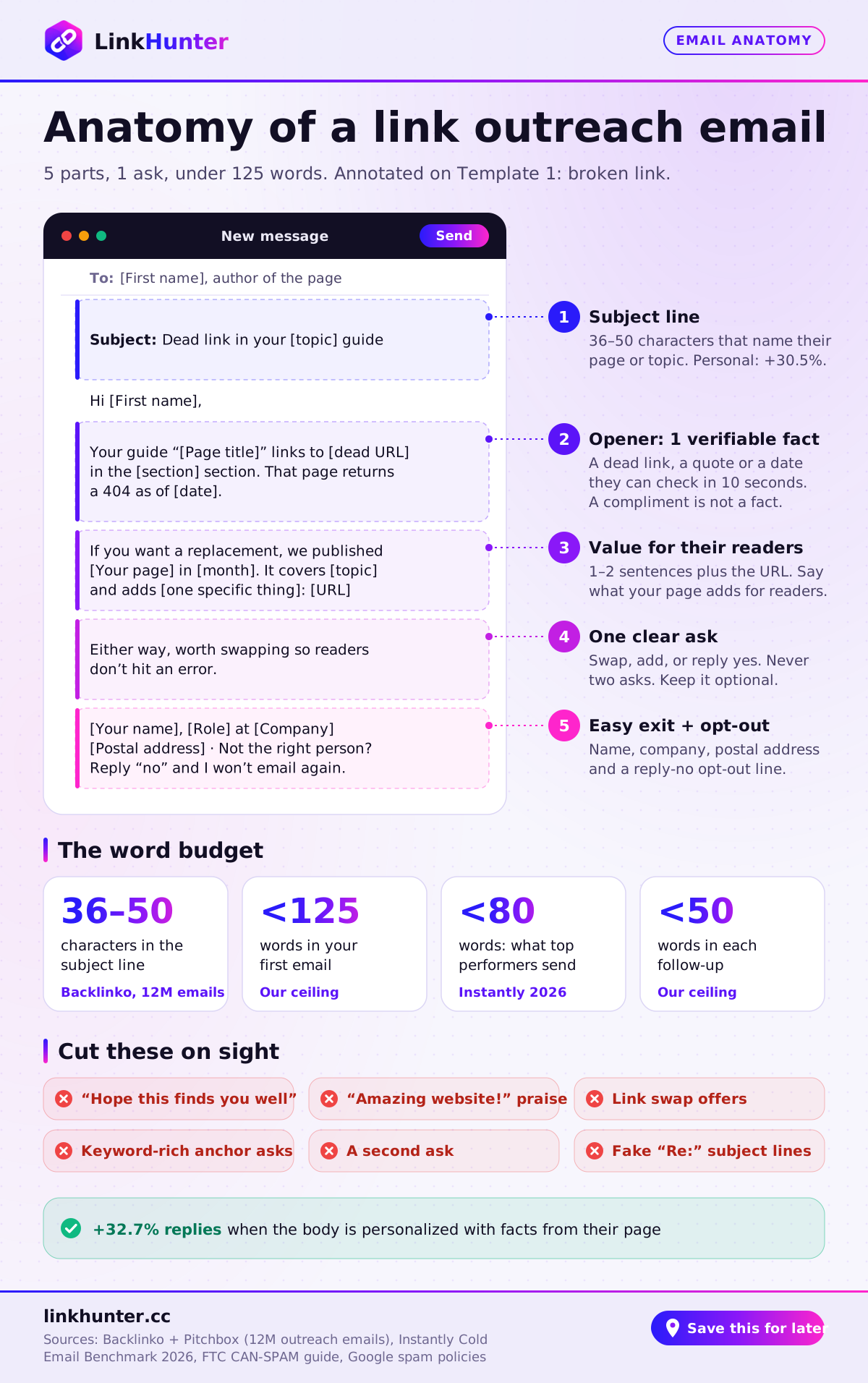
How long should it be? Instantly’s 2026 cold email benchmark reports that its top performers keep first-touch emails under 80 words. Our templates run 25 to 80 words. Past 125, something in yours is about you, not them.
What is a good reply rate for backlink outreach emails?
A good reply rate for backlink outreach sits roughly between 5% and 13% for targeted, personalized campaigns, based on the published datasets below. Mass blasts to big lists can fall under 1%. Each study counts replies differently.
| Dataset | What it measured | Reply rate |
|---|---|---|
| BuzzStream, 2025 | 31M PR outreach emails, 86k campaigns | 0.85% average; 1.15% for campaigns of 1 to 50 emails |
| Instantly, 2026 report | Platform cold email, Jan to Dec 2025 | 3.43% average; 10.7%+ for the top 10% |
| Hunter, 2026 report | 31M emails sent in 2025 | 4.5% average; 13% for digital PR and SEO link building |
| Backlinko x Pitchbox | 12M outreach emails | 8.5% average |
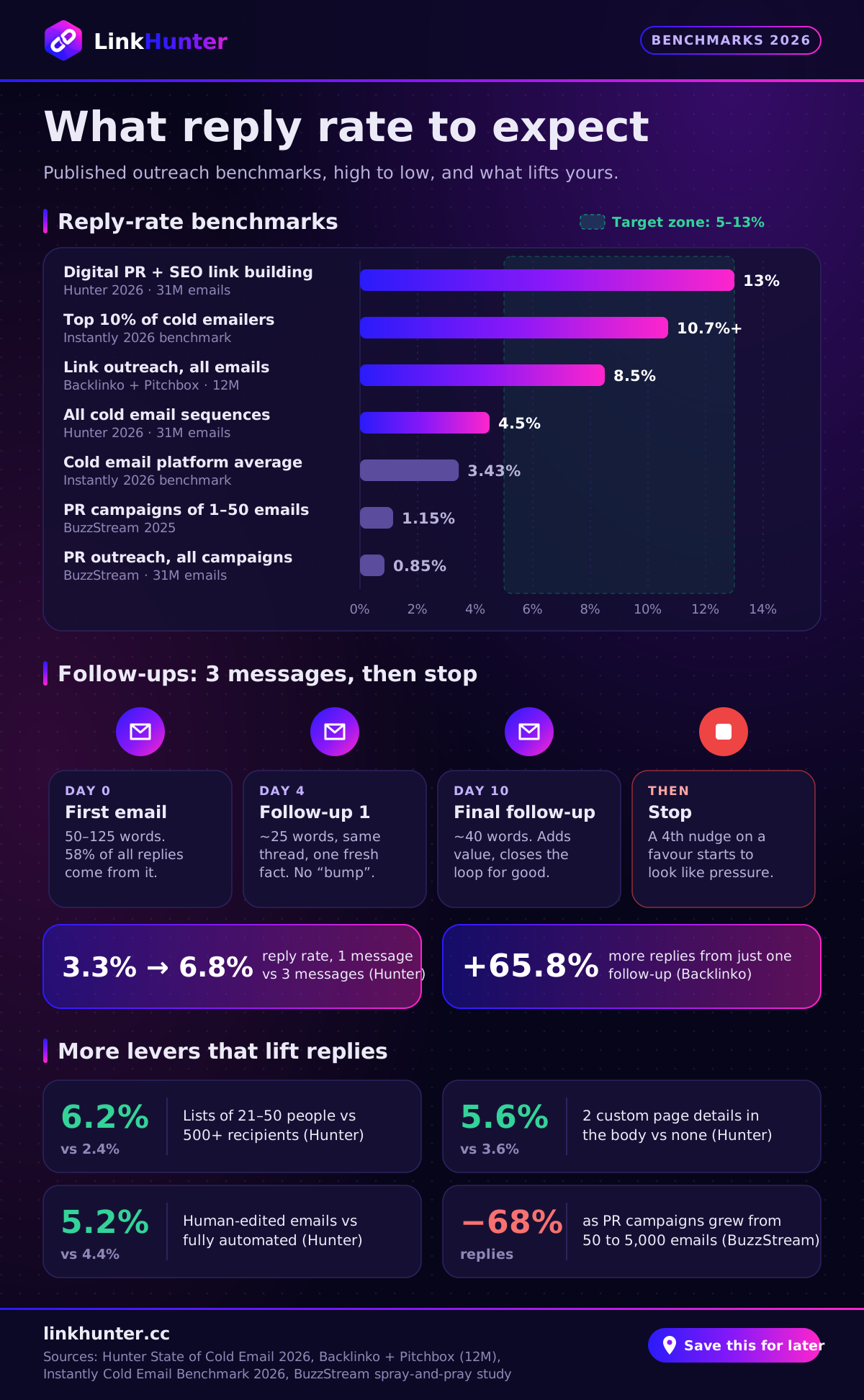
BuzzStream saw reply rates fall 68% as campaigns grew from 50 emails to 5,000, while Hunter’s link building figure is nearly triple its all-sector average. Link outreach isn’t dead. Lazy link outreach is.
Template 1: Broken link replacement
A broken link outreach email tells a site owner that a link on their page is dead and offers a working replacement. It works because you fix a real problem before you ask for anything.
Subject: Dead link in your [topic] guide
Hi [First name],
Your guide “[Page title]” links to [dead URL] in the [section name] section. That page returns a 404 as of [date].
If you want a replacement, we published [Your page title] in [month]. It covers [what the dead page covered] and adds [one specific thing]: [URL]
Either way, worth swapping so readers don’t hit an error.
[Your name], [Role] at [Company]
[Postal address] · Not the right person? Reply “no” and I won’t email again.
Why each line exists:
- Exact URL, section and date: lets the editor verify in ten seconds without trusting you.
- “If you want a replacement”: the fix comes first, the ask is optional.
- “Adds [one thing]”: answers the silent question, “why your page and not another?”
Length: about 80 words. Benchmark: plan against the 8.5% Backlinko average and aim for the 13% Hunter link building figure on well-matched pages.
Template 2: Resource page addition
A resource page outreach email asks a curator to add your tool or guide to a list page that already exists for that purpose. The page is built to link out, so the ask is natural if your resource genuinely fits.
Subject: A free [format] for your [topic] resources
Hi [First name],
Your “[Resource page title]” page lists [Resource A] and [Resource B] under [category], but nothing yet for [specific gap].
We built [Resource name], a free [format] that [does what] with no signup: [URL]. [One proof point, e.g. updated monthly from public data.]
If it fits that section, I’d be glad to see it there. If not, no problem at all.
[Signature and opt-out line]
- Naming two existing entries proves you read the list.
- “Nothing yet for [gap]” gives the curator a reason to edit the page today.
- “No signup” matters: many curators refuse to list gated tools.
Length: about 65 words. Benchmark: 8.5% (Backlinko). Expect less from rarely edited university lists.
Template 3: Unlinked brand mention
An unlinked mention email thanks a writer who named your brand without linking and asks them to add the link. It is the warmest pitch on this page because the writer already chose to talk about you.
Subject: Thanks for mentioning [Brand] in [article topic]
Hi [First name],
Thanks for including [Brand] in “[Article title]”. Your point about [specific point they made] is close to how our customers use it.
Small request: could the mention link to [exact URL]? It saves readers a search. If anything in the description is out of date, I’m happy to send current details.
[Signature and opt-out line]
- A real reference to their point replaces fake flattery with proof you read the piece.
- “Saves readers a search” frames the link as a reader benefit, which is true.
Length: about 60 words. Benchmark: measure against Hunter’s 13% link building average; this warm pitch should sit at the top of your results. If not, check you’re emailing the writer, not a generic inbox.
Template 4: Guest post pitch
A guest post outreach email template pitches specific article ideas to a site that accepts contributors. Editors say yes to topics, not to writers asking “can I write for you?”
Subject: Guest post idea: [specific working title]
Hi [First name],
I read your contributor guidelines and your last few posts on [category]. One gap: nothing yet on [angle].
Three ideas:
1. [Title one]
2. [Title two]
3. [Title three]I run [function] at [Company], so I’d write from [first-hand data or experience]. Recent work: [link], [link]. I’ll follow your link policy, including no link to our site if you prefer.
[Signature and opt-out line]
- Three titles give the editor a choice instead of a yes-or-no decision.
- First-hand experience is the only thing an editor can’t get from a freelancer or a language model.
- “I’ll follow your link policy” matters more in 2026 than ever. Google’s spam policies list “links with optimized anchor text in articles, guest posts, or press releases” as link spam. Never request a keyword-rich anchor.
Length: about 70 words. Benchmark: Backlinko found guest posting pitches had above-average response rates within its 8.5% dataset. To scale it, start with how to find link building prospects; prospect quality moves this number more than copy.
Template 5: Data or expert quote offer for journalists
This template offers a journalist original data or an expert source for a story they are likely to write. The value has to stand alone.
Subject: New data on [beat topic]: [one-line finding]
Hi [First name],
You covered [topic] in “[Article]” on [date]. We just finished [study: what, sample size, period]. The headline finding: [specific number].
Methodology and charts: [URL]. [Expert name, title] is available for a quote or a 10-minute call this week.
If this isn’t your beat any more, tell me and I’ll update my notes.
[Signature and opt-out line]
- The finding goes in the subject line. Journalists triage by subject alone.
- Methodology link: reporters can’t cite what they can’t check.
- No link request at all. Linking to the source is their editorial call.
Length: about 60 words. Benchmark: Hunter’s 13% digital PR average is the target; BuzzStream’s 0.85% is what happens when you blast 5,000 journalists with the same note.
Template 6: Lost link reclamation
A lost link reclamation email asks a site to restore a link that disappeared, usually after a redesign or a URL change. Usually it was an accident.
Subject: Our [resource] link on your [page name] page
Hi [First name],
Your “[Page title]” used to link to our [resource] in the [section] section. Since the update around [month], it [points to a 404 / was removed].
If the removal was intentional, no problem. If it got lost in the redesign, the current URL is [URL]. (We moved it, so that part is on us.)
[Signature and opt-out line]
- “If the removal was intentional, no problem” respects their editorial decision and keeps the relationship clean.
Length: about 60 words. Benchmark: aim above 13%, since the site linked to you once already. If you moved the page, add a 301 redirect too.
Template 7: Integration and partner link request
This template asks a real technology or business partner to list you on their integrations or partners page. It works only when the partnership exists. A swap invented for links is what Google calls an excessive link exchange.
Subject: [Your product] + [Their product] listing
Hi [First name],
Our [integration name] with [Their product] went live on [date]. [Optional, only if true: N customers use it.]
Your directory at [URL] lists partners with a short blurb. Here’s ours, ready to paste: [40-word description] [Docs URL] [Logo files link]
We already link to your docs from our setup guide: [URL]. Anything else you need from us?
[Signature and opt-out line]
- Ready-to-paste copy turns a task into a two-minute job for a partner manager.
- “We already link to your docs” is a fact about a real integration, not a trade offer. Do not write “we’ll link to you if you link to us.”
Length: about 65 words, plus the blurb. Benchmark: this is warm outreach, so a low reply rate usually means the wrong contact, not the wrong words. Our SaaS link building playbook covers integration pages in depth.
Follow-up templates: when and how to nudge
Send one or two follow-ups, three to seven days apart, in the same thread, each shorter than the first email. A third or fourth nudge on a link request starts to look like pressure.
The numbers: Backlinko found one follow-up lifted replies by 65.8%. Hunter found that three total messages instead of one raised replies from 3.3% to 6.8%. Instantly’s data shows the first email still produces 58% of replies, and that step-two messages written like a quick reply beat formal ones by about 30%. Instantly suggests 4 to 7 touches for sales; for link requests we stop at three messages, because the ask is a favour.
Template 8: First follow-up (day 4)
Hi [First name], quick follow-up on my note below about [the dead link on your X guide]. It still returns a 404 today. Worth a swap?
About 25 words. It restates the value, adds a fresh fact and repeats the single ask. No “just bumping this”.
Template 9: Final follow-up (day 10)
Hi [First name], last note from me on this. While checking, I found two more dead links on the same page: [URL], [URL]. Sharing in case they help, whatever you decide about ours. No reply needed, and I won’t follow up again.
About 40 words. It adds value with no strings, then closes the loop for good.
How should you reply when a site asks for payment?
Reply politely, decline payment for an editorial link, and, only if your company buys advertising, offer a clearly labelled sponsored placement with rel="sponsored" on the link. Never pay for a followed link disguised as editorial.
Most template guides skip this reply, yet rate cards are a common answer to outreach. Google’s link spam policy names “buying or selling links for ranking purposes” as a violation, and its guidance on qualifying outbound links says to mark paid placements with rel="sponsored" (with nofollow still acceptable).
Template 10: The compliant “they asked for payment” reply
Thanks for getting back to me, [First name].
We don’t pay for editorial links, so I’ll pass on that. If you’d still like the replacement for your readers, the link is in my note below.
[Optional, only if you buy ads:] If you offer sponsored placements, we could consider one where the post is labelled as sponsored and our link carries rel=“sponsored”. If that works on your side, could you send your rate card?
About 75 words with the optional paragraph. It keeps the editorial door open and any paid deal inside Google’s rules. For what sponsored placements typically cost, see our link building cost breakdown.
Template 11: The thank-you after the link goes live
Send a short thank-you within a day of the link going live. About 45 words, and the cheapest relationship you will ever build.
Thanks, [First name], I see the link live on [page]. Appreciated. If you ever need [data on X / a quote about Y] for a future piece, I’m a reply away. I’ll share the article with our [newsletter / LinkedIn audience] this week.
Only promise the share if you will actually do it. Log the contact so your next pitch to this editor starts warm.
Which subject lines work best for link outreach?
The best link building email subject lines are 36 to 50 characters, name the recipient’s page or topic, and describe the email honestly. Backlinko found that personalized subject lines lifted response rates by 30.5%. And keep it honest: the FTC’s CAN-SPAM guide says subject lines must not mislead about the content of the message.
| Template | Subject line | Why it works |
|---|---|---|
| Broken link | Dead link in your [topic] guide | States the problem, names their page |
| Resource page | A free [format] for your [topic] resources | “Free” plus their list topic |
| Unlinked mention | Thanks for mentioning [Brand] in [topic] | Warm, specific, clearly not a pitch blast |
| Guest post | Guest post idea: [working title] | The idea is the pitch |
| Journalist data | New data on [beat]: [finding] | The news value is visible before opening |
| Lost link | Our [resource] link on your [page] page | Specific and easy to verify |
| Partner | [Your product] + [Their product] listing | Reads like partner admin, because it is |
Avoid “Quick question”, “Collaboration opportunity” and anything with “Re:” on a first email. They read like spam, and Google’s email sender guidelines ask senders to keep reported spam rates below 0.10% and never reach 0.30%.
Bad vs good: rewriting a spammy outreach email
A spammy outreach email is generic, long, flattering and vague about what it wants. Rewriting one is mostly deletion. Here is a composite of pitches we receive weekly.
Before (94 words):
Subject: Collaboration Opportunity!!
Hi there, I hope this email finds you well! I recently came across your amazing website and I must say I was really impressed by the high-quality content you publish. We have a great article that we think your audience will love. We would be happy to write a unique, plagiarism-free guest post for you with one do-follow backlink to our client’s website using the anchor text “best cheap CRM software”. In return, we can also give you a link from one of our partner sites. Looking forward to a long-term partnership! Best regards.
After (69 words):
Subject: Guest post idea: CRM migration checklist
Hi Dana, your CRM section has strong buying guides but nothing on migrating data between tools, which is where most of our clients get stuck. Idea: “The 14-step CRM migration checklist (with field-mapping template)”. Our head of ops has run 60+ migrations and would write it. Samples: [link], [link]. Happy to follow your link policy. Interested?
Sam, [Agency] · [Postal address] · Reply “no” and I won’t email again.
What changed:
- Cut the flattery. “Amazing website” was replaced by a specific gap in her CRM section.
- Named a real title instead of “a great article”.
- Removed the exact-match anchor and the link swap. Both match examples in Google’s link spam policy.
- Added credibility the editor can check: a named role and samples.
- Ended with one yes-or-no question and an opt-out.
How do you personalize at scale without fake flattery?
Personalize with facts from the page, not compliments about the person. One verifiable observation, one gap and one matched asset per prospect is enough.
Real personalization pays. Hunter found emails with two custom attributes in the body replied at 5.6%, against 3.6% with none, and that manually edited emails beat fully automated ones (5.2% versus 4.4%). That is the honest case for a human in the loop.
Our workflow for 100 prospects a week:
- Qualify first. A perfect email to the wrong site still gets ignored.
- Pull one page-level fact per prospect: the dead link, the missing list entry, the unlinked mention, the article date.
- Match one asset to that fact. If you don’t have a good match, skip the prospect.
- Draft from the template, filling only verified fields. An empty field means no send.
- Review every draft before it goes out. Thirty seconds each.

Can an AI outreach email generator write backlink pitches?
Yes, if it drafts from real page data and a human approves each email. AI fills templates well from verified facts. Asked to sound personal with nothing to go on, it produces the “I loved your insightful article” spam.
This is how we built LinkHunter. The Prospect Hunter and Quality Analyzer agents find and score sites, the Contact Finder locates the right person, and the Outreach Writer drafts each email from page-level facts like those above. Nothing sends until you approve it. Every email includes an unsubscribe link, and we don’t rotate mailboxes to dodge spam filters. The AI link building guide explains the full agent workflow.
Where it isn’t the right fit: if you pitch ten dream publications a quarter, write those by hand. Software earns its keep at higher volumes. If you are comparing outreach tools, our Pitchbox alternatives roundup covers price, AI features and deliverability side by side.
What compliance lines should every outreach email include?
Every link outreach email should carry your real name and company, a postal address, an honest subject line and a clear way to opt out, and you should honour opt-outs fast.
Under the FTC’s CAN-SPAM guidance, commercial messages need accurate header information, a valid physical postal address and a working opt-out; opt-outs must be honoured within 10 business days, and each violating email can cost up to $53,088. We treat link requests as commercial to be safe. Google also requires SPF, DKIM and DMARC from anyone sending 5,000+ messages a day to Gmail. Rules differ in the UK, EU and Canada, so check local law.
The line we use: “Not the right person, or not interested? Reply ‘no’ and I won’t email again.” For sequences, add a one-click unsubscribe link as well. For the full process, see our 7-step link building outreach playbook.
Your next step
Pick the template that matches the prospects you already have. Send it to 30 to 50 qualified sites, not 3,000. Follow up twice, measure against the benchmarks above, and revise one line at a time.
If you want AI agents to handle drafting, follow-ups and reply sorting while you approve every send and deal, try LinkHunter free for 14 days, no card needed. If you prefer manual, these 11 templates still work. Either way: one fact, one offer, one ask.
Frequently asked questions
How do you write an email asking for a backlink?
Open with one fact about their specific page, such as a dead link or an unlinked mention of your brand. Offer a resource that helps their readers, include the URL, and make a single, optional ask. Keep it under 125 words, sign with your real name and company, and add an opt-out line.
What is the best subject line for an outreach email?
The best outreach subject lines are 36 to 50 characters, name the recipient's page or topic, and describe the email honestly, for example "Dead link in your CRM guide". Backlinko's 12-million-email study found that range and personalized subject lines performed best. Avoid fake "Re:" prefixes and vague lines like "Quick question".
How long should a link building outreach email be?
Aim for 50 to 125 words for a first email and under 50 for follow-ups. Instantly's 2026 benchmark reports that its top-performing first emails average under 80 words. If your draft runs longer, cut the introduction about yourself first; editors care about their page, not your agency.
How do you follow up on a link request?
Reply in the same thread three to seven days later with a shorter note that restates the specific value and repeats the one ask. Send a final follow-up about a week after that, ideally adding something useful, then stop. Hunter found three total messages lifted replies from 3.3% to 6.8%.
Should you offer payment in an outreach email?
No. Offering money for an editorial link breaks Google's link spam policy. If a site asks for payment and your company buys advertising, you can agree to a clearly labelled sponsored placement where the link carries rel="sponsored" or nofollow. Otherwise decline politely and keep the editorial offer open.
What is a good reply rate for backlink outreach emails?
For targeted, personalized link outreach, a reply rate between roughly 5% and 13% is a reasonable goal. Hunter reports a 13% average for digital PR and link building sequences, while BuzzStream measured 0.85% across 31 million mostly large-scale PR emails. Smaller, well-qualified lists consistently reply better than mass blasts.
Can AI write link building outreach emails?
Yes, when it drafts from verified facts about each page and a person reviews every email before it sends. Hunter found manually edited emails replied at 5.2% versus 4.4% for fully automated ones. Tools like LinkHunter draft from page data and wait for human approval, which avoids generic AI flattery.
Sources
- Backlinko: We Analyzed 12 Million Outreach Emailsbacklinko.com
- Hunter: The State of Cold Email (2026 report, 2025 data)hunter.io
- Instantly: Cold Email Benchmark Report 2026instantly.ai
- BuzzStream: How Effective is Spray and Pray in PR?buzzstream.com
- Google Search Central: Spam policies for Google web searchdevelopers.google.com
- Google Search Central: Qualify your outbound linksdevelopers.google.com
- Google Workspace: Email sender guidelinessupport.google.com
- FTC: CAN-SPAM Act compliance guide for businessftc.gov

About the author
Monjur Hossain
Founder, LinkHunter
Monjur founded LinkHunter (linkhunter.cc) and MotionTrust Digital, where he has led marketplace strategy since 2022. He has eight years in e-commerce and marketplace marketing and writes these guides from the work of building an AI link-building platform: what earns links, what gets ignored, and where a person still needs to make the call.