Link Building Outreach: A 7-Step Playbook That Earns Replies (Without Spam)
A practical 7-step link building outreach playbook with sourced reply-rate benchmarks, deliverability setup, follow-up rules and how to handle paid-link requests.
Contents15 sections
- 1What is link building outreach?
- 2What reply rate should you expect from link building outreach?
- 3Step 1: Match the outreach tactic to your linkable asset
- 4Step 2: Build and qualify a prospect list
- 5Step 3: Find the right person to contact
- 6Step 4: Write a pitch that is short, specific and honest
- 7Step 5: Set up email deliverability before you send
- 8Step 6: How many follow-ups should you send?
- 9Step 7: Handle replies, paid-link requests and negotiation
- 10How do you track and verify links after they go live?
- 11What should you never do in link outreach?
- 12How do AI agents change outreach, and where must humans stay in the loop?
- 13Your first 30 days of link building outreach
- 14Frequently asked questions
- 15Sources
Link building outreach is emailing site owners to earn a link to a specific page that helps their readers. It works best when you match the tactic to the asset, email the right person on an authenticated domain, keep the pitch under 150 words, send at most two follow-ups, and verify every link after it goes live.
Key takeaways
- Across 12 million outreach emails, only 8.5% got any reply, so tactic choice matters more than clever wording.
- Warm angles such as unlinked brand mentions get answered far more often than cold guest post pitches.
- Authenticate your sending domain with SPF, DKIM and DMARC and include an unsubscribe option before you send a single pitch.
- Three total messages roughly doubled reply rates in Hunter data; more than that mostly burns goodwill.
- About two in three guest post replies in a 1,000-site study asked for payment; paid links must carry rel="sponsored" or nofollow.
- AI agents speed up research, drafting and reply sorting, but a human should approve every pitch, deal and payment.
Link building outreach is the part of SEO everyone does and few people run well. Most guides stop at "find prospects, write a nice email, follow up." That covers maybe half of what decides your results. The other half is operational: whether your email lands in the inbox, who reads the replies, what you do when two out of three sites quote you a price, and whether the link is still there in three months.
This playbook covers both halves. It is the process we use and teach, updated for 2026, with sourced reply-rate benchmarks, the deliverability setup Gmail now requires, a clear policy for paid-link requests, and an honest map of where AI agents help and where a human has to stay in charge.
What is link building outreach?
Link building outreach is the practice of contacting website owners, editors and writers to earn a link to a specific page on your site, by showing why that page is useful to their readers. It is the human side of link building: research, a relevant pitch, a conversation, and a decision by the other person.
Backlink outreach covers several tactics, and they behave very differently:
- Unlinked brand mentions: a site already mentions you but does not link. You ask them to add the link.
- Broken or outdated link replacement: a page links to something dead or stale, and you offer a working, current alternative.
- Resource and listicle inclusion: you ask to be considered for a "best tools" or resource list where you genuinely fit.
- Guest posts: you write an article for another site, usually with a contextual link back.
- Data and expert pitches: you offer original research, a quote or a chart that a writer can cite.
The common thread is that someone else decides to link. That is why it still counts as an editorial signal, and why spammy shortcuts tend to fail.
What reply rate should you expect from link building outreach?
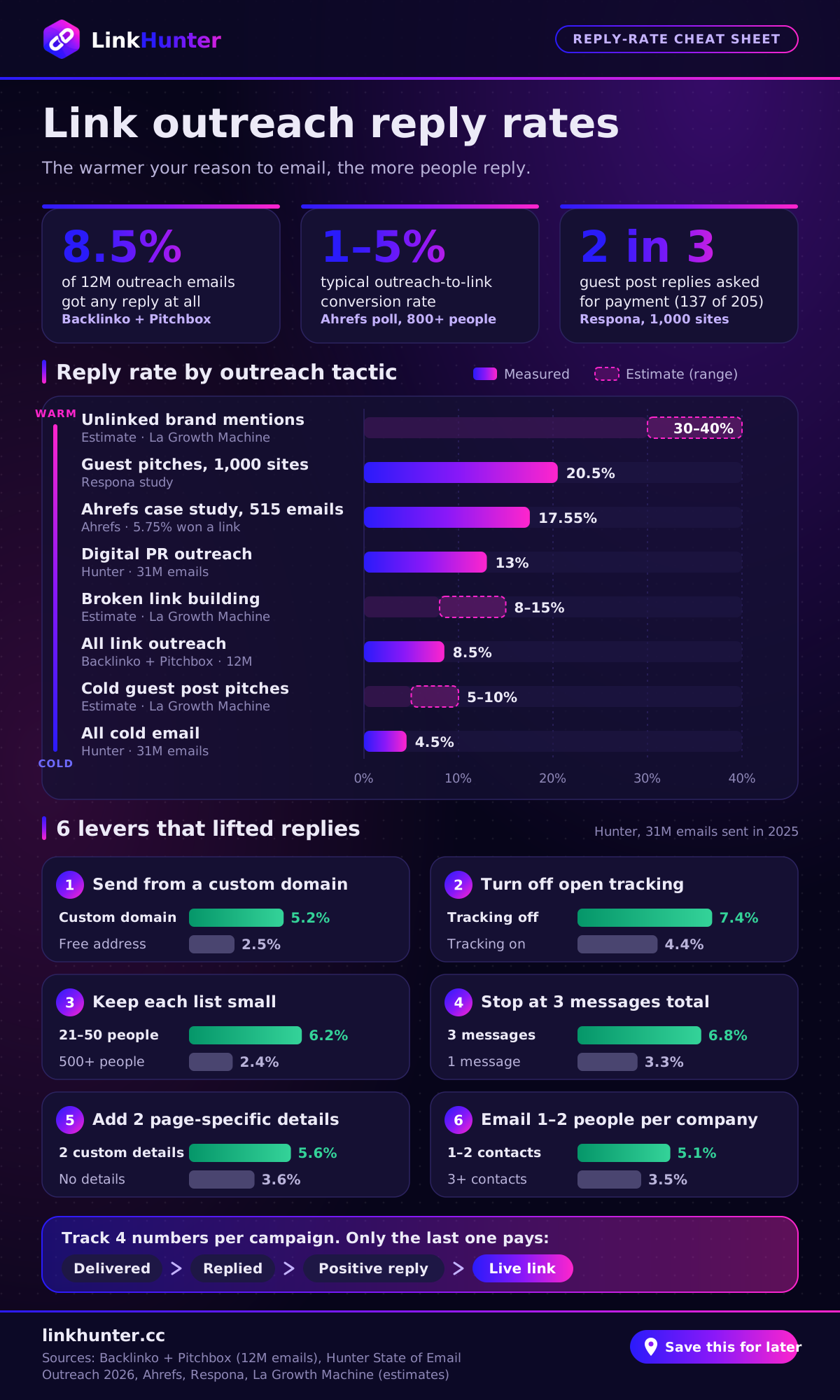
Expect roughly 5-10% replies on cold link outreach and far more on warm angles. The largest public dataset, Backlinko's analysis of 12 million outreach emails with Pitchbox, found that only 8.5% received any response. Replies are not links, either: an Ahrefs poll of 800+ people put typical outreach conversion at 1-5%.
Here is how the numbers line up by tactic. We separate measured data from practitioner estimates, because many "benchmarks" floating around the web are the second kind presented as the first.
| Tactic or dataset | Reply rate | Type | Source |
|---|---|---|---|
| Unlinked brand mentions | 30-40% | Practitioner estimate | La Growth Machine |
| Guest post pitches to 1,000 "write for us" sites | 20.5% | Measured | Respona study |
| Ahrefs link building case study (515 emails) | 17.55% (5.75% won a link) | Measured | Ahrefs |
| Digital PR outreach | 13% | Measured average | Hunter, 31M emails |
| Broken link building | 8-15% | Practitioner estimate | La Growth Machine |
| All link outreach | 8.5% | Measured average | Backlinko + Pitchbox, 12M emails |
| Cold guest post pitches | 5-10% | Practitioner estimate | La Growth Machine |
| All cold email | 4.5% | Measured average | Hunter, 31M emails |
The estimates come from La Growth Machine's backlink outreach guide, which does not publish its underlying data, so treat them as directional. The measured figures come from Hunter's State of Email Outreach report, the Backlinko study and the Respona campaign. The pattern is consistent anyway: the warmer the reason for contact, the higher the reply rate.
Step 1: Match the outreach tactic to your linkable asset
Pick the tactic based on what you can actually offer, not on what is popular. A pitch only works when the page you are promoting fits the reason you are writing.
Start with an honest audit of your linkable assets. Most sites have three kinds:
- Brand and product pages (homepage, feature pages, pricing). Best tactics: unlinked mentions, listicle and "best tools" inclusion, partner and integration pages.
- Reference content (guides, glossaries, templates, calculators). Best tactics: broken and outdated link replacement, resource page inclusion.
- Original data (surveys, benchmarks, product usage stats). Best tactics: digital PR and journalist pitches, which Hunter measured at a 13% average reply rate.
Guest posts sit outside this list because the asset is your expertise, not a page. They are slower and, as we will see in step 7, increasingly tangled up with payment requests.
A quick test before any campaign: could you explain in one sentence why this specific page would make their article better? If not, change the asset or change the target list. No template fixes a weak fit.
Step 2: Build and qualify a prospect list
A good prospect list is short, relevant and scored before anyone gets an email. Hunter's data shows why size works against you: sequences of 21-50 recipients averaged a 6.2% reply rate, while lists of 500+ dropped to 2.4%.
Build the list from sources that match your tactic: competitor backlinks for listicle and resource targets, content searches for guest post targets, brand-mention searches for unlinked mentions, and dead-link checks on high-traffic resource pages. Our guide on how to find link building prospects covers nine methods in detail.
Then qualify every site. We use a simple pass or fail on five questions:
- Is the site topically relevant to the page we are promoting?
- Does it get real organic traffic, not just a high authority score?
- Does it publish edited content written for people, or does it look like a link farm with endless off-topic "sponsored" posts?
- Do outbound links on the target page look editorial, or does every post link to casinos and loan sites?
- Is there a real person whose job includes editing this content?
A site that fails any of these is not worth an email, however tempting its metrics. One editorial link from a relevant site is worth more than ten from pages that exist only to sell links, and it carries none of the risk.
Step 3: Find the right person to contact
Email the person who can change the page, using a verified address, and avoid generic inboxes where possible. For a blog post that is usually the author or the content editor. For a resource page it is often the site owner or a marketing manager.
Who you contact moves the numbers. Backlinko found that reaching out to several contacts at the same organisation produced a 93% higher response rate than a single contact, with returns falling off at five or more. Hunter's 2026 data adds a caution: contacting 1-2 people per company averaged 5.1%, while 3 or more dropped to 3.5%. Our read is to pick the best contact, plus one sensible backup, and never blast an entire team.
Practical order of preference:
- The named author of the exact page you want a link on.
- The editor or content lead for that section of the site.
- The site owner or head of marketing on smaller sites.
- A generic contact form or info@ address, only as a last resort.
Verify every address before sending. Bounces hurt your domain reputation, and Hunter's report puts the average bounce rate across its users' campaigns at 3.6%. A verification step keeps yours below that.
Step 4: Write a pitch that is short, specific and honest
A good outreach email is under 150 words, names their exact page, explains the value to their readers in one sentence, and asks for one clear thing. That is the whole formula. Everything else is decoration.

Ahrefs frames the pitch around three questions: why should they open it, why should they read it, and why should they link. Here is a structure that answers all three:
- Subject line: five or six words that name their topic or page. Hunter found this length performed best on reply rate.
- Line one: who you are and the specific page you are writing about.
- Line two: the problem or gap you noticed, stated plainly.
- Line three: your page and why it helps their readers.
- Line four: one clear ask, plus an easy way out ("If it is not a fit, no worries").
Personalisation helps, but only when it is real. Backlinko measured a 32.7% lift from personalised email bodies and 30.5% from personalised subject lines. Hunter found that emails with two custom details in the body reached 5.6%, against 3.6% with none. Notice those are facts about the page, not compliments about the person.
Which brings us to honesty. Hunter's 2026 survey found that 69% of US decision-makers are bothered when AI writes an email to them, and 65% blame overly sales-focused emails for cold email failing. Fake flattery ("I loved your amazing article!") is the fastest tell. So we follow three rules:
- No compliments you did not mean or could not back up with a specific detail.
- No pretending to be a reader, a customer or a fan when you are a marketer.
- No hiding commercial intent. If you are offering money or a product, say so.
Want ready-made versions for each tactic? Our link building outreach email templates include 11 tested examples with benchmarks.
Step 5: Set up email deliverability before you send
Before your first pitch, authenticate your sending domain with SPF, DKIM and DMARC, use a real custom domain, and add a clear unsubscribe option. Cold email deliverability for link building is the step competitors skip, and it quietly decides whether anyone sees your carefully written email.
Google's email sender guidelines set the baseline. Senders of 5,000+ messages a day to Gmail must have SPF and DKIM, publish a DMARC record, keep spam rates in Postmaster Tools below 0.30% (ideally under 0.10%), align the From domain with SPF or DKIM, and support one-click unsubscribe on marketing messages. Smaller senders face the same filters.
Our setup checklist:
- Use a custom domain, not freemail. Hunter measured a 5.2% reply rate from custom domains against 2.5% from free addresses.
- Publish SPF, DKIM and DMARC for the sending domain. Start DMARC at p=none to monitor, then tighten.
- Warm up gradually. Start a new mailbox at 10-20 emails a day and increase slowly over several weeks.
- Cap daily volume. Hunter found mailboxes sending 20-49 emails a day averaged 5.7% replies, above the 4.5% norm.
- Consider turning off open tracking. Campaigns without open tracking replied at 7.4%, versus 4.4% with it, in Hunter's data. The tracking pixel can hurt placement.
- Add an unsubscribe line and a postal address, and honour opt-outs promptly.
On legality: the FTC's CAN-SPAM guide requires accurate headers, a non-misleading subject, a valid postal address and an opt-out honoured within 10 business days, with penalties up to $53,088 per violating email. In the UK, the ICO's PECR guidance allows email to corporate subscribers but treats sole traders and some partnerships as individuals who need consent. Plenty of bloggers are sole traders, so keep a suppression list and respect it. This is general information, not legal advice.
Step 6: How many follow-ups should you send?
Send one or two follow-ups, three to seven days apart, and stop the moment someone replies or opts out. Follow-ups are where a lot of replies come from, but there is a ceiling.
The data agrees on the first follow-up. Backlinko found one extra message raised replies by 65.8%. Hunter found three-message sequences hit 6.8% against 3.3% for a single email. Ahrefs takes the conservative line: follow up once and leave it there.
Our default sequence:
- Day 0: initial pitch.
- Day 4: short follow-up in the same thread that adds something new, such as a screenshot of the broken link or a stat from your page.
- Day 10-11: a final, polite close ("I will not bother you again on this one").
Never send a follow-up that just says "bumping this." It costs them attention and gives them nothing. And never follow up after an unsubscribe, a clear "no," or an out-of-office that names a different contact. Route that last one to the new person instead.
Step 7: Handle replies, paid-link requests and negotiation
Sort every reply within a day, answer interested people fast, and decide your paid-link policy before the campaign starts. Reply handling is where campaigns quietly leak links, because the positive replies get buried among out-of-offices, refusals and price lists.
Triage replies into five buckets:
- Yes, or interested: reply the same day with exactly what they need (URL, suggested anchor, placement idea).
- Asks for payment: apply your policy, below.
- Wrong person: thank them and contact the name they gave you.
- No, or unsubscribe: add to the suppression list immediately.
- Out of office: pause and resume after their return date.
What to do when a site asks for payment
Expect this a lot. Respona pitched 1,000 "write for us" sites and got 205 replies. Of those, 137 asked for payment and only 55 offered a free guest post. Respona headlines this as three in four sites; by its own raw numbers it is closer to two in three replies. Either way, paid requests are the norm in guest post outreach, not the exception.
Google's position is clear. Its spam policies list "buying or selling links for ranking purposes" as link spam, including "exchanging money for links, or posts that contain links." Paid placements are fine as advertising when they are qualified: Google's guidance on qualifying outbound links says to mark paid links with rel="sponsored", with nofollow still acceptable.
So the honest options are:
- Decline politely and ask whether they accept editorial contributions without payment.
- Pay for exposure, not rankings: if the audience is valuable for referral traffic or brand reach, buy it as an ad with a sponsored tag, written terms and a budget cap.
- Offer non-cash value that is genuinely editorial, such as original data or an expert quote. Be careful here: Google's examples of link spam include sending a product in exchange for a post with a link.
Whatever you choose, a human should approve any money, any deal and any written commitment. For typical price ranges, see our breakdown of how much link building costs in 2026.
How do you track and verify links after they go live?
Check every new link within a few days of the "it's live" email, then recheck it monthly. Links get removed, changed to nofollow, moved behind redirects or left on pages that never get indexed. If you are not checking, you are counting links you no longer have.
For each live link, verify:
- It exists on the agreed URL and points to the agreed page, without a redirect chain.
- The rel attribute matches the deal. Editorial links should be followed; anything paid must be sponsored or nofollow. If a paid link shows up as a plain followed link, ask the site to fix it.
- The anchor text and context are natural and match what you discussed.
- The page is indexable (no noindex, not blocked in robots.txt) and actually shows up in Google.
- It is still there 30, 60 and 90 days later.
Log it all in one place: prospect, contact, tactic, date pitched, date live, link status, rel value and cost if any. That log becomes your real reply-rate and link-rate data, which is far more useful than any benchmark in this article.
What should you never do in link outreach?
Never deceive, never hide payment, never ignore an opt-out, and never send at a volume your targeting cannot justify. These are the habits that get domains blocked and brands mocked in screenshots.
| Never do this | Do this instead |
|---|---|
| Fake compliments or pretend to be a fan | Name a real detail from their page, or skip the compliment |
| Rotate dozens of mailboxes to dodge sending limits | One authenticated domain, capped daily volume, tighter lists |
| Send without an unsubscribe option | Plain opt-out line, honoured immediately and stored in a suppression list |
| Buy followed links "quietly" | Paid placements carry rel="sponsored" with written terms |
| Five or more follow-ups | Two at most, each adding something new |
| Mass link exchanges and "ABC" swap schemes at scale | Editorial links you would want even if Google ignored them |
| Fully automated sends nobody reviews | A human approves the pitch template and each commitment |
Threads like "Has anyone actually made guest posting scalable?" on r/Blogging keep coming back for a reason. In our experience, the people who try to scale guest posting by volume end up with either paid placements or spam. The sustainable version scales by doing the research and admin faster, not by sending more junk.
How do AI agents change outreach, and where must humans stay in the loop?
AI agents cut the time spent on research, contact lookup, drafting and reply sorting, but humans should still approve pitches, spending and any commitment made in your name. The goal is fewer hours per link, not more emails per day.
Hunter's data supports a mixed approach. Manually edited emails averaged a 5.2% reply rate against 4.4% for fully automated ones, and most decision-makers dislike emails that read as AI-written. So the best setup lets software do the grinding work while a person shapes and signs off on what goes out.
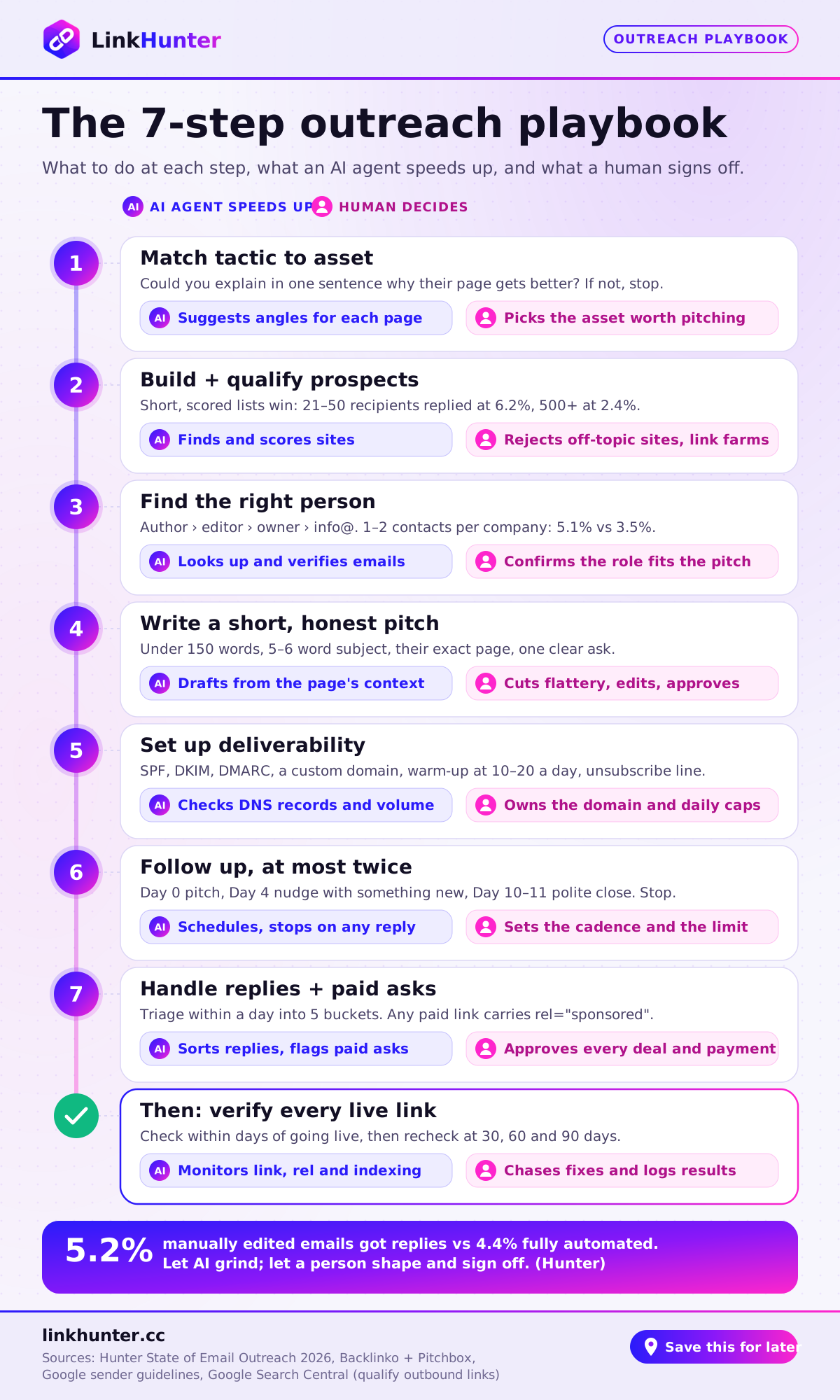
This is how LinkHunter (linkhunter.cc) is built. Seven AI agents map onto the playbook: Prospect Hunter discovers sites via Brave Search and DataForSEO, Quality Analyzer scores them with a transparent breakdown you can check, Contact Finder looks up the right person, Outreach Writer drafts pitches from the actual page context, Reply Manager sorts the inbox, Negotiator works within budget limits you set, and Backlink Monitor checks links after they go live. A human approves every commitment. It also follows the honest-outreach rules above, from unsubscribe links to sponsored tags on paid links. The full breakdown is on our features page, and the about page explains why we built it this way.
Where another approach may be better: if you send fewer than 20 pitches a month, a spreadsheet and a good email client are enough. If your strategy is mostly digital PR to journalists, a dedicated PR database may suit you better. And if you want a single outreach tool you configure yourself, our comparison of the best link building tools in 2026 covers the options by workflow stage. For a deeper look at agent workflows, read AI link building in 2026.
Your first 30 days of link building outreach
Start small, measure honestly and scale only what produces live links. Here is the schedule we would hand a new team member:
- Week 1: authenticate the domain (SPF, DKIM, DMARC), start mailbox warm-up, write your paid-link policy, and list your three strongest linkable assets.
- Week 2: run an unlinked brand mentions sweep and pitch those first. They are the warmest replies you will get.
- Week 3: build a qualified list of 30-50 prospects for one asset and one tactic. Send in small batches with two follow-ups.
- Week 4: triage every reply, verify every live link, and calculate delivered, replied, positive and live rates. Kill or rewrite whatever produced nothing.
Do that for three months and you will have something no benchmark can give you: your own numbers, from your own niche, on a sending domain that still has a good reputation. That is the real advantage. If you want to see the plans side by side first, you can compare pricing or start a free 14-day trial with no card required.
Frequently asked questions
What is a good response rate for link building outreach?
Backlinko and Pitchbox found an average reply rate of 8.5% across 12 million outreach emails, and Hunter puts all cold email at 4.5%. Anything above 10% on a cold list is good. Track replies that lead to a live link, not just replies, because a lot of replies are price lists.
How many follow-up emails should you send for a backlink?
Send one or two follow-ups, so three messages in total. Hunter data shows three-message sequences reached a 6.8% reply rate against 3.3% for a single email, and Backlinko found one follow-up lifted replies by 65.8%. Space them three to seven days apart, stop the moment someone replies, and never follow up after an unsubscribe or a clear no.
How do you ask a website for a backlink?
Name the exact page on their site, explain in one sentence what your resource adds for their readers, and make the request easy to act on with a single URL and a suggested spot. Introduce yourself honestly, skip invented compliments, and give them an easy way to say no. If you mention payment, say so up front.
How long should an outreach email be?
Keep the body under about 150 words, which is three to five short sentences. Use a subject line of five or six words that names their page or topic, include one or two links at most, and leave out attachments and long bios.
What do you do when a site asks for payment for a link?
Decide before the campaign starts whether you will ever pay, and what for. If you do pay, treat it as advertising: the link must carry rel="sponsored" or rel="nofollow" under Google spam policies, the deal should be written down, and a human should approve the spend. If you will not pay, decline politely and ask whether an editorial option exists.
How many outreach emails should you send per day?
Start new domains at 10 to 20 a day and ramp slowly. In Hunter data, accounts sending 20 to 49 emails a day per mailbox hit a 5.7% reply rate, above the 4.5% average. Smaller, tighter batches beat blasts: sequences of 21 to 50 recipients replied at 6.2%, versus 2.4% for lists over 500.
Is cold email outreach for backlinks legal under CAN-SPAM and GDPR?
Usually yes for business addresses, with conditions. CAN-SPAM requires accurate headers, a truthful subject, a postal address and an opt-out honoured within 10 business days. UK PECR allows email to corporate subscribers but treats sole traders as individuals who need consent, and GDPR still applies to personal data. This is general information, not legal advice.
What link building strategies still work in 2026?
The tactics that keep working all start from something real: unlinked brand mentions, broken or outdated resources you can replace, original data people want to cite, expert contributions, and selective guest posts on relevant sites. Manipulative tactics such as bulk paid links without sponsored tags or large link exchanges still violate Google spam policies.
Sources
- Backlinko: We Analyzed 12 Million Outreach Emailsbacklinko.com
- Hunter: The State of Email Outreach 2026hunter.io
- Ahrefs: Link Outreach guide and pollahrefs.com
- Respona: Guest Post Outreach study (1,000 sites)respona.com
- La Growth Machine: Backlink Outreach Guidelagrowthmachine.com
- Google Workspace: Email sender guidelinessupport.google.com
- Google Search Central: Qualify your outbound linksdevelopers.google.com
- Google Search Central: Spam policies for Google web searchdevelopers.google.com
- FTC: CAN-SPAM Act compliance guide for businessftc.gov
- ICO: Electronic mail marketing under PECRico.org.uk

About the author
Monjur Hossain
Founder, LinkHunter
Monjur founded LinkHunter (linkhunter.cc) and MotionTrust Digital, where he has led marketplace strategy since 2022. He has eight years in e-commerce and marketplace marketing and writes these guides from the work of building an AI link-building platform: what earns links, what gets ignored, and where a person still needs to make the call.