Business Directory Submission Guide 2026: A 6-Step Roadmap From Audit to Verified Listing
A practical 2026 directory submission roadmap: audit, master profile, core platforms, a 5-question scorecard, hand submission and verification, plus which directories matter for local, SaaS, agency, e-commerce and startup businesses.

Contents16 sections
- 1What is directory submission?
- 2Does directory submission still work in 2026?
- 3Which types of business directories are there?
- 4The 6-step directory submission roadmap
- 5How do you know if a directory is worth submitting to?
- 6Which directories matter for your type of business?
- 7Worked example: two shortlists built with the same method
- 8Manual vs automated directory submission: which is better?
- 9What should a directory submission tracking log include?
- 10What are the most common directory submission mistakes?
- 11How do you measure whether directory submission is working?
- 12Free vs paid directory submission: what are you paying for?
- 13How does LinkHunter Directory Boost handle directory submission?
- 14Directory submission checklist
- 15Frequently asked questions
- 16Sources
Directory submission still works in 2026 when it is selective. Audit existing listings, write one master profile, claim Google Business Profile, Bing Places and Apple Business, then add only the review sites and niche directories your buyers use. Submit by hand, finish every verification and log each live URL. Skip bulk submission: Google lists low-quality directory links as link spam.
Directory submission has a bad reputation, and some of it is earned. For years it meant blasting a website to hundreds of directories nobody visited, in the hope that the links would move rankings. That version is dead. A smaller, careful version still does real work in 2026: it puts your business on the platforms where customers, search engines and AI assistants look for it, with the same details everywhere.
This guide is the process we use. It covers whether directory submission still works and why, a six-step roadmap from audit to verified listing, a five-question scorecard for judging any directory, which directories matter for your type of business, manual versus automated submission, a tracking log you can copy, and how to tell whether any of it is working. Every number links to the source we read it in.
What is directory submission?
Directory submission is the process of adding your business or website to online directories: platforms that list businesses by category, location or product type, such as Google Business Profile, Yelp, G2 or Clutch. Each listing usually holds your name, website, description and contact details, and often reviews.
A listing that shows your business name, address and phone number is also called a citation. Local SEO people shorten those three details to NAP, or NAP+W when the website is included. Whitespark, which publishes the longest-running survey of local ranking factors, splits citations into two kinds on its citation sources pages: structured citations on business listing sites, and unstructured ones in articles, event pages, news sites and blogs.
So a directory listing is usually two things at once: a structured citation and a link. That matters, because the citation is where most of the value now sits. If local listings are your main goal, our local citation building service page goes deeper on NAP cleanup, and the upcoming local citations guide covers the theory.
Does directory submission still work in 2026?
Yes, as a foundation, not as a ranking shortcut. Directory submission works when it helps people and machines confirm that your business exists, what it does and where it operates. It does not work as a way to manufacture links.
Google is direct about the second part. Its spam policies list "low-quality directory or bookmark site links" as an example of link spam, and paid links are only acceptable when marked rel="sponsored" or rel="nofollow". A pile of links from generic directories is, at best, ignored. At worst, it is a pattern you do not want attached to your domain.
Here is what still earns its place, with the evidence:
- Accurate core listings feed local results. Google says local results are based mainly on relevance, distance and prominence, and that prominence draws on information from across the web, including links to your business and your reviews.
- Review platforms are where buyers decide. In BrightLocal's Local Consumer Review Survey 2026 (1,002 US adults), 97% of consumers said they read reviews for local businesses, and the average consumer uses six review sites. Being absent from the sites your customers use is a real gap.
- The platform mix is shifting. The same survey found Google's share of review readers fell from 83% to 71%, while Apple Maps rose from 14% to 27%. One profile is no longer enough.
- AI assistants read the web about you. BrightLocal also found that use of ChatGPT and other generative AI tools for local recommendations jumped from 6% to 45%. Whitespark's 2026 Local Search Ranking Factors experts scored citation quality factors higher for AI search visibility than for the local pack. Google's own guidance for AI features adds no special requirements, but it does recommend keeping Business Profile information up to date.
Treat directory submission like getting your paperwork in order. It will not win the market for you, but leaving it messy costs you trust and visibility. It also sits alongside, not instead of, the work in our guide to link building for AI search.
Which types of business directories are there?
There are seven useful types of directory, plus one type to avoid. They do different jobs, so decide where your time goes before you open a single sign-up form. The examples below are well-known platforms, not a complete list, and availability depends on your country.
| Directory type | Examples | Main benefit | Best for |
|---|---|---|---|
| Core map and search platforms | Google Business Profile, Bing Places for Business, Apple Business (formerly Apple Business Connect) | Maps, local results, voice assistants | Any business with a location or service area |
| Review platforms | Yelp, Facebook, Trustpilot, Better Business Bureau, Sitejabber | Reviews and trust at the moment of choice | Local services, e-commerce, consumer brands |
| General and local business directories | Yellow Pages, Foursquare, Hotfrog, Cylex, Manta, Yell | Citation consistency, some referral visits | Local businesses in the matching country |
| Industry and service marketplaces | Houzz, Angi, Thumbtack, Nextdoor | Visitors with buying intent | Home services and trades |
| Software review sites | G2, Capterra, TrustRadius, SourceForge, AlternativeTo, SaaSHub | Comparison traffic and buyer reviews | SaaS and software companies |
| Launch and startup platforms | Product Hunt, BetaList, Indie Hackers, Wellfound, Crunchbase | Early users, press and investor visibility | Startups and new products |
| Agency directories | Clutch, GoodFirms, DesignRush, The Manifest, Sortlist, UpCity | Shortlist visibility for B2B services | Agencies and consultancies |
| Generic "submit your URL" directories | Sites with no editorial review, no audience and thousands of unrelated links | None worth the risk | Nobody: skip them |
For a ranked list by category, see our upcoming roundup of the best business directories. Software companies should also read the SaaS directory submission and startup submission pages, which cover review sites and launch platforms in detail.
The 6-step directory submission roadmap
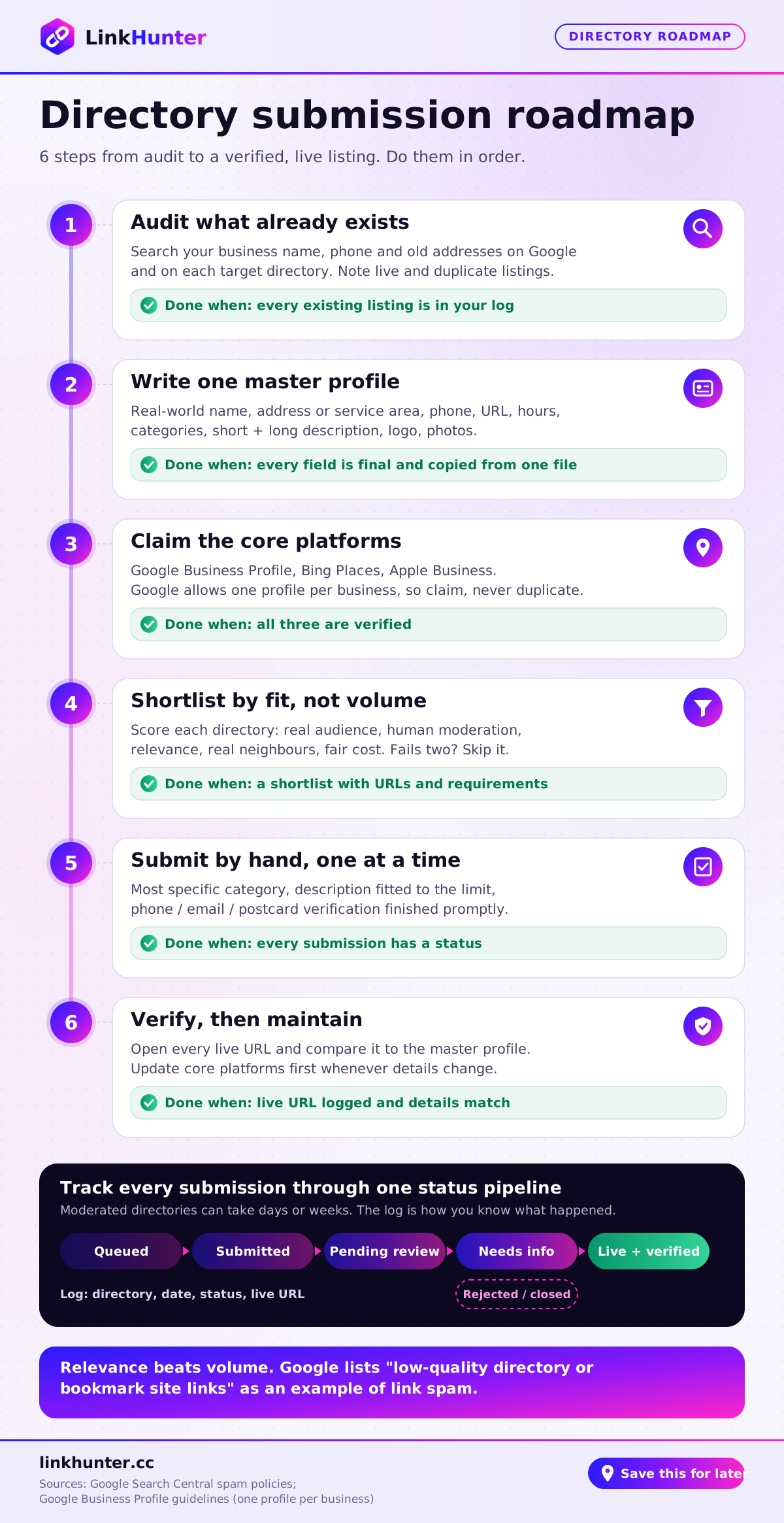
Work in this order: audit, master profile, core platforms, shortlist, hand submission, then verification and maintenance. Most problems with directory listings come from rushing straight to submission without an audit or a master profile, which creates inconsistent details that are tedious to fix later. Each step below ends with a "done when" test, so you know when to move on.
Step 1: Audit what already exists
Before you create anything, find out what is already out there. Search Google for your business name, your phone number and any old addresses, then search each directory on your likely shortlist the same way. Many businesses already have listings, created by a previous owner, a data provider, an old agency or an earlier campaign. Write every listing you find into your log with its URL and whether the details are correct, outdated or duplicated.
This is the step most guides skip, and it is the one that saves the most time. Claiming and correcting an existing listing is usually faster than creating a new one, and it avoids splitting reviews across two profiles.
Step 2: Write one master business profile
Write everything down once, in a single document, and copy from it every time. Include:
- Exact business name, as it appears on your signage and paperwork
- Address, or service area if you do not serve customers at your premises
- One main phone number and one website URL (the page you want people to land on)
- Contact email, opening hours and holiday hours
- Primary and secondary categories
- A short description (one or two sentences) and a long description (two or three paragraphs)
- Logo, a set of real photos, and social profile links
Google's Business Profile guidelines are a good standard for every directory: your name should reflect the real-world name, "unnecessary information" in the business name is not permitted, P.O. boxes are not acceptable addresses, and service-area businesses should hide their address. Following those rules everywhere keeps you out of trouble on stricter platforms.
Step 3: Claim the core platforms first
Claim or create Google Business Profile, Bing Places for Business and your listing in Apple Business, where you control your logo, hours, photos and key details on Apple Maps. Complete every field, pick accurate categories and finish verification.
These platforms feed so many other services that getting them right first saves rework. Google is explicit that there should be only one profile per business, so if Step 1 turned up a duplicate, resolve it before you go further.

Step 4: Shortlist directories by fit, not volume
Use the business-type matrix further down and the five-question scorecard in the next section to build a shortlist: the main review sites for your market, then industry directories, then a few reputable general directories in your country. Write each one into your log with its URL, cost, verification method and any special requirements, such as a minimum number of reviews or a business email address.
Step 5: Submit by hand, one directory at a time
Copy details from your master profile. Pick the most specific category available, and rewrite the description to fit each directory's length limit rather than cutting it off mid-sentence. Note which directories need an account, a phone call, an email confirmation or a postcard to verify, and complete those steps promptly. Unverified listings often never go live, which makes the whole submission wasted effort.
Step 6: Verify every listing, then maintain it
When a listing goes live, open it and check it against your master profile, field by field. Log the live URL. Then treat the listings as something you own: when you move, change phone number, rebrand or change hours, update the core platforms first and work through your log. Reply to reviews on the platforms where customers leave them.
How do you know if a directory is worth submitting to?
Score it on five questions, and skip any directory that fails two or more. This takes about a minute per directory and removes most of the risk that Google's link spam policy describes.
| Question | Pass looks like | Fail looks like |
|---|---|---|
| 1. Would a customer use it? | It appears when you search your category plus city or product type, and has real reviews or activity | It never appears in search and shows no sign of visitors |
| 2. Does a human review submissions? | Verification by phone, email or postcard, or visible editorial approval | "Instant approval for any URL" |
| 3. Is it relevant to your category and country? | A trade, software, agency or local directory that matches what you sell and where | A UK plumber on an Australian list, or a SaaS tool on a restaurant guide |
| 4. Are the other listings real businesses? | Category pages full of companies you recognise or could call | Casino, pill and loan sites mixed with everything else |
| 5. Is the cost fair for what you get? | Free, or paid with clear traffic or leads, with paid links marked sponsored or nofollow | A fee for a "guaranteed dofollow link" or a renewal invoice you never agreed to |
On question 5, remember Google's link attribute rules: sponsored is for "advertisements or paid placements", and nofollow covers cases where a site would prefer not to be associated with the linked page. A paid listing that sends real customers is fine. A paid listing sold as a ranking link is the thing to avoid.
Which directories matter for your type of business?
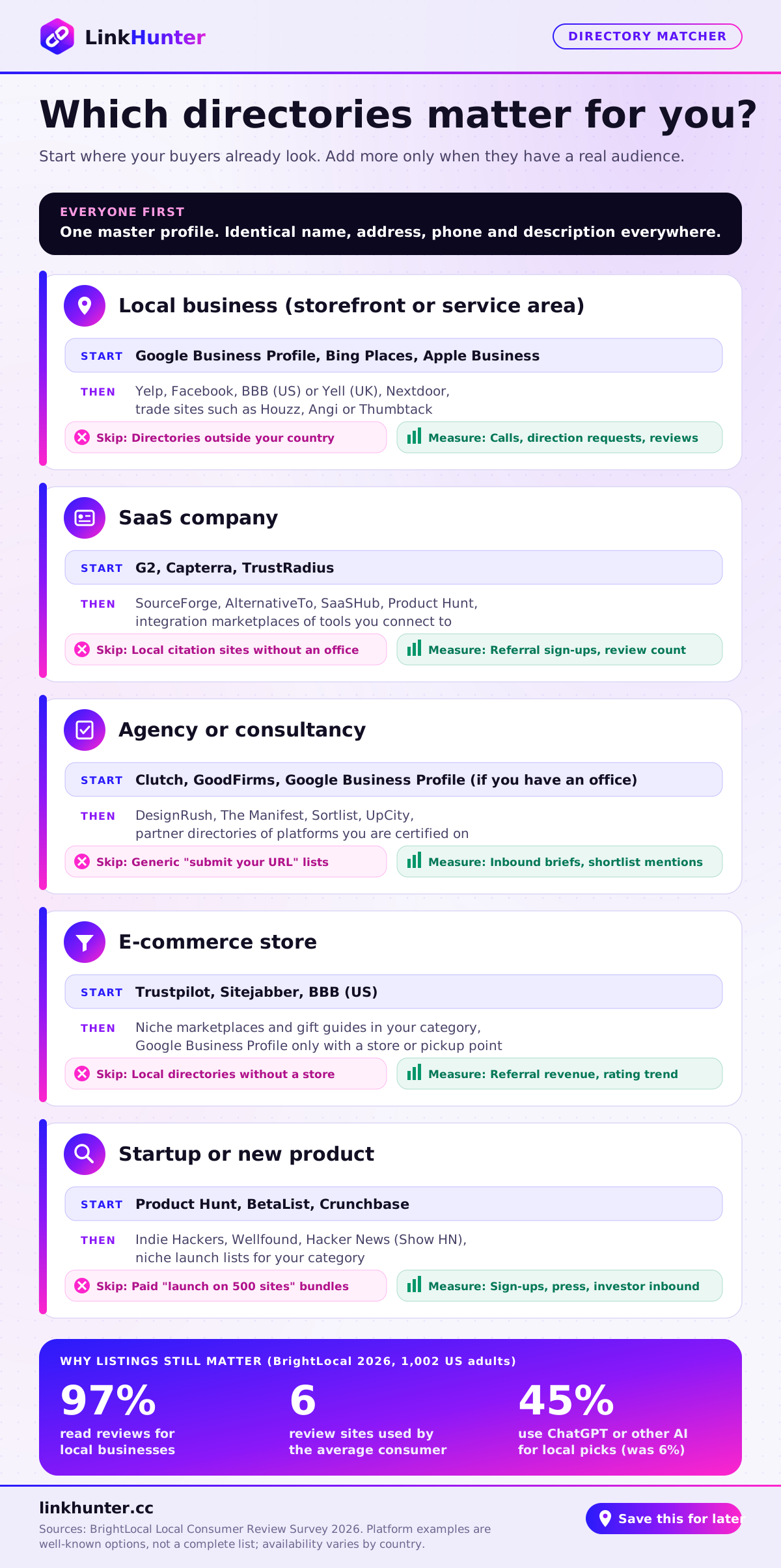
Start where your buyers already compare options, then stop when the next directory has no real audience. A plumber, a SaaS tool, an agency, an online shop and a pre-launch startup all need different lists. Use this matrix as your starting point, then run each candidate through the scorecard above.
Local businesses and service-area businesses
Your core platforms do most of the work. After Google Business Profile, Bing Places and Apple Business, add the review sites your customers actually use (Yelp and Facebook are the usual pair, plus BBB in the US or Yell in the UK), then trade marketplaces for your category and two or three reputable general directories in your country. Whitespark publishes free top citation sources by country if you need a starting list outside the US.
SaaS and software companies
Software buyers browse comparison sites, not maps. Start with G2, Capterra and TrustRadius, then add SourceForge, AlternativeTo and SaaSHub, plus the app marketplaces of tools you integrate with. Local citation directories add little unless you have a physical office that customers visit. Our SaaS link building guide covers what to do after the directory layer is in place.
Agencies and consultancies
B2B buyers use agency directories to build shortlists. Clutch and GoodFirms are the usual starting point, then DesignRush, The Manifest, Sortlist and UpCity depending on your services and region. If you have an office, claim Google Business Profile too. Partner directories from platforms you are certified on (for example, a CMS or ad platform) are often the most qualified source of all.
E-commerce stores
Online shops need trust signals at checkout time. Trustpilot and Sitejabber are the common review platforms, BBB matters for US shoppers, and niche marketplaces or gift guides in your category can send buyers directly. Only create a Google Business Profile if you have a store or a pickup point customers can visit, since the guidelines require a real location or service area.
Startups and new products
Launch platforms are about early users and visibility, not citations. Product Hunt, BetaList and Crunchbase come first, then Indie Hackers, Wellfound and a "Show HN" post when you have something people can try. Plan launches one at a time so you can answer comments. Our upcoming startup launch platforms guide covers timing and preparation.
Worked example: two shortlists built with the same method
The same six steps produce very different lists for different businesses. Here is how the method plays out for two hypothetical companies. These are illustrations of the process, not client results.
| Step | Plumber in Manchester, UK | B2B invoicing SaaS, remote team |
|---|---|---|
| 1. Audit | Finds an old Yell listing with a previous phone number and a duplicate Google profile created by a former van-signage supplier | Finds an unclaimed Capterra profile auto-created from public data, with an old logo |
| 2. Master profile | Service-area business: address hidden, service area set to Greater Manchester | No public address; one product URL, short and long descriptions, screenshots |
| 3. Core platforms | Google Business Profile (duplicate removed), Bing Places, Apple Business | Google Business Profile skipped (no customer-facing location); brand searches checked instead |
| 4. Shortlist | Yell, Facebook, Checkatrade-style trade sites, Nextdoor, two UK general directories | G2, Capterra (claim), TrustRadius, AlternativeTo, SaaSHub, accounting-software marketplaces |
| 5. Submit | Phone verification on two sites, postcard on one | Vendor verification via company email; review requests to existing customers |
| 6. Verify and measure | Calls and direction requests in Google Business Profile; enquiries mentioning "found you on" | Referral sign-ups from review sites in analytics; review count per platform |
Notice what is not on either list: generic web directories, "bulk 300 directories" packages and anything outside the business's country or category. Both shortlists would likely end up in the tens of directories, not hundreds, which is a practitioner estimate rather than a rule.
Manual vs automated directory submission: which is better?
Manual submission is better on the directories that matter, because they moderate entries and require verification that software cannot complete. Automated tools promise hundreds of submissions in minutes, but their targets overlap heavily with the low-quality directories Google calls link spam.
| Manual submission | Automated software | |
|---|---|---|
| Directories reached | Hand-picked, moderated, relevant | Mostly directories that accept anything |
| Verification steps (phone, email, postcard) | Completed by a person | Usually skipped or failed |
| Category and description quality | Chosen and adapted per directory | One template pasted everywhere |
| Existing and duplicate listings | Claimed and corrected first | Often creates new duplicates |
| Risk under Google's link spam policy | Low, when directories are reputable | Higher, because of low-quality targets |
| Speed | Slower | Fast |
| Proof of work | Live listing URLs you can open and check | Often a report of "submissions" with no live links |
Directory lists age quickly, too. When TheGuideX re-checked its own list, it tested 655 directories and found only 247 had a working add page. Any tool or package that promises a fixed count of submissions is likely sending some of them into directories that no longer work.
If you outsource, ask any provider three questions: which directories exactly, is every submission done by a person, and will you receive the live listing URLs. Be cautious of anyone promising guaranteed rankings or a fixed number of dofollow links. No one controls whether a directory approves a listing, and no one controls Google's rankings.
What should a directory submission tracking log include?
One row per directory, with its status, dates and the live URL. Moderated directories can take days or weeks to respond, and some never approve a submission, so the log is how you know what actually happened. A spreadsheet is enough.

| Column | What to record | Example |
|---|---|---|
| Directory | Name and submission URL | Yell, yell.com/free-listing |
| Type and score | Directory type and scorecard result (0-5) | General local, 5/5 |
| Status | Queued, submitted, pending review, needs info, live, rejected | Pending review |
| Dates | Submitted, last checked, went live | 3 Nov, 10 Nov, - |
| Verification | Method and whether it is complete | Phone call, complete |
| Login | Which account or email owns the listing (store passwords in a password manager, not the sheet) | listings@ shared inbox |
| Live URL | The public listing page | Added when live |
| Matches master profile? | Yes, or which field is wrong | Hours missing Sunday |
| Link attribute | Followed, nofollow, sponsored or ugc (for your records, not as a goal) | nofollow |
What are the most common directory submission mistakes?
The costly mistakes are inconsistency, duplicates and chasing volume. Most of them come from skipping the audit or the master profile.
- Inconsistent details. "Ltd" on one site, "Limited" on another, an old phone number on a third. Pick one version and use it everywhere.
- Keyword-stuffed business names. "Smith Plumbing Best Emergency Plumber London" breaks most directories' rules, and Google does not permit unnecessary information in the business name.
- Wrong categories. A vague category puts you next to the wrong competitors and in front of the wrong searchers.
- Abandoned verifications. A listing waiting for a postcard code you never entered is not a listing.
- Duplicate listings. Creating a new profile instead of claiming the existing one splits reviews and confuses customers.
- Chasing volume. Two hundred listings on irrelevant directories are worth less than twenty on platforms your customers use.
- Paying for "guaranteed dofollow" links. That is buying links for ranking purposes, which Google's policy names directly.
- Never checking the results. Without a log of live URLs, you cannot tell whether a campaign happened at all.
How do you measure whether directory submission is working?
Measure the outcomes a listing can actually influence, and give it a few months. Rankings are a lagging and noisy signal; accurate listings, referral visits and enquiries are not.
- Live, accurate listings. The count of published listings that match your master profile, with URLs.
- Referral visits. In your analytics, check sessions from directory domains. Review sites and marketplaces often show up here first.
- Calls, direction requests and enquiries. Google Business Profile reports these directly. Ask new customers where they found you.
- Reviews. New reviews on the platforms where you are now listed, and your rating trend.
- AI answers. Ask ChatGPT, Gemini and Perplexity about your business and category once a month, and note whether your details are right and whether you are mentioned.
Rankings may move, especially in local results where consistent citations support your Google Business Profile. But Whitespark noted that citations lost about half a percentage point of weight in the local pack in its 2026 survey, so judge directory work on visibility and accuracy first, and expect links, reviews and on-page work to do more of the ranking lifting. For the link side, see how to get backlinks and our link building outreach playbook.
Free vs paid directory submission: what are you paying for?
You can do all of this yourself for free; what you pay for is time and care. Most of the important platforms cost nothing to join, and the six steps above are the whole method. Our free directory submission page lists where to start.
The time goes into research, writing per-directory descriptions, verifications, follow-ups and checking live listings. If you compare services, compare what they deliver rather than the headline number of directories. Look for hand-made submissions on named directories, duplicate checks, status tracking and live listing URLs. Our directory submission pricing page shows what we charge and what each package includes, so you can weigh it against doing it in-house. For wider budget context, our guide to link building cost explains how link work is usually priced.
How does LinkHunter Directory Boost handle directory submission?
Directory Boost runs this exact roadmap with a person doing every submission. We built it, so weigh our view accordingly. Directory Boost starts with a free audit: enter your website and we match it against our directory catalog by category and country. You confirm one business profile, choose the directories you want, and our team submits each one by hand. Every submission is tracked from queued to published, and each live listing is verified with its URL in your dashboard.
The first 5 submissions are free for a verified business, with no card needed. Paid packages start at $99 for up to 50 submissions. We do not guarantee that a directory will publish a listing or that Google will rank you higher, because nobody honestly can. You approve every listing before it goes out.
If your next step after directories is earning editorial links, LinkHunter's main product finds prospects, drafts outreach and tracks replies; see the features or our comparison of the best link building tools.
Directory submission checklist
Eight steps, in order. Print it, or copy it into the top of your tracking log.
- Audit existing and duplicate listings for your name, phone and old addresses.
- Write one master business profile and use it for every listing.
- Claim Google Business Profile, Bing Places and Apple Business first.
- Shortlist directories with the five-question scorecard; skip any that fail two.
- Match the shortlist to your business type: local, SaaS, agency, e-commerce or startup.
- Submit by hand, adapt descriptions, finish every verification.
- Log every submission with a status and verify each live listing URL.
- Update listings when details change, answer reviews, and measure listings, visits, enquiries and AI answers, not link counts.
Directory submission rewards care more than volume. Get your details consistent on the platforms that matter, add the directories your customers really use, and keep a record of every live listing. If you want to see which directories fit your website before you start, run the free directory audit.
Frequently asked questions
Is directory submission still good for SEO in 2026?
Directory submission is still useful in 2026 when it is selective. Listings on core platforms, review sites and relevant niche directories help customers and search engines confirm your business details, and they can send referral visits. Mass submission to generic directories is not worth it, because Google names low-quality directory or bookmark site links as an example of link spam.
How many directories should I submit my business to?
There is no ideal number. A local business usually needs the core platforms, the main review sites and a handful of directories for its trade and country. A SaaS company needs software review sites, launch platforms and a few niche lists. Stop adding directories when the next one fails our five-question scorecard or has no real audience in your market.
Are directory backlinks dofollow, and do they still pass value?
Many directory links carry nofollow, sponsored or ugc attributes, and paid listings should, under Google's rules. So do not count on directory backlinks for ranking power. Their value is mostly elsewhere: accurate business details, reviews, referral traffic and being present where buyers already compare options. Google also counts links to your business as one input into local prominence.
What is the difference between a citation and a backlink?
A citation is any online mention of your business name, address and phone number, with or without a link. A backlink is a link from another site to yours. A directory listing is usually both: a structured citation with a link. For local SEO the accuracy of the citation matters most; for link building the editorial quality of the link matters most.
Are free directory submissions worth it?
Many of the best directories are free to join, including Google Business Profile, Bing Places, Apple Business and most review platforms. Free directory submissions are worth it when the directory is relevant, moderated and visited by your customers. A free listing on a spammy directory with no audience is still a waste of time, and a pattern of them can look like link spam.
How long does it take for a directory listing to go live?
Approval time varies by platform. Some listings go live within minutes, while moderated directories and review platforms can take days or several weeks, and some require a phone, email or postcard verification first. Some never approve a submission at all, which is why every submission needs a status in your log until it is either live and verified or closed.
Should I use automated directory submission software?
Automated directory submission tools are fast but risky. They tend to target directories that accept anything, which overlaps with the low-quality directories Google treats as link spam, and they often fail on moderated sites that require verification. Manual submission takes longer, but it lets you pick categories, write proper descriptions, claim existing listings and fix problems before they spread.
Do directory listings help you show up in ChatGPT and AI Overviews?
They can help indirectly. AI assistants describe businesses from what reputable sources say, so consistent details across major platforms make accurate answers more likely. Google says there are no special requirements for AI Overviews beyond normal indexing, and recommends keeping Business Profile information up to date. Whitespark's 2026 survey also rated citation quality higher for AI search than for the local pack.
Is it worth paying for a directory submission service?
It can be, if you are paying for time and care rather than volume. A good service names every directory, submits by hand, completes verifications, checks for duplicates and gives you the live listing URLs. Be wary of anyone who promises guaranteed rankings, a fixed number of dofollow links or hundreds of submissions for a flat fee, because no one controls approvals or Google.
Sources
- Google Search Central: Spam policies for Google web search (link spam)developers.google.com
- Google Search Central: Qualify your outbound links (nofollow, sponsored, UGC)developers.google.com
- Google Search Central: AI features and your websitedevelopers.google.com
- Google Business Profile Help: Guidelines for representing your businesssupport.google.com
- Google Business Profile Help: Tips to improve your local ranking on Googlesupport.google.com
- BrightLocal: Local Consumer Review Survey 2026brightlocal.com
- Whitespark: Local Search Ranking Factors 2026whitespark.ca
- Whitespark: Top local citation sources by countrywhitespark.ca
- Apple Business (Maps listings, formerly Apple Business Connect)business.apple.com
- TheGuideX: Directory submission sites list 2026 (655 directories tested)theguidex.com
- Prospeo: Global business directories, which ones matter in 2026prospeo.io

About the author
Monjur Hossain
Founder, LinkHunter
Monjur founded LinkHunter (linkhunter.cc) and MotionTrust Digital, where he has led marketplace strategy since 2022. He has eight years in e-commerce and marketplace marketing and writes these guides from the work of building an AI link-building platform: what earns links, what gets ignored, and where a person still needs to make the call.