

Guest Posting for SEO in 2026: How to Find, Vet and Pitch Sites Without Breaking Google’s Rules
A practical guest posting guide for 2026: the search operators that find real sites, a 10-point vetting scorecard, three pitch templates, a clear paid-post policy and what Google’s spam rules actually say.
Contents16 sections
- 1What is guest posting?
- 2Does guest posting still work for SEO in 2026?
- 3What do Google's spam policies say about guest posting?
- 4How do you find guest posting sites?
- 5How do you vet a guest posting site?
- 6How do you choose guest post topics that editors accept?
- 7How do you write a guest post pitch that gets accepted?
- 8How do you write a guest post that helps both sides?
- 9What should your paid guest post policy be?
- 10What does a guest posting workflow look like end to end?
- 11How do you measure guest posting results?
- 12What guest posting mistakes should you avoid?
- 13How can AI agents help with guest posting?
- 14Your first 60 days of guest posting
- 15Frequently asked questions
- 16Sources
Guest posting is writing an article for another website, usually with a byline and a link back to you. It still works in 2026 when you pick relevant sites with real readers, pitch specific ideas, write something better than their own posts, use branded anchors, and tag any paid or self-placed link rel="sponsored" or nofollow, as Google advises.
Guest posting has been declared dead more times than any other link building tactic, and it is still one of the most common. The reason is simple: writing for a site whose readers you want is a genuinely good way to earn attention, authority and links. The problem is everything that grew around it, from "DA 50 guest post, $40" price lists to networks of sites that publish anything with a payment attached.
This guide treats guest posting as what it should be: a selective outreach channel. You will get the search operators that find real sites, a 10-point scorecard for vetting them, three pitch templates you can adapt, a clear policy for paid posts, and a plain reading of what Google's spam policies say about guest posts today. Every number is linked to its source, and where something is our own rule of thumb, we say so.
What is guest posting?
Guest posting, also called guest blogging, is writing an article that is published on someone else's website under your name, usually with a short bio and a link back to your site. The host gets free, expert content. You get exposure to their audience, a credible byline and, often, a link.
That exchange is the whole idea, and both sides need to win. A guest post is a good deal when:
- the host's readers are people you want to reach, whether as customers, partners or future hires;
- you know the topic well enough to write something better than what the site already has;
- the host has editorial standards, so being published there means something;
- any link to you is useful to the reader in context, not just to you.
When those conditions hold, guest posting is ordinary marketing. When they do not, it turns into what Google calls link spam. Most of this guide is about staying on the right side of that line while still getting results.
Does guest posting still work for SEO in 2026?
Yes, as a selective channel for audience, authority and brand mentions. No, as a volume tactic for passing link equity. The practitioners who still swear by it mostly describe the first kind; the ones who call it dead mostly tried the second.
The SEO community is split. When Marie Haynes polled more than 400 SEOs in November 2022, 44% said they do not guest post for SEO, 32% said they do and 12% said they do on occasion. Ahrefs, citing Aira's State of Link Building report, notes that guest blogging was the go-to link building tactic for 47% of surveyed SEOs. Both things are true at once: lots of people still do it, and lots of people stopped doing it for links.
The same split shows up on Reddit. In an r/SEO_LLM thread asking whether guest posting still works in 2026, replies converged on relevance and credibility over metrics, and one commenter argued that for AI assistants, being mentioned in trusted sources may matter more than the link itself. That lines up with our own experience and with what we cover in link building for AI search: a byline on a respected site in your niche helps people and machines connect your brand with a topic.
Referral traffic is usually modest. Ahrefs reports that in a survey of 500+ bloggers, the average referral traffic was 50 visits per guest article across 239 articles. So judge a placement on the whole package: who reads it, whether it builds your authority, whether it leads to the next opportunity, and only then the link.
What do Google's spam policies say about guest posting?
Google does not ban guest posting, but it lists "links with optimized anchor text in articles, guest posts, or press releases distributed on other sites" as link spam, along with buying links and posts that contain links. The fix Google offers is to qualify those links with rel attributes.
The current spam policies for Google web search list these link spam examples that matter for guest posting:
- "Buying or selling links for ranking purposes", including "exchanging money for links, or posts that contain links".
- "Exchanging goods or services for links", and sending someone a product in exchange for a write-up with a link.
- "Advertorials or native advertising where payment is received for articles that include links that pass ranking credit".
- "Links with optimized anchor text in articles, guest posts, or press releases distributed on other sites".
- "Creating low-value content primarily for the purposes of manipulating linking and ranking signals".
The same page adds the important exception: it is not a violation to have such links "as long as they are qualified", meaning tagged with rel="sponsored" or rel="nofollow".
Large-scale guest posting campaigns
Google spelled out the pattern it looks for back in 2017. Its post "A reminder about links in large-scale article campaigns" said article campaigns become a problem "when the main intent is to build links in a large-scale way back to the author's site", and named four warning signs when taken to an extreme:
- stuffing keyword-rich links to your site in your articles;
- having the articles published across many different sites;
- using or hiring article writers who are not knowledgeable about the topics;
- using the same or similar content across these articles.
It also told publishers to vet guest articles carefully and to nofollow questionable links. That advice still describes exactly how a guest post campaign goes wrong.
Site reputation abuse
There is a second policy that affects host sites more than authors. Since 19 November 2024, Google's site reputation abuse policy covers third-party content used to exploit a site's ranking signals "regardless of whether there is first-party involvement or oversight of the content." Google is equally clear that third-party content alone, including freelance content, is not a violation. For you as a guest author, the practical lesson is to avoid hosts that publish large volumes of off-topic third-party content to rank, because those sections are the ones most at risk of being demoted.
How Google's stance has evolved
| Date | What Google said | What it means for you |
|---|---|---|
| Jan 2014 | Matt Cutts: "if you're using guest blogging as a way to gain links in 2014, you should probably stop", later clarifying that exposure, branding and community are still fine reasons | Guest post for audience, not for links |
| May 2017 | Warning about large-scale article campaigns with keyword-rich links | No exact-match anchors, no spreading thin across many sites |
| Jun 2020 | John Mueller: if you provide the content and links, those links "should have the rel-sponsored / rel-nofollow attached" | Expect self-placed links to carry little or no ranking weight |
| Nov 2021 | Mueller: Google uses "lots of different signals to try to figure out what might be a guest post" | Disguising a guest post is not a strategy |
| Nov 2024 | Site reputation abuse policy applies even with first-party oversight | Avoid hosts with big off-topic third-party sections |
How do you find guest posting sites?
Use three sources together: search operators that surface sites inviting contributors, the author pages of people already writing in your niche, and the sites that link to content like yours. Operators alone mostly find sites that advertise for guest posts, which is also where most link farms live.
Search operators by intent
Swap [topic] for your niche keyword, such as "B2B SaaS onboarding" or "local SEO". Google's own documentation only formally covers the site: operator, which it notes may not show every indexed URL, so treat the others as useful but imperfect filters.
| Goal | Example query | What it finds |
|---|---|---|
| Contributor pages | [topic] intitle:"write for us" | Sites with a write-for-us page in your niche |
| Guidelines pages | [topic] "contributor guidelines" OR "guest post guidelines" | Sites with published standards (a good sign) |
| URL footprints | [topic] inurl:write-for-us OR inurl:contribute | Contributor pages that use common slugs |
| Published guest posts | [topic] "guest post by" OR "guest author" | Sites that already run guest content |
| Where an author writes | "[author name]" -site:[their own domain] | Other sites a known niche author contributes to |
| Recent activity | Any query above + Tools > Past year | Sites still accepting contributions |
| Exclude marketplaces | Any query + -"guest post price" -"buy guest post" | Fewer pay-to-publish sellers |
One caution from experience: the more a site optimises its "write for us" page to rank, the more likely it is selling placements. The best hosts often have a quiet contributor page or none at all.
Competitor and author footprints
The highest-quality opportunities usually come from following people, not footprints. Pick five respected writers in your niche, look at the sites in their bios, author archives and LinkedIn "featured" sections, and list every publication that ran their work. Do the same for competitors: export their backlinks in any SEO tool and filter for URLs containing "author", "contributor" or "guest". Semrush suggests a similar approach in its guest blogging guide, filtering backlinks by "author" in the URL.
Warm sources most people miss
- Partners and integrations: companies whose customers overlap with yours often welcome a joint how-to.
- Newsletters and community blogs: many run contributed issues and have engaged readers even with modest traffic.
- Sites that already mention you: an editor who wrote about you once is far more likely to say yes to a full article.
- Industry associations and event blogs: slower, but the bylines carry real authority.
Our guide on how to find link building prospects covers more discovery methods, and the same lists feed broken link building if a guest pitch does not land.
How do you vet a guest posting site?
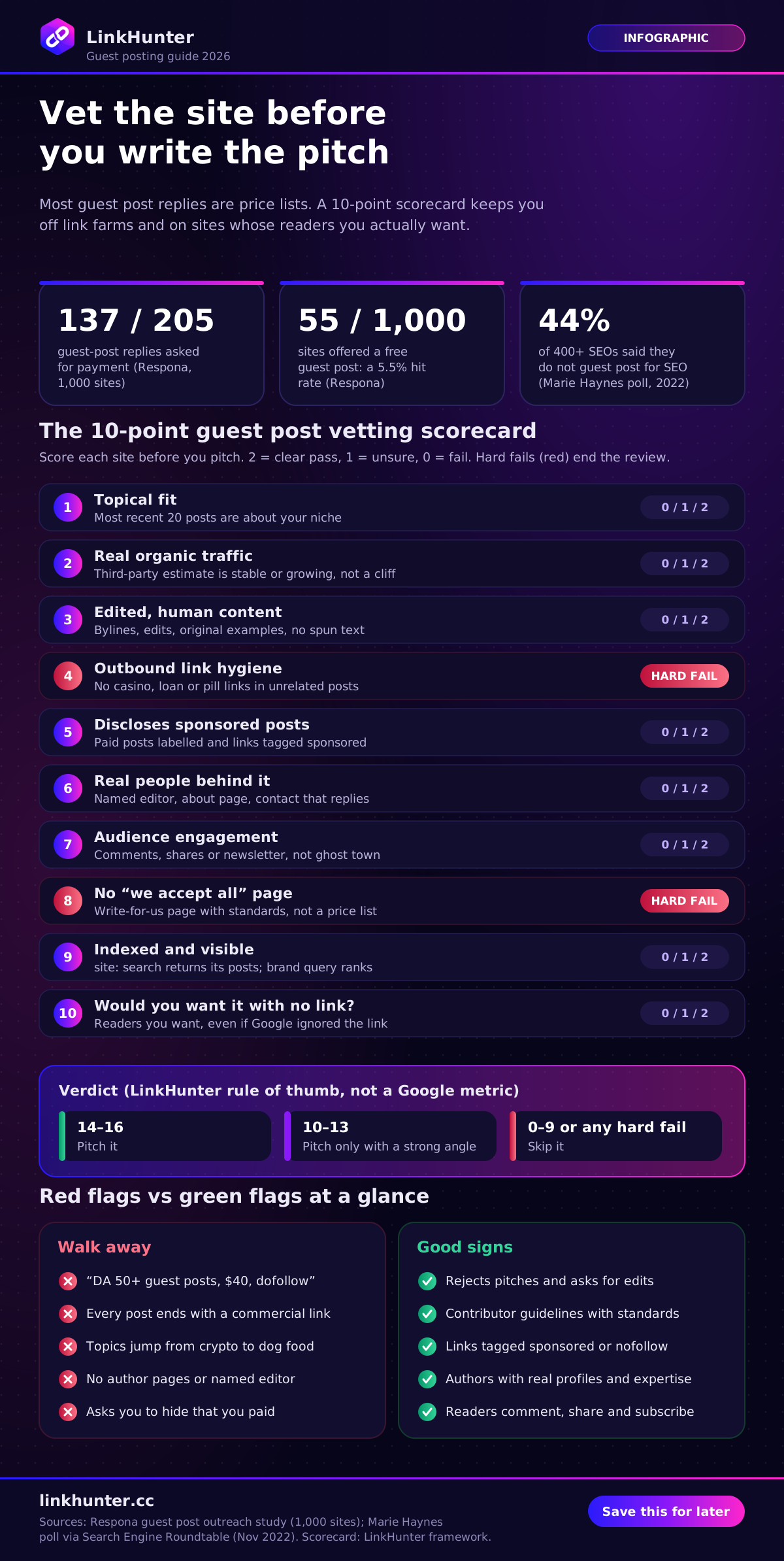
Score every site on a short checklist before you write a word: topical fit, real traffic, editorial quality, outbound link hygiene, disclosure practices and real people behind it. Ten minutes of vetting saves hours of writing for a site that harms you or never sends a reader.
Authority metrics such as Domain Rating or Authority Score are a quick first filter, but they are third-party estimates and easy to inflate. The things that matter are visible on the site itself. Here is the scorecard we use. Score each check 0 (fail), 1 (unsure) or 2 (clear pass). Two checks are hard fails: if either one fails, stop the review.

- Topical fit. Are most of the last 20 posts about your niche? A marketing blog that also covers crypto, pets and CBD is a publisher of anything.
- Real organic traffic. Is the third-party traffic estimate stable or growing? A sudden cliff often means a penalty or a core update hit.
- Edited, human content. Do posts have named authors, original examples and evidence of editing, or do they read like spun text?
- Outbound link hygiene (hard fail). Open five recent posts. Casino, loan or pill links in unrelated articles mean the site sells links. Walk away.
- Discloses sponsored posts. Are paid posts labelled, and are their links tagged sponsored or nofollow? Hosts that do this are protecting themselves and you.
- Real people behind it. Is there a named editor, an about page and a contact who answers?
- Audience engagement. Comments, shares, a newsletter, an active community: signs that people actually read it.
- No "we accept all" page (hard fail). A write-for-us page that is really a price list with "DA", "dofollow" and "permanent link" in it is a link seller.
- Indexed and visible. Does a
site:search return its posts, and does the brand name rank for itself? - The no-link test. Would you want this audience even if the link were ignored?
The eight scored checks give a maximum of 16. Our rule of thumb, which is a LinkHunter working threshold and not a Google metric: pitch at 14 to 16, pitch only with an unusually strong angle at 10 to 13, and skip anything below 10.
How do you choose guest post topics that editors accept?
Pitch topics the host has not covered well, that its readers clearly want, and that you are uniquely able to write. Editors say yes to gaps they recognise, not to generic "ultimate guides".
A quick way to find those gaps:
- Read the archive. Search
site:theirdomain.com [topic]and note what is missing, outdated or thin. - Check the comments and their social posts. Reader questions that the site never answered are ready-made titles.
- Use your own data. A small survey, product usage pattern or before-and-after result gives you something no one else can write. Original data also gives editors a reason to choose you over a dozen similar pitches.
- Take a contrarian but defensible angle. "Why we stopped doing X" posts, backed by evidence, tend to stand out in a crowded inbox.
- Match their format. If the site runs case studies and checklists, do not pitch a 4,000-word opinion essay.
Ahrefs' guest blogging guide describes similar idea techniques such as refreshing an outdated post or splitting a broad topic into a narrower one. Whatever method you use, the title should make an editor think, "we should have published that already."
How do you write a guest post pitch that gets accepted?
Send a short, specific email to the right editor: show you read the site, propose two or three concrete titles that fill a gap, prove you can write them, and ask one easy question. Semrush recommends keeping pitches to about 100 to 150 words, which matches our experience.
Four rules before the templates:
- Find the right person. The managing editor or content lead, not info@. If the site uses a submission form, use the form.
- Follow their guidelines literally. Word counts, formats, whether they want a draft or an outline. Ignoring guidelines is the fastest route to the trash.
- Pitch one site at a time per idea. If you pitch the same idea to several sites and two say yes, you have to let one down.
- Do not lead with the link. Talk about readers and the article. The link comes up later, if at all.
Template 1: The gap pitch (cold, best for most sites)
Subject: Idea for [Site]: [specific gap in 4 to 6 words]
Hi [First name],
I read your piece on [recent article] and noticed you have not covered [specific gap] yet, which comes up a lot with [their audience].
Three ideas I could write for [Site]:
1. [Title one, specific and outcome-led]
2. [Title two]
3. [Title three]I am [role] at [company], where we [one line of relevant proof]. Recent writing: [one or two links].
Would any of these fit your calendar? Happy to send an outline first.
[Name]
Template 2: The data pitch (when you have original numbers)
Subject: New data on [topic] for [Site] readers
Hi [First name],
We just analysed [what, how many, when] and found [one surprising, specific finding]. I have not seen this covered anywhere yet, and it ties directly to your post on [their article].
I would like to write it up exclusively for [Site]: the method, the full results and what [their audience] should do about it. Charts included.
Interested? I can send the outline and raw numbers this week.
[Name]
Template 3: The warm pitch (they already know you)
Subject: Following up on your [mention / podcast / comment]
Hi [First name],
Thanks again for [mentioning us in X / having me on Y]. Your readers asked a few questions about [topic] in the comments, and I think a full how-to would answer them better than a reply.
Working title: [title]. Around [word count from their guidelines], with [examples / screenshots / templates].
Want me to draft it?
[Name]
Follow-up and the "you need to pay" reply
Send one follow-up after five to seven days, and make it add something: a new angle, a sharper title or a relevant data point. If there is still silence, move on. Respona's study shows why you should expect payment requests: of 205 replies to 1,000 guest post pitches, 137 asked to be paid, 55 offered a free guest post and 13 said no. Decide in advance how you answer. A polite version:
Thanks for the quick reply. We only do editorial contributions, so we will pass on the paid option. If you ever want a free expert piece on [topic], the ideas above are yours.
For more tested wording, see our link building email templates, and our link building outreach playbook covers deliverability, sending volumes and follow-up timing in depth.
How do you write a guest post that helps both sides?
Write the best article the host has published on that topic, in their style, with a single, natural link to a page of yours that genuinely adds to it. The quality of the post is what earns the next invitation.

A checklist we use for every draft:
- Match the house style. Same heading depth, tone, image style and length as their best-performing posts.
- Bring something original. Your own examples, screenshots, data or templates. Google's 2017 warning specifically named writers who are not knowledgeable about the topic and the same or similar content across articles.
- Never reuse content. Do not republish the guest post on your own site, and do not spin it for other hosts.
- Link to other sites generously. Cite sources, including the host's own articles. A post that links only to you looks like what it is.
- One link to you, in context. Point it at a page that helps the reader go deeper, not your homepage with a money keyword.
- Use a real bio. Name, role, one line of credibility, and a branded link if the host allows one.
- Accept edits gracefully. Semrush suggests replying to editor feedback within 48 to 72 hours, a sensible standard.
Anchor text: what is safe?
| Anchor type | Example | Risk |
|---|---|---|
| Brand | LinkHunter | Low |
| Plain URL | linkhunter.cc | Low |
| Descriptive / partial | our guide to outreach follow-ups | Low when natural and varied |
| Generic | this study | Low |
| Exact-match commercial | best link building software | High, especially repeated across sites |
The risk column is our reading of Google's policy wording on "optimized anchor text" in guest posts, not a published Google scale. The pattern to avoid is the same commercial keyword pointing at the same page from many guest posts.
What should your paid guest post policy be?
If you pay for a placement, it is advertising: the link needs rel="sponsored" (nofollow is also accepted) and readers should see a clear disclosure. If you will not pay, decline politely and keep pitching editorial sites. Write the policy down before the first price list arrives.
Google's qualify your outbound links page says to "mark links that are advertisements or paid placements (commonly called paid links) with the sponsored value". That covers money, but the spam policy also covers goods and services, so a free product or free software account in exchange for a post counts too.
The disclosure side is separate from SEO. The US Federal Trade Commission's Endorsement Guides FAQ says material connections should be disclosed "clearly and conspicuously", close to the content they relate to, and warns that "consumers may miss a disclosure at the bottom of a blog or page." A "Sponsored by [brand]" label at the top of the article is the simple answer. This is general information, not legal advice, and rules differ by country.
| Situation | Link attribute | Disclosure | Our call |
|---|---|---|---|
| Free editorial guest post, link you wrote | nofollow or sponsored per Google guidance; many hosts leave it plain | Author bio is enough | Fine. Value it for audience, not link equity |
| Editor adds a link to you unprompted | None needed | None | The best kind of link |
| Paid post on a relevant, real site | rel="sponsored" | Clear "sponsored" label near the top | Acceptable as advertising, with a budget cap |
| Free product or account in exchange for a post | rel="sponsored" | Clear disclosure | Treat exactly like a paid post |
| Paid "dofollow, no sponsored tag" offer | Would violate the spam policy | Usually hidden | Decline |
| Site asks you to hide that you paid | Would violate the spam policy | Hidden by design | Decline and drop the site |
The question comes up constantly. An r/SEO thread titled "Is paying to publish a guest blog post on another site considered link spam?" drew answers ranging from one commenter saying paid links had hurt their larger sites to another calling it a grey area in practice; one practitioner summed up the practical rule as: if payment is made specifically for the link, mark it sponsored. That rule is Google's rule, and it is the one we follow. For budgeting, our link building cost breakdown explains how paid placements compare with other channels.
What does a guest posting workflow look like end to end?
Find, vet, pitch, write, link correctly and track. Each step has one rule that prevents most failures. The infographic below puts the whole process on one page, along with the rel attribute decision and Google's timeline.
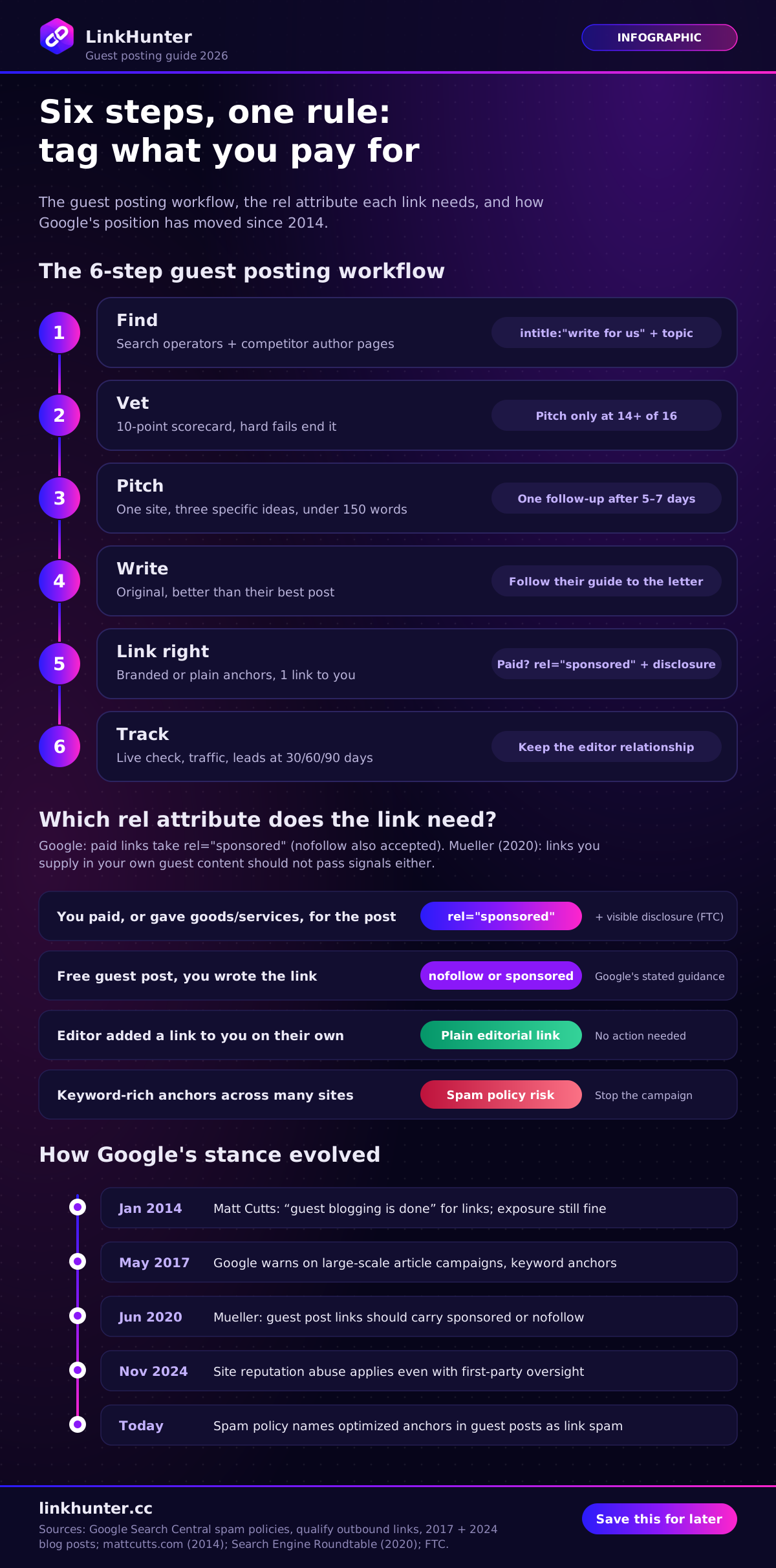
In practice, a small team running this well might have a list of 40 to 60 vetted sites, 10 to 15 active pitches at any time, and one or two placements a month. Those are our working estimates for a single writer, not industry benchmarks; your numbers will depend on niche, reputation and how strong your ideas are.
How do you measure guest posting results?
Track each placement at 30, 60 and 90 days: is the link live and unchanged, how many referral visits and signups it sent, and whether it led to another opportunity. Rankings move for many reasons, so judge guest posts on what you can attribute.
A simple tracking sheet needs these columns:
- URL and publish date, plus the editor's name.
- Link status: live, removed, changed to nofollow, anchor edited. Hosts redesign and links disappear.
- Referral sessions and conversions from your analytics, tagged by placement.
- Brand mentions and follow-on opportunities: podcast invites, partnership emails, repeat guest slots.
- Cost: hours spent, plus any fee for sponsored placements.
After a quarter, sort by results per hour. Usually a few hosts produce most of the value. Double down on those relationships, pitch them again, and drop the rest. Our post on how to get backlinks covers the other channels worth adding once guest posting is running.
What guest posting mistakes should you avoid?
The most damaging mistakes are buying untagged links, repeating exact-match anchors, chasing authority scores over relevance, and spraying one generic pitch at hundreds of sites. Each one either wastes time or creates the footprint Google's policies describe.
| Mistake | Why it hurts | Do this instead |
|---|---|---|
| Buying "dofollow" posts from price lists | Listed as link spam in Google's policies | Pay only for tagged, disclosed sponsored posts, or do not pay |
| Same money keyword as anchor everywhere | Matches the "optimized anchor text" example | Brand, URL or natural descriptive anchors |
| Choosing hosts by DA or DR alone | Metrics are easy to inflate and say nothing about readers | Use the 10-point scorecard |
| Mass, generic pitches | Low replies, more payment requests, burned sending domain | One site, three specific ideas, one follow-up |
| Recycled or AI-spun articles | Google named same or similar content across articles in 2017 | Original examples, data and expertise in every post |
| Never checking links after publishing | Removed or edited links go unnoticed | Recheck at 30, 60 and 90 days |
How can AI agents help with guest posting?
AI agents are good at the repetitive parts: finding candidate sites, gathering vetting signals, locating the right editor, drafting a first pitch and checking links after publication. People should still choose the topics, write or heavily edit the article, and approve any payment.
This is how LinkHunter (linkhunter.cc) approaches it. Prospect Hunter discovers candidate sites via Brave Search and DataForSEO, Quality Analyzer scores each one with a transparent breakdown you can check against a checklist like the one above, Contact Finder looks up the right person, Outreach Writer drafts a pitch from the host's actual content, Reply Manager sorts responses (including the inevitable price lists), Negotiator works only within limits you set, and Backlink Monitor checks placements after they go live. A human approves every commitment, and paid placements are flagged so they get rel="sponsored". The details are on our features page.
Where another approach may suit you better: if you place fewer than five guest posts a quarter, a spreadsheet, a search engine and a good email client are enough. If your strategy is mostly SaaS-specific, our SaaS link building guide covers channels such as integration pages and review sites that may outperform guest posts. And if you want to compare tools first, see the best link building tools roundup.
Your first 60 days of guest posting
Spend the first month building and vetting a short list and writing your policy; spend the second pitching, writing and tracking. Small and careful beats big and fast.
- Week 1: write your paid-post policy, pick two or three topics where you have real expertise or data, and collect five example articles you are proud of.
- Week 2: build a raw list of 60 to 100 sites with operators, author footprints and competitor backlinks.
- Week 3: run the scorecard and keep only sites scoring 14 or more. Expect the list to shrink a lot.
- Week 4: read each remaining site's archive and draft three gap-filling titles per site.
- Weeks 5 to 6: pitch in small batches, one idea per site, one follow-up each. Answer price lists with your policy.
- Weeks 7 to 8: write and deliver accepted posts, promote them when they go live, and set 30, 60 and 90-day checks.
At the end of 60 days you will know which hosts respond to you, which topics editors want, and what a placement is actually worth in visits and leads. That is the data that tells you whether to scale guest posting or shift effort elsewhere. If you want to see what an agent-assisted version would cost, compare the plans.
Frequently asked questions
Is guest posting still effective for SEO in 2026?
Yes, when the site is relevant, edited and has real readers. Practitioners are split: in a 2022 poll of 400+ SEOs by Marie Haynes, 44% said they do not guest post for SEO and 32% said they do. The value today is audience, authority and brand mentions, with the link as a bonus rather than the goal.
Are guest posts bad for SEO?
Not by themselves. Google’s spam policies target links with optimized anchor text in guest posts and low-value content made mainly to manipulate rankings. A well-written article on a relevant site, with a branded or plain link that is tagged correctly, is normal marketing. Mass-produced posts on unrelated sites are the risky part.
Should links in guest posts be nofollow?
Google’s stated guidance is yes for links you supply yourself. In 2020 John Mueller said links in content you provide should carry rel="sponsored" or rel="nofollow", and in 2021 he repeated that guest post links should be nofollow. Paid placements must be tagged sponsored or nofollow under Google’s link spam policy.
How do I find guest posting sites?
Combine three methods. Use search operators such as intitle:"write for us" plus your topic, look at where competitors and known authors in your niche have published, and check sites that already link to similar content. Then score each site on relevance, real traffic, editorial standards and outbound link hygiene before you pitch.
Is paying for a guest post against Google’s guidelines?
Paying is not banned, but paying for a link that passes ranking credit is. Google lists exchanging money for links, or posts that contain links, as link spam unless the links are qualified. If you pay, the link needs rel="sponsored" (or nofollow) and readers should see a clear disclosure that the post is sponsored.
What is the difference between a guest post and a sponsored post?
A guest post is accepted on its editorial merit, without payment. A sponsored post is published because money, goods or services changed hands. In practice, the line is the payment: once there is one, Google expects rel="sponsored" on the links, and the FTC expects a clear disclosure placed where readers will not miss it.
How do you pitch a guest post?
Send a short email to the right editor that shows you read the site. Name a recent article, propose two or three specific titles that fill a gap in their coverage, add one line of proof that you can write them, and ask a simple yes-or-no question. Keep it under about 150 words and follow their guidelines exactly.
How many guest posts should I publish per month?
There is no safe number, and quotas are how campaigns drift into spam. Google’s 2017 warning was about articles published across many sites with keyword-rich links. For most small teams, one or two strong placements a month on sites that pass a vetting checklist beat ten weak ones. This is a practitioner estimate, not a Google figure.
How long should I wait before following up on a guest post pitch?
Wait five to seven days, then send one short follow-up that adds something new, such as a fresh angle or a relevant data point. If there is still no reply, move on and pitch the idea elsewhere. If two sites accept the same idea, tell the second one straight away and offer a different topic.
Sources
- Google Search Central: Spam policies for Google web searchdevelopers.google.com
- Google Search Central: Qualify your outbound linksdevelopers.google.com
- Google Search Central Blog: A reminder about links in large-scale article campaigns (2017)developers.google.com
- Google Search Central Blog: Updating our site reputation abuse policy (2024)developers.google.com
- Google Search Central: site: search operatordevelopers.google.com
- Matt Cutts: The decay and fall of guest blogging for SEO (2014)mattcutts.com
- Search Engine Roundtable: Google says guest post links should be nofollowed, paid or not (2020)seroundtable.com
- Search Engine Roundtable: Google uses many signals to detect guest posts (2021)seroundtable.com
- Search Engine Roundtable: Poll, many SEOs still guest post for SEO (2022)seroundtable.com
- Respona: Guest post outreach study (1,000 sites)respona.com
- Ahrefs: Guest blogging guideahrefs.com
- Semrush: Guest blogging guidesemrush.com
- FTC: Endorsement Guides, what people are askingftc.gov

About the author
Monjur Hossain
Founder, LinkHunter
Monjur founded LinkHunter (linkhunter.cc) and MotionTrust Digital, where he has led marketplace strategy since 2022. He has eight years in e-commerce and marketplace marketing and writes these guides from the work of building an AI link-building platform: what earns links, what gets ignored, and where a person still needs to make the call.