

How to Find Link Building Prospects: 9 Methods and a Qualification Scorecard
Nine ways to find link building prospects, a copyable search operator library, and a transparent 0-100 scorecard that tells you which sites are worth a pitch.
Contents19 sections
- 1What is link prospecting?
- 2How to find link building prospects: 9 methods compared
- 3Method 1: Competitor backlink gap analysis
- 4Method 2: Search operators for guest posts and resource pages
- 5Method 3: Broken link and dead page mining
- 6Method 4: Unlinked brand mentions
- 7Method 5: "Best X" listicles and roundups in your niche
- 8Method 6: Podcasts, newsletters and communities
- 9Method 7: Using AI search engines to discover prospects
- 10Method 8: Image and data reuse
- 11Method 9: Partners, integrations and customers
- 12How do you qualify a link prospect? A 0-100 scoring rubric
- 13Is DR or DA a good way to judge a site?
- 14Red flags: link farms, PBNs and paid-link networks
- 15How many prospects do you need to earn one link?
- 16How do you automate prospecting without losing quality?
- 17Your first 100 qualified prospects: a five-day plan
- 18Frequently asked questions
- 19Sources
To find link building prospects, start with sites that already link to two or more competitors (link gap analysis), then add search-operator finds, broken and unlinked-mention pages, "best X" listicles that AI answers cite, and podcasts or partners. Qualify every site on relevance, real traffic, outbound-link health, paid-link signals and contactability before you pitch.
Most guides on how to find link building prospects stop at the moment you have a list. That is the easy part. Any backlink tool will hand you 5,000 URLs in a minute. The hard part is knowing which 150 of them deserve an email, and that is where most campaigns fail: the outreach is fine, the list is bad.
This guide, updated for late 2026, covers both halves. You get nine prospecting methods (including one the older guides could not cover: mining the pages that ChatGPT, Perplexity and Google AI Overviews already cite), a copyable search operator library, and a transparent 0-100 qualification scorecard you can paste into a spreadsheet today.
What is link prospecting?
Link prospecting is the process of finding and vetting websites that could plausibly link to a specific page of yours, before you contact anyone.
A useful prospect record has five parts:
- The page where your link would live (a resource list, a listicle, an article with a dead link).
- The reason they would link: a better resource, a missing tool, a fixed broken link, a credit they owe you.
- The asset on your site that earns it.
- The person who can edit that page.
- A score that says whether it is worth your time.
If a row in your sheet is missing the reason, it is not a prospect yet. It is a URL.
How to find link building prospects: 9 methods compared
Each method produces a different kind of prospect with different odds of saying yes. The effort and reply ratings come from our own campaigns, not a published benchmark.
| Method | Best for | Main tools | Effort | Reply odds |
|---|---|---|---|---|
| 1. Competitor link gap | Any site with real competitors | Ahrefs Link Intersect, Semrush Backlink Gap | Low | Medium |
| 2. Search operators | Guest posts, resource pages | Google, Brave Search | Medium | Low to medium |
| 3. Broken link mining | Sites with strong evergreen content | Backlink tool, Wayback Machine | High | Medium |
| 4. Unlinked mentions | Brands with some press or community buzz | Google Alerts, mention trackers | Low | High |
| 5. "Best X" listicles | SaaS, ecommerce, services | Google, backlink tool | Medium | Medium |
| 6. Podcasts, newsletters, communities | Founders and experts with a story | Podcast directories, newsletter archives | Medium | Medium to high |
| 7. AI search citations | Brands that want AI visibility | ChatGPT search, Perplexity, AI Overviews | Medium | Medium |
| 8. Image and data reuse | Sites that publish original charts or photos | Google Lens, TinEye | Low | High |
| 9. Partners and integrations | B2B, SaaS, local businesses | Your CRM, partner directories | Low | Very high |
Method 1: Competitor backlink gap analysis
A link gap analysis lists the sites that link to two or more of your competitors but not to you. These domains have already shown they link to your topic, which makes them the warmest cold prospects you will find.
- Pick the right competitors. Use the sites that rank for your target page's keywords, not just business rivals. A publisher that outranks you is a link competitor.
- Run the gap tool. Ahrefs Link Intersect and Semrush Backlink Gap both compare several competitor domains at once. Set the filter to "links to at least 2 of these" and exclude your own domain.
- Remove what you already have. Cross-check against your own referring domains. Google Search Console's Links report shows your top linking sites for free, though Google notes it is a sample rather than a complete list.
- Classify each link by how it was earned: editorial list, guest post, resource page, directory, press mention or paid placement. This tells you whether it is replicable.
- Drop the unreplicable ones. A link earned from a funding announcement or a ten-year-old conference sponsorship is not a prospect for you.
Method 2: Search operators for guest posts and resource pages
Search operators are commands such as site:, intitle: and inurl: that narrow Google results to pages with a specific footprint. They are free, fast and still the best way to find guest post opportunities and resource pages that backlink tools miss.
One caveat: even for the site: operator it warns that results are not exhaustive. Treat every search as a sample, and repeat queries on Brave Search or Bing.
The copyable search operator library
Replace keyword with your topic and brand with your company name.
| Goal | Query to copy |
|---|---|
| Guest post pages | "keyword" intitle:"write for us" |
| Guest post guidelines | "keyword" "guest post guidelines" OR "submission guidelines" |
| Sites already running guest posts | "keyword" "this is a guest post by" OR "guest author" |
| Contributor programs | "keyword" inurl:contribute OR inurl:contributors |
| Resource pages | "keyword" intitle:resources inurl:links |
| Curated link lists | "keyword" intitle:"useful links" OR intitle:"helpful resources" |
| University and library guides | site:.edu "keyword" intitle:resources |
| Listicles in your category | intitle:"best keyword" 2026 |
| Competitor alternatives pages | intitle:"competitor alternatives" -site:competitor.com |
| Weekly roundups | "keyword" intitle:roundup OR intitle:"this week in" |
| Unlinked brand mentions | "brand" -site:yourdomain.com -site:linkedin.com -site:x.com |
| Podcast guest slots | "keyword" podcast "be a guest" OR "guest application" |
| Wikipedia dead links on your topic | site:en.wikipedia.org "keyword" "dead link" |
| Exclude marketplaces and noise | Add -site:pinterest.com -site:medium.com -inurl:tag |
"Write for us" searches work, but every link seller knows the footprint too, so expect plenty of pages that list a fee. The best guest post opportunities usually come from the third row: sites that publish guest content without advertising it. For resource page link building, offer a real resource. A free calculator, template or checklist gets added; a product homepage rarely does.

Method 3: Broken link and dead page mining
Broken link building means finding links that point to pages which no longer exist, then offering your page as a replacement. The site owner gets a fix, you get a link, and the pitch writes itself.
Garrett French of Citation Labs laid out the manual approaches in 2011 (resource pages, old niche directories, Wikipedia dead links), and they still hold. Tools now do the heavy lifting.
- Find dead pages with links. In your backlink tool, open a competitor or a large industry site and filter its pages by HTTP 404 status, sorted by referring domains. A dead page with 40 referring domains is 40 prospects.
- See what the page said. Load the URL in the Wayback Machine. You need to know what people linked to before you offer a replacement.
- Match or beat it. Update a similar page to cover the same ground, or decide whether 40 linking sites justify creating one.
- Export the linking pages, not just the domains, and confirm the broken link is still on each page before you pitch.
This is the highest-effort method here. A near-perfect replacement converts well; a loosely related page reads as spam.
Method 4: Unlinked brand mentions
An unlinked mention is a page that names your brand, product, founder or research without linking to it. These are the easiest links you will ever ask for, because the writer already chose to talk about you.
- Set up Google Alerts for your brand, product names and founder names.
- Run the
"brand" -site:yourdomain.comquery from the library above every month. - If you use Ahrefs, its Content Explorer and Web Explorer can surface pages mentioning a term that do not link to a given domain.
Keep the ask short: thank them, quote the sentence, and suggest the most useful URL. If a mention is negative, fix the problem before asking for anything.
Method 5: "Best X" listicles and roundups in your niche
"Best X" listicles are comparison articles such as "The 12 best CRM tools for agencies", and getting added to them is one of the highest-value link plays in 2026. They rank for commercial queries, they send referral traffic from buyers, and AI assistants read them.
In a December 2025 Ahrefs study of 750 top-of-funnel prompts and 26,283 source URLs, "best X" blog lists made up 43.8% of all page types ChatGPT cited. No other format came close.
To find them:
- Search
intitle:"best [category]",intitle:"[competitor] alternatives"and"[category] tools" intitle:2026. - Check which lists already include two or more of your competitors. That is your shortlist.
- Look at the update date. Lists refreshed in the last six months have an active editor; abandoned lists rarely change.
- Note what each list is missing (a free tier, a niche use case, a region) and pitch your product as that gap.
Some list owners are vendors who will never add you, and some offer a "featured" slot for a fee. If you pay, Google's guidance on qualifying outbound links is clear: paid placements should carry rel="sponsored" (nofollow is still acceptable).
Method 6: Podcasts, newsletters and communities
Podcasts and newsletters link to their guests and sources in show notes and web archives, so they turn a conversation into a link.
- Podcasts: check that a show publishes episode pages on its own domain with guest links. A show that only lives on Spotify gives exposure, not a link.
- Newsletters: many on Substack and beehiiv keep a web archive. Search
site:substack.com "keyword"and offer data, a quote or a tool they can feature. - Communities: Reddit, Slack groups and forums rarely pass link value, and dropping links gets you banned. Use them to meet the people who run blogs and newsletters.
Method 7: Using AI search engines to discover prospects
AI search engines show you which pages already shape the answer for your category, and those cited pages are some of the best link prospects you can find. If Perplexity cites a listicle every time someone asks for the best tool in your niche, being on that page matters twice: once for the link, once for the AI answer.
The older guides could not cover this method. Here is the workflow we use:
- Write 15 to 30 buyer prompts in plain language: "best link tracking tool for small agencies", "alternatives to [competitor]", "how do I [job your product does]".
- Run each prompt in ChatGPT search, Perplexity and Google (AI Overviews or AI Mode). Run each one at least twice, because answers vary between sessions.
- Collect every cited URL into one sheet with the prompt, the engine and whether your brand was mentioned.
- Count repeats. URLs cited across several prompts and engines go to the top of your list.
- Open every URL yourself. AI tools still occasionally cite pages that have changed or do not support the claim. Never pitch from an AI summary.
Classic authority and AI citations are linked, but indirectly. Ahrefs found that the sites ChatGPT mentions most tend to have high Domain Rating, and cautions this is probably because LLMs retrieve from search results where strong sites rank, not because they read DR. We go deeper on that in our guide to AI link building.
Method 8: Image and data reuse
If you publish original charts, photos or statistics, other sites are probably using them without a link. These are credit requests, not cold pitches, and they convert well.
Run your best images through Google Lens or TinEye every quarter. For data, search the exact statistic in quotes, for example "your exact statistic" -site:yourdomain.com. Ask for a source credit with a link, and offer a higher-resolution or updated version.
Method 9: Partners, integrations and customers
Your existing business relationships are link prospects you can win with one internal email.
- Integration and app marketplace pages for every tool you connect with.
- Agency, reseller and affiliate partner directories.
- Customer case studies and "tools we use" pages (ask happy customers).
- Suppliers, associations, chambers of commerce, alumni and event sponsor pages.
Search "competitor" intitle:integrations or "competitor" intitle:partners to see which directories list your rivals. Keep it honest: Google's link spam policy calls out "excessive link exchanges" and partner pages that exist only for cross-linking. A real integration page is fine; a swap page of 200 unrelated logos is not.
How do you qualify a link prospect? A 0-100 scoring rubric
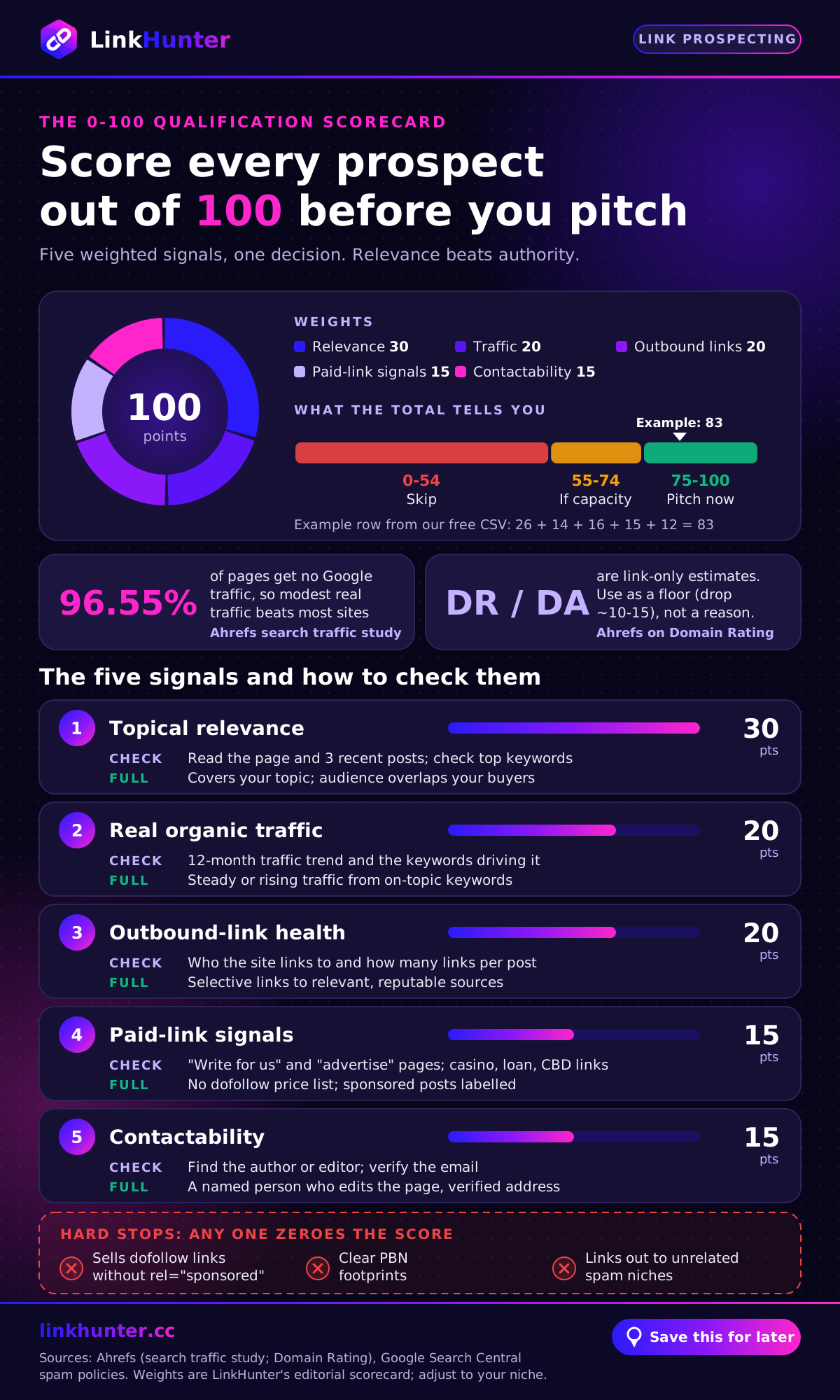
Qualify a link prospect by scoring it on five weighted signals: topical relevance, real organic traffic, outbound-link health, paid-link signals and contactability. Anything under 55 out of 100 gets skipped, however good its authority metric looks.
A bad prospect wastes the research, the email, the follow-up and your sender reputation. The scorecard below is built around the same signals LinkHunter's Quality Analyzer scores, with the weights shown so you can change them.
| Signal | Points | How to check | Full marks look like |
|---|---|---|---|
| Topical relevance | 30 | Read the target page and three recent posts. Check the site's top organic keywords. | The page covers your topic and the audience overlaps with your buyers. |
| Real organic traffic | 20 | Traffic estimate and its 12-month trend in your SEO tool; keywords driving it. | Steady or rising traffic from keywords that fit the site's topic. |
| Outbound-link health | 20 | Look at who the site links to and how many links each post carries. | Selective links to relevant, reputable sources. |
| Paid-link signals | 15 | Check "write for us", "advertise" and author pages; scan for casino, loan or CBD links. | No price list for dofollow links; sponsored content labelled. |
| Contactability | 15 | Find the author or editor; verify the email. | A named person who edits the page, with a verified address. |
Be strict on relevance: a marketing blog that once mentioned your industry is a 10, not a 25. Keep traffic in context: Ahrefs' search traffic study found 96.55% of pages in its index get no Google traffic at all, so a modest real audience already beats most of the web.
Hard stops that zero the score
- The site openly sells dofollow links without
rel="sponsored"or nofollow. - Clear PBN footprints.
- Outbound links to spam niches unrelated to the site's topic.
What to do with the total
- 75-100: pitch now, with a personalised angle.
- 55-74: pitch when capacity allows, or use a lighter template.
- 0-54: skip, and record why so nobody re-adds it next quarter.
You can download the prospect scorecard sheet (CSV) and open it in Google Sheets or Excel. It includes columns for each signal, the hard-stop flag, the decision, the contact and the pitch angle.
Is DR or DA a good way to judge a site?
DR and DA are useful as a rough floor, but they are poor main criteria for choosing link prospects. They measure links, not relevance, readers or editorial standards.
Ahrefs is upfront about this in its own explanation of Domain Rating. DR is "purely link-based", it "doesn't account for backlink SPAM", and large amounts of low-quality backlinks may raise it rather than lower it. Neither DR nor Moz's Domain Authority is a Google metric; both are third-party estimates built from each vendor's own link index.
In a 2026 r/seogrowth thread on backlink pricing, the poster noted that some sites with an authority score of 10 to 20 charge $200 to $400 or more per link. Replies stressed that these are third-party metrics and that a smaller site with a targeted audience can be worth more.
Our rule: use DR or DA to remove the bottom of the list (for most niches, anything under 10 to 15 with no real traffic), then stop looking at it. A DR 25 niche blog with 3,000 relevant monthly visitors beats a DR 70 general news site with a "sponsored" tag on every third post.
Red flags: link farms, PBNs and paid-link networks
A link farm or PBN (private blog network) is a site, or group of sites, that exists mainly to sell or pass links rather than to serve readers. Google's spam policies name buying or selling links for ranking, excessive link exchanges and advertorials that pass ranking credit. Here is how that looks during prospecting:
- Topic sprawl. Crypto, home decor, pet food and B2B SaaS posts on the same blog in one week.
- A public price list. "Dofollow guest post: $150, permanent link" on a "write for us" or "advertise" page.
- Every post links out commercially. Each article carries two or three exact-match anchor links to unrelated businesses.
- Traffic that does not fit. High DR, near-zero organic traffic, or a traffic graph that collapsed after a core update and never recovered.
- Faceless authors. Dozens of contributors with stock photos, no social profiles and no other bylines.
- Repurposed expired domains. The Wayback Machine shows a dentist's site in 2021 and a "marketing tips" blog today.
Not every site that charges is a link farm. Real publications sell properly labelled sponsored posts. If you pay for visibility, make sure the link is marked sponsored or nofollow and judge it on the audience it brings. See our link building cost guide for fair prices.

How many prospects do you need to earn one link?
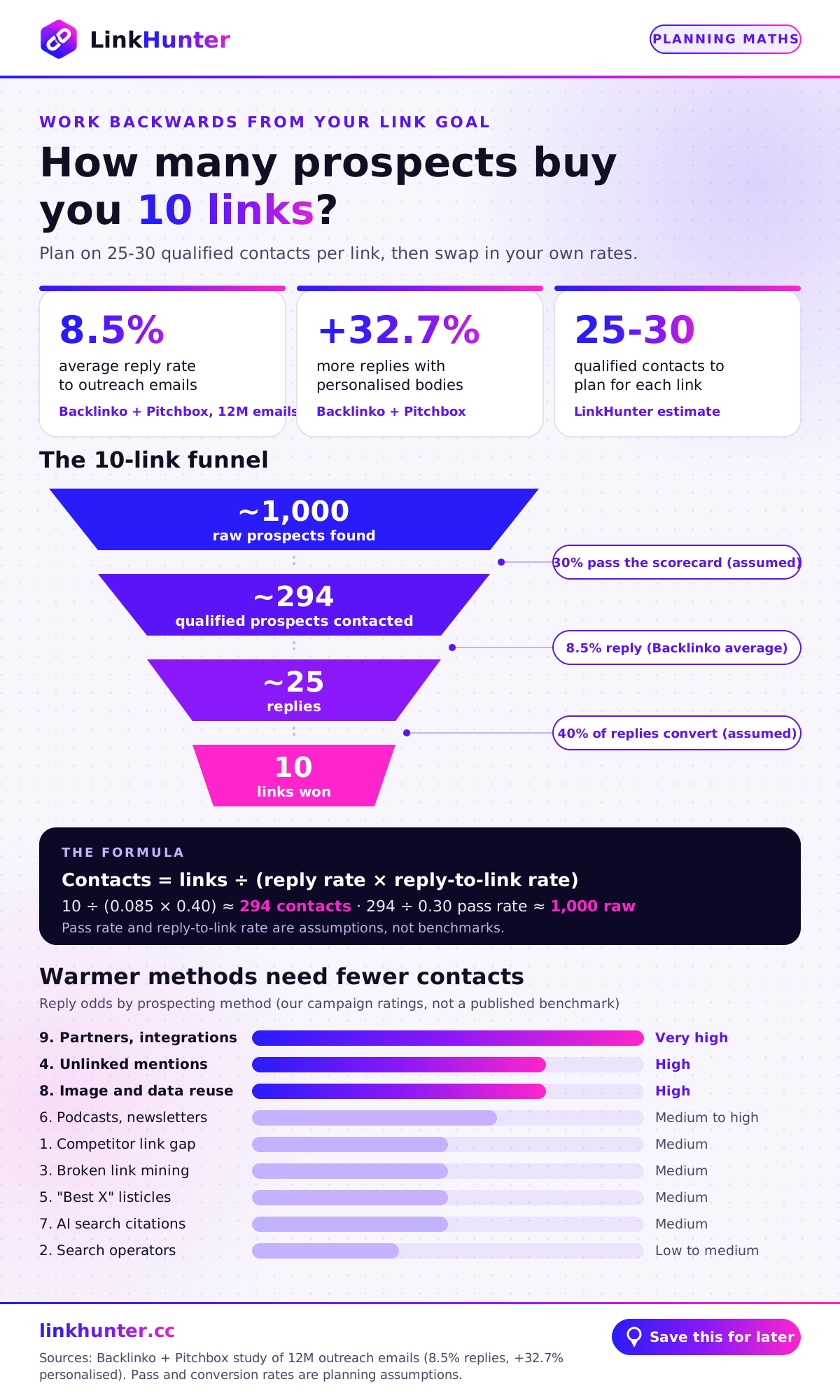
Plan on contacting roughly 25 to 30 qualified prospects for every link you want, and finding three or more raw prospects for each one you qualify. Your own numbers will differ, so work backwards and adjust after the first batch.
The best large public dataset is still Backlinko's analysis of 12 million outreach emails, run with Pitchbox data. It found an 8.5% average response rate. Personalised email bodies lifted responses by 32.7%, which is one more reason qualification matters: you can only personalise for sites you actually understand.
A reply is not a link. If 40% of replies turn into links (an assumption, not a benchmark), the maths for ten links looks like this:
- 10 links / (8.5% reply rate x 40% reply-to-link rate) = about 294 contacts.
- If 30% of raw prospects pass your scorecard, you need roughly 1,000 raw prospects.
- Warmer methods (4, 8 and 9) reply well above average, so a list heavy in them needs far fewer contacts.
Once you have a qualified list, the pitch decides the rest. Our link building outreach playbook covers sequencing and follow-ups, and the outreach email templates give you a starting point for each method above.
How do you automate prospecting without losing quality?
Automate the repetitive parts of prospecting (discovery, deduplication, metrics, contact lookup and first-pass scoring) and keep humans on the judgement calls: final relevance, the pitch angle and any commitment.
| Task | Automate? |
|---|---|
| Running operator and gap searches | Yes |
| Deduplicating against past outreach | Yes |
| Pulling traffic and link metrics | Yes |
| Finding and verifying contacts | Yes, with spot checks |
| First-pass scoring | Yes, with visible rules |
| Final relevance call | No |
| Agreeing to any payment or exchange | Never |
This is the model we built LinkHunter (linkhunter.cc) around. Its Prospect Hunter agent discovers candidates through Brave Search and DataForSEO, the Quality Analyzer scores each one with a visible breakdown rather than a black-box number, and the Contact Finder looks up the right person. Nothing goes out, and nothing gets agreed, without a human approving it. You can see how the agents fit together on the features page.
It is not for everyone. If you already pay for Ahrefs or Semrush and need 30 prospects a month, their gap tools plus the spreadsheet above are enough. For a deep historical audit of one competitor, a dedicated backlink tool beats any all-in-one platform. Our comparison of the best link building tools maps each one to the stage it handles best, and this guide to automating link building safely covers the guardrails in more detail.
Your first 100 qualified prospects: a five-day plan
You can build a scored list of 100 prospects in a working week by running two or three methods a day and scoring as you go.
- Day 1: Pick one target page. Run a competitor link gap (Method 1) and score the top 40 results.
- Day 2: Work through the operator library (Method 2) and add the best 30 finds.
- Day 3: Run your buyer prompts through ChatGPT, Perplexity and Google (Method 7), and pull "best X" lists (Method 5).
- Day 4: Collect the easy wins: unlinked mentions, image reuse and partners (Methods 4, 8 and 9).
- Day 5: Re-score anything in the 55-74 band, find contacts for everything above 55, and write a one-line pitch angle per row.
The list is not the goal. A list where every row has a reason, a person and a score is.
Frequently asked questions
How do you find websites that will link to you?
Start with sites that already link to similar content. Run a link gap analysis on two or three competitors, look for unlinked mentions of your brand, and search for resource pages and "best X" lists in your niche. Sites that have linked to your topic before are far more likely to say yes than random high-authority domains.
How do you find guest post opportunities?
Combine your topic with footprints such as "write for us", "guest post guidelines", "contribute" or "this is a guest post by" in Google. Also check where people in your niche already publish guest content by searching their name plus "author" or "contributor". Skip sites whose guidelines list a price for a dofollow link: those are paid placements, and Google expects them to carry rel="sponsored" or nofollow.
What makes a good link building prospect?
A good prospect publishes on your topic for an audience that overlaps with yours, has steady organic traffic, links out selectively to useful pages, shows no signs of selling links, and has a named person you can contact. Authority metrics help as a floor, but relevance and real readers matter more.
Is domain authority important for backlinks?
Domain Authority (Moz) and Domain Rating (Ahrefs) are third-party estimates of link strength, not Google metrics. Ahrefs itself says DR is purely link-based and does not account for spam, so a site can have a high score and still be a poor prospect. Use DR or DA to remove the very weakest sites, then judge the rest on relevance, traffic trend and outbound-link quality.
How do you find broken links on other websites?
Use a backlink tool such as Ahrefs or Semrush to list pages on competitor or industry sites that now return 404 but still have referring domains. Check the dead page in the Wayback Machine to see what it covered, then build or point to a better replacement. For single pages, a browser extension like Check My Links highlights broken outbound links in a few seconds.
What search operators are used for link building?
The most useful are site: (limit results to one domain), intitle: and inurl: (match words in the title or URL), quotation marks for exact phrases, and the minus sign to exclude sites. Typical combinations are "keyword" intitle:resources, "keyword" "write for us" and "brand name" -site:yourdomain.com for unlinked mentions. The old link: operator is retired.
How do you find who links to your competitors?
Paste a competitor domain into a backlink checker such as Ahrefs Site Explorer, Semrush Backlink Analytics or Moz Link Explorer and export its referring domains. To find the overlap, use a gap tool (Ahrefs Link Intersect or Semrush Backlink Gap) with two to four competitors and filter for domains that link to at least two of them but not to you.
Sources
- Google Search Central: Spam policies for Google web search (link spam)developers.google.com
- Google Search Central: Qualify your outbound links to Googledevelopers.google.com
- Google Search Central: site: search operatordevelopers.google.com
- Google Search Console Help: Links reportsupport.google.com
- Ahrefs: Domain Rating (DR), what it is and how it worksahrefs.com
- Ahrefs: Do self-promotional "best" lists boost ChatGPT visibility? Study of 26,283 source URLsahrefs.com
- Ahrefs: How to earn LLM citationsahrefs.com
- Ahrefs: Search traffic study (96.55% of pages get no Google traffic)ahrefs.com
- Backlinko: We analyzed 12 million outreach emailsbacklinko.com
- Citation Labs: 4 prospecting approaches for broken link builders (2011)citationlabs.com
- Reddit r/seogrowth: Backlink pricing makes zero sense sometimesreddit.com

About the author
Monjur Hossain
Founder, LinkHunter
Monjur founded LinkHunter (linkhunter.cc) and MotionTrust Digital, where he has led marketplace strategy since 2022. He has eight years in e-commerce and marketplace marketing and writes these guides from the work of building an AI link-building platform: what earns links, what gets ignored, and where a person still needs to make the call.